One Parasite Generation
Dispersion of a Parasite Generation

Using the concepts of vectorial capacity (VC) and human transmitting capacity (HTC), we develop formulas to compute the dispersion of single parasite generation.
Related: VC Matrix & HTC matrix & Connectivity
Macdonald’s formula for \(R_0\) is useful, in the same way a political cartoon is useful, but transmission in real systems is heterogeneous over space and time. If we want to study malaria transmission in real systems, we need a strong rationale for the mathematics that describe it. A core concept is a parasite generation.
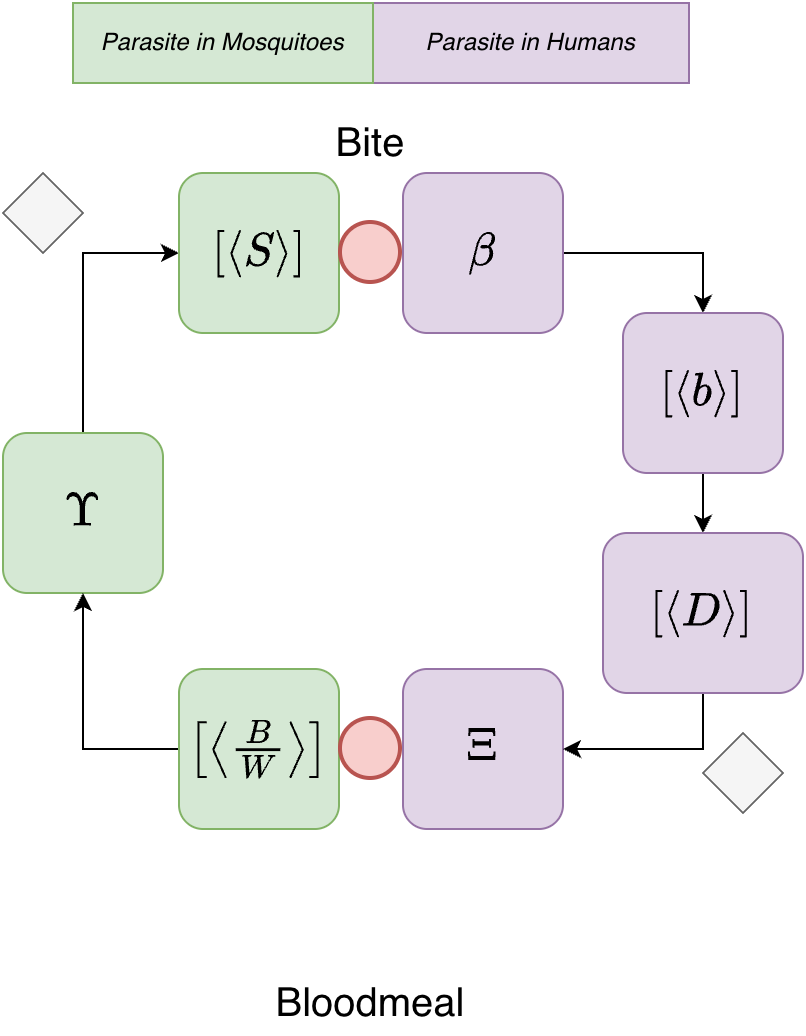
Transmission is defined by two events: a bite by an infective mosquito that transfers parasites and infects a human; and a blood meal taken by a mosquito from an infective host that infect a mosquito. The study of transmission is concerned about parasite dispersion – how far has a parasite moved in an infected human between the bite and the blood meal, and how far has a parasite moved in an infected mosquito between the blood meal and the bite?
Review
Here, we develop theory for the spatial and temporal dispersion of a parasite generation. The formulas have two parts:
Vectorial Capacity (VC)
Human Transmitting Capacity (HTC)
Vectorial Capacity
We use an updated formula for VC for Macdonald’s model: \[V = \frac{M}{H} \frac{f^2 q^2}{g^2} e^{-gn}\]
We use this to motivate framework for computing VC: \[V = \frac{M}{W} \Upsilon s\] where:
\(B\) is total blood feeding rate
\(W\) is the availability of hosts
\(\Upsilon\) describes survival (and dispersal) through the EIP
\(s\) describes infective biting after becoming infectious
Spatial Dispersion
In VC for metapopulations, we developed a formula for the VC matrix: \[[V] = fq \Omega^{-1} \cdot e^{-\Omega \tau} \cdot \left[\left<\frac{fq\bar M}W \right>\right] = [s] \cdot \Upsilon \cdot \left[\left< \frac{B}{W} \right>\right]\] and the VC vector is: \[V = \vec 1 \cdot [V]\]
Temporal Dispersion
In VC with forcing, we developed a formula for VC with forcing. The number of infective bites arising at time \(\ell>t\) from all the mosquitoes blood feeding on a single human at time \(t\) is:
\[V_\ell(t, \ell) = \begin{cases} 0 & \text{if } \ell < t + \tau(t) \\ B\left(t\right) \Upsilon\left(t, \tau\left(t\right)\right) f(\ell) q(\ell) G\left(t+\tau\left(t\right), \ell\right) & \text{if } \ell > t+\tau(t) \end{cases}\] where \[V(t) = \int_0^\infty V_\ell(t,\ell) d \ell\]
Spatio-Temporal Dispersion
Finally, in VC Generalized we developed a general formula for the temporal VC matrix: \[[V]_\ell(t, \ell) = \begin{cases} 0 & \text{if } \ell < t + \tau(t) \\ B\left(t\right) \Upsilon\left(t, \tau\left(t\right)\right) f(\ell) q(\ell) U\left(t+\tau\left(t\right), \ell\right) & \text{if } \ell > t+\tau(t) \end{cases}\] So \[V(t) = B\left(t\right) \Upsilon\left(t, \tau\left(t\right)\right) \int_{t+\tau(t)}^\infty f(\ell) g (\ell) G(t+\tau(t), \ell) d\ell\]
Human Transmitting Capacity
Let \(c(\alpha)\) denote the expected infectiousness at infection age \(\alpha,\) and let \(r(\alpha)\) denote the fraction of infections that have persisted to age \(\alpha.\) A formula for the HTC on day \(\ell > t\) for an infection that started on day \(t\) is: \[D_\ell(t, \ell) = c(\ell) r(\ell)\] and \[D = \int_t^\infty c(\ell) r(\ell) d\ell.\]
HTC Matrix
The HTC matrix is:
\[\left[D_\ell(t, \ell) \right] = \beta(t) \cdot \left[\left< bD_\ell(t, \ell) \right>\right] \cdot \Xi(\ell) \]
and \[\left[D(t)\right] = \int_t^\infty \left[D_\ell(t, \ell) \right] d \ell\]
Temporal Dispersion
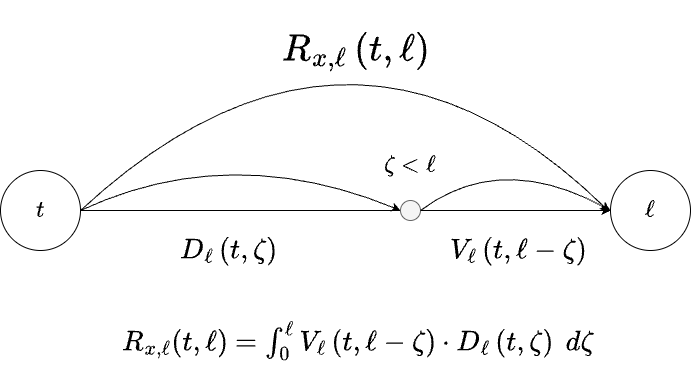
With these terms in place, we are now in position to define the dispersion of a generation as a convolution. Starting from an infected human:
\[R_{x, \ell}(t, \ell) = \int_0^\ell V_\ell\left(t,\ell-\zeta\right) \cdot D_\ell\left(t, \zeta\right) \; d \zeta \] …and from an infected mosquito:
\[R_{z, \ell}(t, \ell) = \int_0^\ell D_\ell\left(t, \ell - \zeta\right) \cdot V_\ell\left(t,\zeta\right) d \zeta \]