The Parasite Life Cycle
A Overview

The life cycle of malaria parasites is a good entry point for understanding malaria. Starting with the zygote stage in the mosquito, we describe parasite development in the mosquito through a bite that transmits parasites in saliva and infects a human. Next, we trace parasite development in the human until parasites are taken up in a blood meal and infect a mosquito. The life-cycle of the parasite is the scaffolding for the study of malaria.
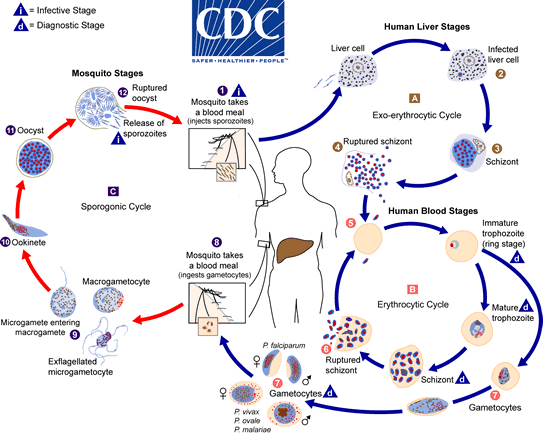
[1]
Parasite Biology — We start by following the parasite through its life-cycle
Infection — The next time through, we seek to understand malaria infections
Context —
Blood Feeding
Malaria Epidemiology
Parasite Biology
Plasmodium falciparum and other malaria parasites have a complex life cycle (Figure 1): in each stage, the parasite takes on a different form or shape, it expresses different genes, and it occupies different tissues or habitats in two different hosts.
The Definitive Host
P. falciparum is a eukaryotic organism, but it is only diploid for a short time as a zygote in the mosquito midgut; the moquito is thus called the definitive host. From the lumen (interior space) of the mosquito midgut, the parasite encysts in the mosquito midgut, ruptures into the hemocoel (open body cavity), and migrates to the salivary glands. (See In the Mosquito.)
The Bite
P. falciparum sporozoites move from a mosquito into a human in mosquito saliva when it bites.
The Human Host
In the human, the mosquito moves from the dermis into the blood stream and then the liver, where it infects a hepatocye (a liver cell). After approximately six days in the liver, the parasites emerge into the blood stream again as merozoites that infect red blood cells. Inside the red blood cell, the parasites replicate, making more merozoites. Some of these merozoites make a developmental switch, so that in the next red blood cell they infect, they become either macrogametocytes (female) or microgametocytes (male). The gametocytes sequester in deep tissues, and then emerge into the bloodstream where they are taken up by a mosquito in a blood meal.
The Blood Meal
Parasite’s move from the human back to the mosquito in a blood meal. Inside the mosquito, a macrogametocyte fuses with a microgametocyte to form a zygote.
Infection
After describing the parasite life-cycle from the parasite’s point of view, we can walk through the same process from the host’s point of view. We want to identify parameters that describe the process of infection.
Vectors
In malaria vectors, we are interested in two concepts: vector competence and vectorial capacity.
Vector Competence
Vector competence is defined by…
Vectorial Capacity
Infectivity: The Bite
What fraction of bites by infective mosquitoes transmit sporozoites?
Human Infections
If we want to understand malaria in humans, we must begin to develop a quantitative understanding of parasite population biology. This points us to a different set of questions: How long does a human infection last? What are lags for latency and incubation in humans and mosquitoe? How does the parasite manage to evade the immune system? What limits parasite densities in human blood? What is the relationship between infection and human disease? At what points in the life cycle can we intervene?
To understand malaria in humans, we must also study mosquitoes and the parasite in the mosquito. Like parasites, mosquitoes have a complex life cycle. Adult female mosquitoes feed on blood; the protein in blood is used by the mosquito to make mosquito eggs. The eggs are laid in aquatic habitats, where they hatch into a larval form. Mosquitoes are homometabolous insects; like butterflies, the larvae molt into four distinct larval instars befor pupating.
Some basic questions about the parasite life cycle that can not be answered by merely studying the parasite. Some details about parasites in the mosquito and human also matter. The life cycle require that a parasite get transmitted twice: gametocytes are taken up by a mosquito in a blood meal, infecting a mosquito; and sporozoites are passed from the mosquito in a bite, infecting a human. In biological terms, this is a generation. How long does it take from blood meal to bite? How long from bite to blood meal? If we follow the parasite through one full generation, how many offspring would there be? The measure of reproductive success for P. falciparum is how many zygotes per zygote: if we started counting from one infected mosquito, how many infected mosquitoes would there be after one parasite generation? How far do parasites move in infected mosquitoes from blood meal to bite? How far to parasites move in infected humans from bite to blood meal? The answer to these questions vary by location and time of year, and the underlying causes are related to mosquito ecology, human behaviors, and other factors.
Many of these questions will be in explored in other vignettes. Here, we walk through the life cycle stage by stage, drawing attention to some details and identifying some terms.
Infectivity: The Blood Meal
Malaria Metrics
EIR
PR
Malaria Transmission Dynamics
Having described some basic parameters to describe infection, we can now discuss malaria transmission dynamics.
Malaria Epidemiology
Mosquito Ecology
See Mosquito Ecology
Blood Feeding
We are interested now in understanding malaria as a system.
Malaria Control
A changing baseline modified by control.
Health Care
Malaria Vaccines
Mass Treatment
Vector Control
Several modes of vector control.
Realism
See Realism
Multiple vector species.
Spatial Dynamics
See Space
Human Mobility
Forcing
See Forcing
Weather and hyddrology
Heterogeneous Transmission
Heterogeneous biting; heterogeneous mixing; environmental heterogeneity
Evolution and Adaptation
Things change over time.
Control Strategies
Malaria control strategies adapt to changing conditions.
Pesticide Resistance
mosquito populations evolve resistance
Mosquito Bahaviors
[2]
Drug Resistance
parasites evolve to be resistant to drugs
Economic Development
Economies develop
Annotated Bibliography
Recommended Reading