The HTC Matrix
Infectious Days Spent

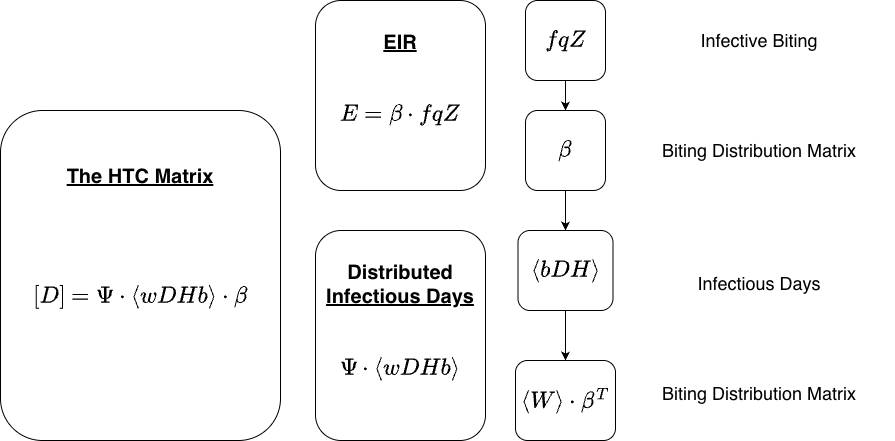
To understand parasite dispersal by humans, we need the HTC matrix. The human transmitting capacity (HTC) matrix describes the number of fully infectious days spent in each patch from an infection acquired in each patch.
Previous: HTC | Next: Spatial Thresholds & Connectivity & Parasite Generation
The HTC matrix can be expressed best as the product of three terms:
\(\beta\) — the biting distribution matrix, the fraction of a bite on each stratum arising from a single bite in each patch. For example the daily EIR \((E)\) is \(E = \beta \cdot fqZ.\)
\(\left[\left< bD \right>\right]\) — the diagonalized vector of \(bD,\) the expected number of infectious days per infective bite.
\(\Xi = \left[\left< wH \right>\right] \cdot \Psi\) — the population weighted time at risk matrix.
HTC Matrix
The HTC matrix is:
\[\left[D_\ell(t, \ell) \right] = \beta(t) \cdot \left[\left< bD_\ell(t, \ell) \right>\right] \cdot \Xi(\ell) \]
and \[\left[D(t)\right] = \int_t^\infty \left[D_\ell(t, \ell) \right] d \ell\]