Malaria Connectivity
Parasite Dispersal in Metapopulations

Connectivity describes parasite dispersal between infectious bites. If we traced a parasite gene backwards in time, through a sequence of bites in alternating mosquito and human hosts, the parasites would move around. We need in mosquitoes between one pair of bites, and they would move in humans between the other. Here, we develop formulas that describe connectivity in meta-population models.
Previous: VC Matrix & HTC matrix & A Parasite Generation
We want to be able to describe malaria dispersal among patches in meta-population models. Ideally, we would like to describe malaria connectivity in simple and intuitive terms. In a meta-population the different formulas start at different points in the parasite generation matrices (see the vignette).
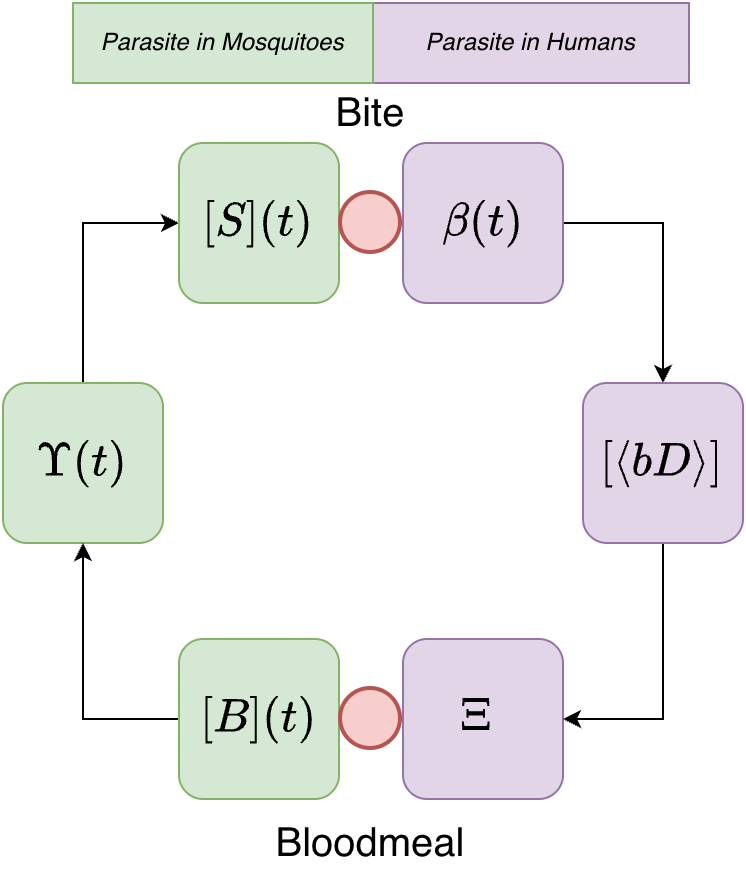
To measure connectivity in populations, we want to look at bulk flows, not per-capita measures. To get started, we look at connectivity for spatial models without a seasonal component:
- Mosquito to Mosquito — If we consider all the infections bites arise in the next parasite generation in every other patch from \(M_0\) blood feeding mosquitoes in each patch (including \(\kappa\)), we get:
\[[D] \cdot [V] \cdot \left[\left<W \kappa \right>\right]\]
- Human to Human — If we consider all the infectious bites occurring in each patch at some point in time, \(fqZ,\) how many infectious bites would eventually arise in the next parasite generation in every other patch?
\[[V] \cdot [D] \cdot \left[\left< fqZ \right>\right]\]
- Malaria Importation — Let \(h_T\) be the travel FoI for the strata (a vector of length \((N_h).\) The number of infectious bites arising in every patch from every stratum would be: \[[V] \cdot \Xi \cdot \left[\left< h_T D \right>\right],\] and if we wanted a measure fro patch to patch, then: \[[V] \cdot \Xi \cdot \left[\left< h_T D \right>\right] \cdot J^T\]
The matrices we generate are interpreted as directed graphs with a self-loop. The on diagonal elements are the number of infections arising in each patch that trace back to every other patch in the previous generation.