The Precision Engineering and the Mechatronics Mindset
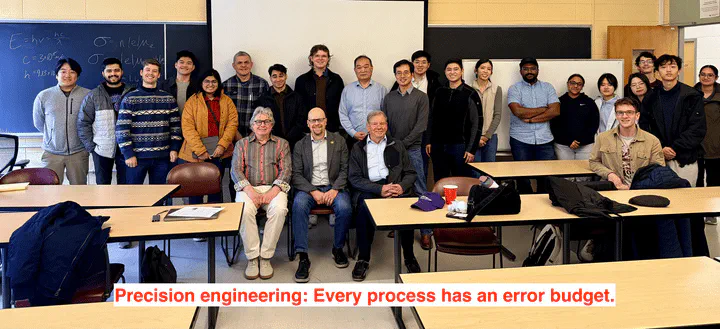
When three Presidents of the American Society for Precision Engineering (ASPE) gather in one room, the conversation moves from simple measurements to the future of systems thinking.
It was a privilege to host Dr. Stuart T. Smith (UNC Charlotte) at the University of Washington for his seminar, “Precision Instruments and Machines along the Mechatronics Road.”
Precision engineering is often misunderstood as simply making things “small” or “shiny.” In reality, it is a rigorous discipline of uncertainty management. The session bridged 50 years of experience with the modern POEMS (Precision Optics, Electronics, and Mechanical Systems) framework.
As highlighted in the seminar, the core of this field rests on three pillars:
-
The Error Budget: Every engineering process must have an “error budget.” Much like a financial budget, this tracks where inaccuracies creep in (thermal expansion, vibration, geometric errors) and ensures the final system meets its performance specifications.
-
Measurement Uncertainty: A measurement without an associated uncertainty is meaningless. Understanding the limits of how we see and touch the physical world is the first step toward controlling it.
-
Deterministic Design: Following best practices, such as Pat McKeown’s eleven principles, allows engineers to design machines that are predictable and repeatable rather than relying on trial and error.
🛠️ The “POEMS” Framework
Dr. Smith introduced the concept of POEMS to describe the evolution of high-tech systems. Today’s most advanced machines are no longer just mechanical; they are integrated Precision Optics, Electronics, and Mechanical Systems.
To master these systems, a Mechatronics Mindset is required:
-
Process Driven: Design begins with the end process in mind – whether it’s atomic-scale microscopy or aerospace manufacturing.
-
Ishikawa Visualization: Utilizing cause-and-effect diagrams to map out how every variable in a system influences the final result.
-
Modular Math and Control: Creating systems that are mathematically coherent and modular, allowing for complex technology integration without losing precision.
The highlight of the afternoon was a remarkable gathering of ASPE leadership, bringing together: Graham Siddall: Past ASPE President, Dr. Stuart T. Smith: Seminar Speaker and Past ASPE President, Alex Sohn: Current ASPE President, a standing-room-only crowd of students, researchers, and collaborators at UW.
This special lecture is also a follow-up event of a recent visit that Graham and I made to UNCC and their Center for Precision Metrology (CPM). Thank you Dean Robert Keynton and Director Ed Morse, for the kind invitation and arrangement of my talk about “From Vision to Velocity: Driving Manufacturing and Robotics Innovation Across Aerospace and Beyond.”

From the smartphones in our pockets to the satellites orbiting Earth, our modern world depends on the ability to bridge the gap between theoretical physics and physical deployment. By treating precision as a fundamental mindset rather than an afterthought, engineers can drive innovation across industries including medicine, robotics, and aerospace.