Neuroscience For Kids
The Hows, Whats and Whos of Neuroscience
The Whats


What is a neuron?
A neuron is a nerve cell. The brain is made up of approximately 86 billion neurons (Source: Frederico Azevedo et al., Equal numbers of neuronal and nonneuronal cells make the human brain an isometrically scaled-up primate brain. J. Comp. Neurol., 513: 532-541, 2009.).
Neurons are similar to other cells in the body in some ways such as:
- Neurons are surrounded by a membrane.
- Neurons have a nucleus that contains genes.
- Neurons contain cytoplasm, mitochondria and other "organelles".
However, neurons differ from other cells in the body in some ways such as:
- Neurons have specialized projections called dendrites and axons. Dendrites bring information to the cell body and axons take information away from thecell body.
- Neurons communicate with each other through an electrochemical process.
- Neurons form specialized connections called "synapses" and produce special chemicals called "neurotransmitters" that are released at the synapse.
There are approximately 1 quadrillion synapses in the human brain. That's 1,000,000,000,000,000 synapses! This is equal to about a half-billion synapses per cubic millimeter. (Statistic from Changeux, J-P. and Ricoeur, P., What Makes Us Think?, Princeton: Princeton University Press, 2000, p. 78)
Types of Neurons
What is
behind the saying "We use only 10% of our brain?" Is this true?
No...it is not true. We use all of our brain. I have created a special page called "Do we use only 10% of our brain" that discusses this question in more detail.
The Hows
How big is the brain?
How much does the brain weigh?
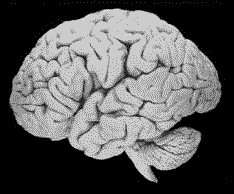 The adult human brain weighs between 1300 g and 1400 g (approximately 3
lbs). A newborn human brain weighs between 350 and 400 g. For
comparison:
The adult human brain weighs between 1300 g and 1400 g (approximately 3
lbs). A newborn human brain weighs between 350 and 400 g. For
comparison:
elephant brain = 6,000 g
chimpanzee brain = 420 g
rhesus monkey brain = 95 g
beagle dog brain = 72 g
cat brain = 30 g
rat brain = 2 g
How many neurons (nerve
cells) are in the brain? How big are they?
There are approximately 86 billion (86,000,000,000) neurons in the human brain.
To get an idea of how small a neuron is, let's do some math:
The dot on top of this "i" is approximately 0.5 mm (500 microns or 0.02 in) in diameter. Therefore, if you assume a neuron is 10 microns in diameter, you could squeeze in 50 neurons side-by-side across the dot. However, you could squeeze in only 5 large (100 micron diameter) neurons.
How long is a
neuron?
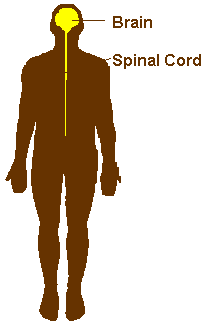
Some neurons are very short...less than a millimeter in length. Some neurons are very long...a meter or more! The axon of a motor neuron in the spinal cord that innervates a muscle in the foot can be about 1 meter (3 feet) in length.
 Think about how long the axon of a motor neuron would be if you wanted
to make a model of it. The cell body of a motor neuron is approximately
100 microns (0.1 millimeter) in diameter and as you now know, the axon is
about 1 meter (1,000 millimeter) in length. So, the axon of a motor
neuron is 10,000 times as long as the cell body is wide. If you use a
ping-pong ball (diameter = ~3.8 cm or 1.5 inch) to model the cell body,
your axon would have to be 38,000 cm (380 meters) or 1,247 feet in length.
If you use a basketball (diameter = ~24 cm or 9.5 inch) as the cell body,
then your axon would have to be 240,000 cm (2.4 kilometers) or 7874 ft
(1.49 miles) in length!
Think about how long the axon of a motor neuron would be if you wanted
to make a model of it. The cell body of a motor neuron is approximately
100 microns (0.1 millimeter) in diameter and as you now know, the axon is
about 1 meter (1,000 millimeter) in length. So, the axon of a motor
neuron is 10,000 times as long as the cell body is wide. If you use a
ping-pong ball (diameter = ~3.8 cm or 1.5 inch) to model the cell body,
your axon would have to be 38,000 cm (380 meters) or 1,247 feet in length.
If you use a basketball (diameter = ~24 cm or 9.5 inch) as the cell body,
then your axon would have to be 240,000 cm (2.4 kilometers) or 7874 ft
(1.49 miles) in length!
How big is the brain
compared to the rest of the body?
If you assume the average person is 150 pounds and the average brain weighs 3 lbs., then the brain is 2% of the total body weight.
How long is the spinal cord
and how much does it weigh?
The average spinal cord is 45 cm long in men and 43 cm long in women. The spinal cord weighs approximately 35 g.
How fast does information
travel in the nervous system?
Information travels at different speeds within different types of neurons. Transmission can be as slow as 0.5 meters/sec or as fast as 120 meters/sec. Traveling at 120 meters/sec is the same as going 268 miles/hr!!! Check the math out yourself. More about the speed of signals in the nervous system.
More Whats and some Whos, Whys and Hows
What do neuroscientists
study?
Perhaps, the best way to describe what neuroscientists study is to list the "levels" at which experiments can be done:
- Behavioral Level: study of the neural basis of behavior. In other words, what causes people and animals to do the things they do.
- System Level: study of the various parts of the nervous system like the visual or auditory system. This could also include investigations of what parts of the brain are connected to other parts.
- Local Circuit Level: study the function of groups of neurons (nerve cells).
- Single Neuron Level: study what individual neurons do in relation to some "event." Also, could study what is contained within a single neuron (neurotransmitter studies).
- Synapse Level: study what happens at the synapse.
- Membrane Level: study what happens at ion channels on a neuronal membrane.
- Genetic Level: study the genetic basis of neuronal function.
How do you become
a neuroscientist? How long do you have to go to school?

- First, you have to finish high school...so from 1st to 12th grade is 12 years.
- Second, you get a university degree...at least another 4 years of school.
- Third, you go to either graduate school for a Ph.D. degree or go to medical school for an M.D. degree...at least another 4 years of education.
Let's add up what we have so far -- 12 yrs + 4 yrs + 4 yrs = 20 yrs
That's 20 yrs. of school. While you are in graduate school or medical school you can call yourself a neuroscientist in training. After you get your Ph.D. or M.D. you can call yourself a "neuroscientist." Some people go back to school and get another degree so they have both a Ph.D. and an M.D. degree. Most people continue their training in a different laboratory after they get their Ph.D. or M.D. degree. This period of time is called Postdoctoral Training and neuroscientists learn new methods and techniques. This usually lasts 2-4 years. It is the hope of most neuroscientists that they can get jobs at a university, hospital or company after their postdoctoral training period. To find out more about becoming a neuroscientist, read Another Day, Another Neuron, a short essay I wrote for the Genentech Access Excellence Web site.
Ok, so after all this school
and training, what kind of jobs are available?
 Jobs in
Neuroscience
Jobs in
NeuroscienceWhy do neuroscientists do
what they do?
Different neuroscientists have different reasons for getting into their careers. However, I am sure that some scientists are motivated by their curiosity to learn more about the brain. Neuroscientists would also like to find treatments and cures for the diseases that affect the nervous system. Neurological illnesses affect more than 50 million Americans each year - this costs billions of dollars each year. Here is more information on some of the major nervous system diseases (from Brain Facts, Society for Neuroscience and other sources including The American Academy of Neurology)
Major Nervous System Diseases
| Disease | Number of Cases | Cost per year |
| Chronic Pain | 97,000,000 | $100 billion |
| Hearing Loss | 28,000,000 | $56 billion |
| Depression Disorders | 20,500,000 | $44 billion |
| Alzheimer's Disease | 4,500,000 | $100 billion |
| Stroke | 4,700,000 | $51 billion |
| Epilepsy | 2,500,000 | $3.5 billion |
| Traumatic Head Injury | 5,000,000 | $56.3 billion |
| Huntington's Disease | 30,000 | $2 billion |
| Schizophrenia | 2,000,000 | $32.5 billion |
| Parkinson's Disease | 1,000,000 to 2,000,000 | $25 billion |
| Multiple Sclerosis | 2,500,000 | $9.5 billion |
| Traumatic Spinal Cord Injury | 250,000 | $10 billion |
Who was the first
neuroscientist?
Hmmm....I don't think anyone really knows the answer to this one. Here is my opinion. Some skulls that are at least 10,000 years old have unusual holes in them. Scientists believe that these holes were put there intentionally to "let out the bad spirits." This implies that these people had some belief that the head or brain had some importance for health and well-being. Perhaps these people could be considered the first neuroscientists.
 The first recorded use of the word "brain" belongs to the
ancient Egyptians. The word for "brain" and other "neuro" words appear in
the Edwin Smith Surgical Papyrus which was
written by an unknown Egyptian surgeon around 1,700 BC.
The first recorded use of the word "brain" belongs to the
ancient Egyptians. The word for "brain" and other "neuro" words appear in
the Edwin Smith Surgical Papyrus which was
written by an unknown Egyptian surgeon around 1,700 BC.
Socrates (469-399 B.C.) and Aristotle (384-322 B.C.) were early "thinkers" who wrote about the brain and mind. However, Aristotle believed that the heart, not the brain, was important for intelligence. Galen (129-199) was another early neuroscientist. Leonardo da Vinci (1452-1519), who came along much later, also could be thought of as a neuroscientist. If you are interested in more about the history of the Neurosciences, try Milestones in Neuroscience Research.
How many research papers
about the brain are published each year?
For 2015, a PubMed search using the term "brain" shows that 87,294 papers were published.
For 2014, a PubMed search using the term "brain" shows that 85,025 papers were published.
For 2013, a PubMed search using the term "brain" shows that 80,032 papers were published.
For 2012, a PubMed search using the term "brain" shows that 75,168 papers were published.
For 2011, a PubMed search using the term "brain" shows that 70,279 papers were published.
For 2010, a PubMed search using the term "brain" shows that 65,193 papers were published.
For 2009, a PubMed search using the term "brain" shows that 61,270 papers were published.
For 2008, a PubMed search using the term "brain" shows that 55,874 papers were published.
For 2007, a PubMed search using the term "brain" shows that 53,258 papers were published.
For 2006, a PubMed search using the term "brain" shows that 51,163 papers were published.
For 2005, a PubMed search using the term "brain" shows that 47,383 papers were published.
For 2004, a PubMed search using the term "brain" shows that 42,849 papers were published.
For 2003, a PubMed search using the term "brain" shows that 39,964 papers were published.
For 2002, a PubMed search using the term "brain" shows that 37,304 papers were published.
For 2001, a PubMed search using the term "brain" shows that 36,884 papers were published.
For 2000, a PubMed search using the term "brain" shows that 37,000 papers were published.
For 1999, a PubMed search using the term "brain" shows that 34,828 papers were published.
For 1998, a PubMed search using the term "brain" shows that 33,027 papers were published.
For 1997, a PubMed search using the term "brain" shows that 32,112 papers were published.
For 1996, a PubMed search using the term "brain" shows that 31,040 papers were published.
What are some of the methods
and techniques used by neuroscientists?
You want methods? Here they are.
Copyright © 1996-2019, Eric H. Chudler All Rights Reserved.
