|
Page contents:
|
Physics 116A, Winter 2007
Oscillations, Waves, and Modern Physics News, Announcements, etc
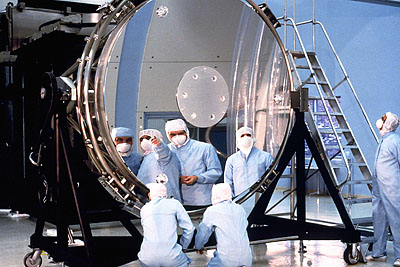
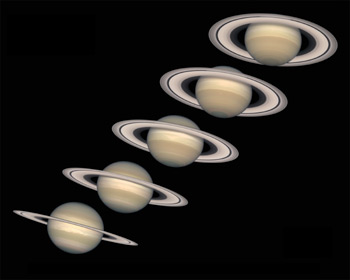
01/05/07. Yesterday (Thursdsay) we started with simple harmonic oscillations. We will continue today and Monday working on these topics, then on Tuesday we will finish SHO and start with Waves, Ch. 14. At the end of class several of you showed me that you had a different Walker text. I checked with our office and... some of you have Walker's 2nd Edition, and others the 3rd Edition. At least for Chapter 13 on Oscillations, the two editions are almost identical. The 3rd edition has added some end of chapter problems but has not changed a single figure except for the one at the start of the chapter; the 3rd edition has added some "color" and changed the level of difficulty of some of the problems, pretty insignificant... Whe you check on Assignments for End of Chapter recommended problems, please note that I have added a sentence to what I posted yesterday with the number of the problems as in Walker's 2nd edition. Both sets (2nd and 3rd) are identical except for some of the numbers in the last problem (the problem is the same). I suggest you keep the 2nd Edition if this is the one you bought. I have both editions and I'll make sure that any assignment or topic is equivalent in both texts. 01/05/07 (after class). The University Bookstore claims that they have plenty of Walker, 3rd Edition texts left... I have not checked personally, but I'll try to do so. Also: please re-register your clicker!!! I made a mistake in setting the file and those who registered (including myself) ended mixed up with a Phys 121 file from years past... don't worry if you don't do it instantly, the file saves your repplies by clicker number. Last... I will gete an approximate schedule added to the web site. On Monday we will finish Chapter 13 and start Chapter 14. 01/12/07 (after class). Please note that the Tycho homework will be due on Thursday, Jan. 18, at midnight this coming week. The problem called Superposition could not be assigned for credit, so it just for practice. I can tell you the solution, if you have "doubts". This is why it reads (or will read shortly) 0 points. I have posted solutions to the extra problems from Ch. 13 of Walker's book that I had suggested. Under Assignments, I also posted problems from Ch. 14 of Walker's book; solutions to these problems will be posted next Wednesday. Finally, I was asked if I had "old practice exams". My answer so far: last time I taught this class was around 10 years ago or longer, before there were multiple choice questions or we had everything on the UW computer system... I'll look and see what I have. THE FIRST EXAM IS FRIDAY, JAN 19 (NEXT WEEK). Material for the exam will be what we have done through next Tuesday (probably we will not have done Beats by then, and may not have done the Doppler effect, which I postponed from the order in the text). I plan to talk about standing waves and musical instruments on Tuesday, intensity of sound, and what we hear and if there is time the Doppler effect. We will also finish solving the handout I passed around today. 1/15/07. Today I uploaded my solutions to the selected problems from Ch. 14 of Walker. Check the link. 1/24/07. The solutions to the problems in the first exam were uploaded a few minutes ago. You can access them through Solutions on the left margin. The preliminary average for the test is 72, with a "broad" standard deviaton of 18 points. I think both the grader and I were "quite generous" with the partial credit... but in general test responses were good. Later today there will be some additional problems from the text regarding Beats, Interference (Ch. 14) and Electromagnetic Waves (Ch 25). I would like to write a quick summary of some results regarding capacitors, inductors, and LC circuits, as we are doing currently in class. If you have Volume 2 of Walker's text (3rd Edition), check Ch. 24, Section 6, particularly Fig. 24-23 which compares a simple harmonic oscillator of mass M and spring constant K with a circuit (also a simple harmonic oscillator) with capacitance C and inductance L, and establishes that in the circuit 1/C is the equivalent of K, and L is the equivalent of M, so the angular frequency is Omega = Square Root (1/LC) for the circuit and Omega = Square Root (K/M) for the spring-mass system. 1/24/07. Additional problems from Walker's book have been posted (from Ch. 25). Please go to Assignments. 1/25/07. I wrote "by hand" a comparison between the spring-mass harmonic oscillator and the capacitor-inductor harmonic oscillator. I'll distribute these notes in class today, but if you want to see them "on line" click on left margin under "Oscillatiions". 1/31/07. Solutions to the extra problems from Chapter 25 have been posted. Go to Solutions to download. Extra problems from Chapters 26 and 27 will be posted shortly. Next test is on Thursday, February 8 (thursday next week). It will cover the following topics: Ch 15, beats and interference, Ch. 25 (all), Ch 26 (likely all), Ch 27 (camera and the eye). Even if compound microscope and telescope are done in class thorse topics will not be in the 2nd test but in the 3rd test. More "news" will be added before the weekend, I'll check for very old sample tests. 2/4/07. I have posted the solutions to the extra problems from Walker, Chapter 26 and beginning of 27. Go to the "Solutions" link on the margin. I have posted also some "old and ancient" tests about EM waves, mirrors, refraction and lenses, go to Exams and click on Sample Test 2. The next Exam is this coming Thursday, 2/8/07. Exam will be like last one, about 10 questions and two problems. A page of notes is fine, please bring a standard scan sheet for tests, don't forgete to write your name and student number. One more note today: the Tycho homework due Wednesday night is long, don't leave it to the last minute. There are two "hard" problems, the one of the prism and the one with the double convex lens, third part with the object to the right of the lens. The prism problem seems "hopeless" unless you extend the normal lines perpendicular to the surface of the prism until they "cross" inside the prism. The angle they form where they intersect is 120 degrees (one can form a four-sided figure, with the 60 degree angle at the top, two 90 degree angles on the surface, and the sum of all angles on a four-sided figure is 360 degrees!). This problem is very long to solve! On the lens problem, if no light rays go through the object (lilke inn the third part of the converging lens problem), then the object distance is negative. Making a drawing by ray tracing is a good way to see this. I'll say something in class, but probably not until Tuesday. 02/14/07. Happy Valentine's Day! I uploaded the solutions to the second exam, please go to Solutions. Also I noted some additional problems from chapters 27 and 28 which you should try to do. I will have solutions posted by next weekend. Please go to Assignments. 02/15/07. I uploaded two pictures I got from the web, one of the mirror of the Hubble Space Telescope, which is in orbit 350 km above Earth, and the other one of Saturn as seen by the telescope over a period of a few years. The UW campus also has an ancient telescope (a refracting one, two convex lenses) which is on the North side of campus near the 17th Ave entrance. It is open to visitors and to viewing two days a month beginning in March. The link is http://www.astro.washington.edu/observatory/ Looking at it this morning I learnt that this is the second oldest building on Campus (oldest is Denny Hall). I had thought that Parrington was the second oldest... learn something every day. The Hubble Space telescope site (Google "Hubble Space Telescope") has tons of pictures! If you look at the UW Astronomy Department web site, it also has pictures of the other telescopes (in New Mexico, etc...). 02/16/07. I wrote and uploaded the solutions to the "extra" problems from Chapters 27 annd 28 of Walker's text. Please go to Solutions. Today in class we will talk about thin film interference, single slit diffraction, and diffraction from a circular aperture. If we have time we will start talking about resolution. We will finish Chapter 28 on Tuesday next week. I am about one full class behind schedule....I will post a revised schedule after the weekend. We will skip entirely Chapter 29 on Special Relativity (although it is fun...). 02/25/07. I wrote and uploaded solutions to the extra problems from Chapter 30 and the beginning of Chapter 31. Some time on Monday I'll upload a "sample test" or "sample questions". Remember, the third exam is this coming Thursday. It should cover the material of the Tycho homeworks 6, 7, and 8, or from about systems with multiple lenses and optical instruments through interference, diffraction, thin films, diffraction gratings, resolution, black body radiation (see comment below), photoelectric effect and on up to Bohr atom. If we don't get to Bohr atom by Tuesday it will not be in the test, but I think we will get there. A comment on the current Tycho homework. To solve the problem on the radiation from outer space at a very cold temperature you need to use Wien's displacement law in the form lambda x T = constant = 0.002898 meter Kelvin and not the form in Walker's book for f = constant x T. IT IS NOT TRUE THAT f(peak) = c/lambda(peak) because the two equations refer to "different peaks", the one in Walker's book to the Intensity per unit frequency interval, and the form above to the peak in the Intensity per unit wavelength interval. If you use the equation above to solve for "lambda peak" it will be about 500 nm, quite close to the graph peak. If you use Walker's equation you will get a lambda that is 5/3 different! Please ask questions in class, this material is going very fast and you will have a lot of information in a very short time! 03/05/07. Just a few quick notes. A) The complete scores for the Exam 3 are on Tycho. The average score was 53. The maximum score was 97, which is also the maximum possible score (you will notice that Problem 1 had only 22 points, not 25 as I though I had... I removed one more question and fergot to reduce the points). The "standard deviation" was 19 points. B) I will not have office hours on Tuesday or Wednesday of this week. Satoru Inoue, the TA for the class, will be in the Study Center at 1:30 pm tomorrow and stay longer than usual to help with tycho homework. I expect to be back in town by Thursday class time. C) On Thursday and Friday we will solve in class the last two Tycho problems on radioactivity. D) As I announced in class today, you can bring two sheets of notes, written both sides, to the final exam. The final will be all multiple choice, with about half the test on Chapters 30, 31 and 32. A more detailed selection of topics will be posted later on. Please review the three exams you have taken, and the last two Tycho homeworks... 03/08/07. I have posted a sample final exam from Summer Quarter 1992, and some notes regarding the final exam next week. I have not posted the solutions to the sample exam, but I'll post them tomorrow. I will also scan and post my typed notes for chapter 32. More tomorrow. Go to Exams to link to the samples and notes. 03/09/07. I have posted my notes from the last two lectures on the nucleus and radioactivity. Click on margin on "nuclear notes". A solution to the sample problems from the "modern physics" part will be posted, but not until the end of the weekend or Monday. 03/14/07. The final exam is tomorrow, Thursday, 3/15/07, at 8:30 am in the usual classroom. I uploaded the solution to the sample final posted last week, please go to Solutions and download them. I'm sorry it is kind of late and the quality of the scan is not great (I wrote the solution in pencil in a hurry...), but it is visible and you should be able to complete some of the very light spots. Exam is all multiple choice (30 questions). Exam lasts 1hr50m. Class grades will not be available until some time Monday morning since I have to get the scanned sheets back before I can start checking everything. Today, Wednesday, I'll be at the Study Center from 2:30 to 4:30 pm. Come by if you have questions! 03/16/07. A blank copy of the final exam has been posted in Exams, and its solution in Solutions. The average score for the final was 80 points (16 questions right), with the top score being 125 points (25 questions right). The graph in Tycho is in percentages, not points, so it ends in 100%, which corresponds to 150 points. Grades are not done yet. I'll post a note here when done, but you should be able to see them on Tycho too. I doubt that they will be finished by the end of today since there are lots of details to check. O.V. |
|
Send mail to:
lowtemp@u.washington.edu Last modified: 3/16/2007 9:41 AM |