|
Jawi Literature:
Note: Some of these papers on Jawi literature are permanently archived at
ResearchWorks at the University of
Washington.
- A Concise Handlist of Jawi Authors and Their
Works (version 2.3). This is a pdf file of 85 pages. It contains a
list of works by authors from Southeast Asia who wrote in Malay or in
Arabic on traditional Islamic subjects. These works are often referred to
as kitab jawi or kitab kuning and most of them were written
in Mecca where their authors studied and later taught.
Note: The permanent URL for this file is: http://hdl.handle.net/1773/4870.
The TeX source file is available here.
- Hukum Akal. This is a short Jawi (old
Malay) text copied from an introductory gloss in the margin of Muhammad
Mukhtar ibn `Utarid al-Jawi al-Batawi al-Buquri's Kitab Usul al-Din.
The file is in html format with utf-8 encoding. An image-based pdf file of
Al-Buquri's Kitab Usul al-Din can be downloaded here
- A Famous Pantun. Victor Hugo popularized the
pantun or pantoum when in 1829 he published Ernest Fouinet's French
translation of this poem in the Notes at the end of Les
Orientales. The original Malay text along with an English translation was
published in 1812 by William Marsden in his A Grammar of the Malayan
Language. This is a pdf file made with Klaus Lagally's ArabTeX. It
includes Marsden's original Jawi text of the pantun, a transliteration into
modern Malay spelling, Marsden's English translation and Fouinet's French
translation. For information on the relationship between the Malay pantun and
the Western pantoum see the article "Jatuh ke Laut Menjadi Pulau: Mengamati
Hubungan Pantun Melayu Dan Pantoum Barat" by Md. Salleh Yaapar, located at pantun.usm.my/makalah4-1.asp.
Note: The permanent URL for this file is: http://hdl.handle.net/1773/4880.
- Two Arabic Manuscripts in the Handwriting of
Syeikh Yusuf al-Taj. Two Arabic manuscripts copied by Shaykh Yusuf al-Taj
during his residence in the Middle East have survived to the present day. They
are Sprenger 677 in the Berlin Library and Yahuda 3872 in the Garrett
Collection in the Princeton University Library.
Note: The permanent URL for this file is: http://hdl.handle.net/1773/4881.
- A List of Malay Manuscript Catalogues.
Note: The permanent URL for this file is: http://hdl.handle.net/1773/4882.
- Links to Sites on Jawi Literature:
Online Publications:
- Papers on Islamic Philosophy, Theology and
Mysticism. A PDF file of 84 pages containing the following
papers and lectures:
- A Lecture on Islamic Philosophy
- Ibn
Sina's Justification of the Use of Induction in Demonstration
-
Al-Abhari and al-Maybudi on God's Existence
- A Lecture on Islamic
Theology
- Rational and Scriptural Proofs in Islamic Theology
-
al-Jami on Whether an Eternal Effect Can Result from an Agent with
Choice
- `Abd al-Rahman al-Jami's Argument for
the Existence of Existence
- The Sufi Position with Respect to the
Problem of Universals
These papers
are also available as individual files below.
Note: The permanent URL for this file is: http://hdl.handle.net/1773/4883.
- The Stations of the Heart. An extract
from the translation of Bayān al-Farq bayn al-Ṣadr
wa-al-Qalb wa-al-Fu'ād wa-al-Lubb, a Sufi work attributed to
al-Ḥakīm al-Tirmidhī. In PDF format. The full
translation was published in Three Early Sufi Texts by Nicholas Heer
and Kenneth Honerkamp, Louisville: Fons
Vitae, 2003. A digital copy, in PDF format, of my 1958 edition of the
Arabic text of Bayān al-Farq (بيان الفرق بين الصدر والقلب
والفؤاد واللب) can be downloaded here. The
2009 Arabic edition of Yusuf Walid Mar`i can be downloaded from The Royal Islamic Strategic
Studies Centre in Amman, Jordan.
Note: The permanent URL for this file is: http://hdl.handle.net/1773/4884.
- Substitute page for Three Early Sufi
Texts. Pages 26 and 27 of the published work have some strange
typesetting mistakes. A single passage of several lines is repeated six
times. This page, in PDF format, can be downloaded and substituted for
those two pages.
- A
Lecture on Islamic Theology.
Note: The permanent URL for this file is: http://hdl.handle.net/1773/4885.
- A
Lecture on Islamic Philosophy.
Note: The permanent URL for this file is: http://hdl.handle.net/1773/4886.
- Al-Abhari and al-Maybudi on God's Existence.
This is a translation in PDF format of the first six sections of Chapter Two
of al-Maybudī's commentary on al-Abharī's Hidāyat
al-Ḥikmah. These sections all have to do with issues pertaining
to the Necessary Existent's existence. The first section presents a proof
for the existence of the Necessary Existent. The second and third sections
deal with the question of whether the Necessary Existent's existence
(wujūd), necessity (wujūb) and individuation
(ta`ayyun) are identical with Its essence or additional to it. The
fourth section takes up the question of whether there can be more than one
necessary existent. The fifth section deals with the question of whether it
is possible for a necessary being to change. And finally the sixth and last
of the translated sections discusses the question of whether the existence of
the Necessary Existent is of the same nature as the existence of contingent
beings.
Note: The permanent URL for this file is: http://hdl.handle.net/1773/4887.
- Al-Ḥakīm al-Tirmidhī's
Kitāb Ithbāt al-‘Ilal
Note: The permanent URL for this file is: http://hdl.handle.net/1773/37263.
- `Abd al-Rahman al-Jami's Argument for the
Existence of Existence
Note: The permanent URL for this file is: http://hdl.handle.net/1773/4872.
- Rational and Scriptural Proofs in Islamic
Theology
Note: The permanent URL for this file is: http://hdl.handle.net/1773/4873.
- The Proof for the Truthfulness of the
Prophet
Note: The permanent URL for this file is: http://hdl.handle.net/1773/4874.
- Al-Jami on Whether an Eternal Effect Can
Result from an Agent with Choice
Note: The permanent URL for this file is: http://hdl.handle.net/1773/4875.
- The Sufi Position with Respect to the
Problem of
Universals
Note: The permanent URL for this file is: http://hdl.handle.net/1773/4876.
- Ibn Sina's Justification of the Use of
Induction in Demonstration
Note: The permanent URL for this file is: http://hdl.handle.net/1773/4877.
- Five Unedited Texts on the Sufi Doctrine of
Waḥdat al-Wujūd by al-Sayyid al-Sharīf
al-Jurjānī.
Note: The permanent URL for this file is: http://hdl.handle.net/1773/22418.
- A Review of Seyyed Hossein Nasr, The Islamic
Intellectual Tradition in Persia. Edited by Mehdi Amin Razavi.
(Richmond, Surrey: Curzon Press, 1996).
Note: The permanent URL for this file is: http://hdl.handle.net/1773/4878.
- Some Papers Pertaining to al-Muntada al-Adabi in
the Library of the Hoover Institution
Note: The permanent URL for this file is: http://hdl.handle.net/1773/4879.
These papers are also permanently archived at ResearchWorks
at the University of Washington
Out-of-Date Material:
- My Original Web Page. This site is now
completely out of date. It may nevertheless prove useful for people who
are still using old software in old computers. It contains some samples
of Arabic html files which can be used for testing various Internet
browsers. It also contains a sample of an ArabTeX file showing how Arabic
poetry can be formatted in two columns. There is also information on
using Arabic and Persian on a Linux box.
- My Old Anonymous
FTP Site. The files here are also for the most part out of date, but
some of the information on character sets and conversion to and from
various Arabic and Persian code pages may be of interest to some. There
are also some Arabic texts in various encodings.
- al-Qur'an al-Karim. This is a zipped package
containing the complete text of the Qur'an in both ISO 8859-6 encoding
(quran-8859-6.txt) and in UTF-8 encoding (quran-utf8.txt) as well as
Pickthall's English translation of the Qur'an (pickthall.txt). These are
all plain-text files. The Arabic text of the Qur'an is unvocalized and in
modern Arabic orthography (rasm imla'i) rather than traditional Qur'anic
orthography (rasm `uthmani). The text is therefore easy to search because
there is no need to vocalize the words or phrases being searched for. It
is also easy to copy verses and to paste them into other files.
The original source of the Arabic text as well as Pickthall's translation
is apparently the Islamic Computing Centre in London. The files seem to
have been uploaded in 1993 to a number of ftp sites by Mohammad Jamil
Sawar, CBLU, Leeds University, Leeds LS2 9JT, U.K.
(sawar@cbl.leeds.ac.uk). See the two files sawarmessage1.txt and
sawarmesasge2.txt.
Unfortunately, the digitized Qur'anic text has a number of minor errors.
These are listed in the corrections.txt file. Make sure, therefore, that
you check the Qur'anic text against these corrections or against a printed
mushaf.
For other digitized versions of the Qur'an in MS Word (.doc) format go to
http://qurankareem.info/. To view
these files you will need Microsoft Word or Open Office Writer. You may
also have to download some Arabic fonts. These texts of the Qur'an are
fully vocalized, so if you want to search for words and phrases you will
have to vocalize the words you search for. You can, however, easily copy
verses and paste them into other files.
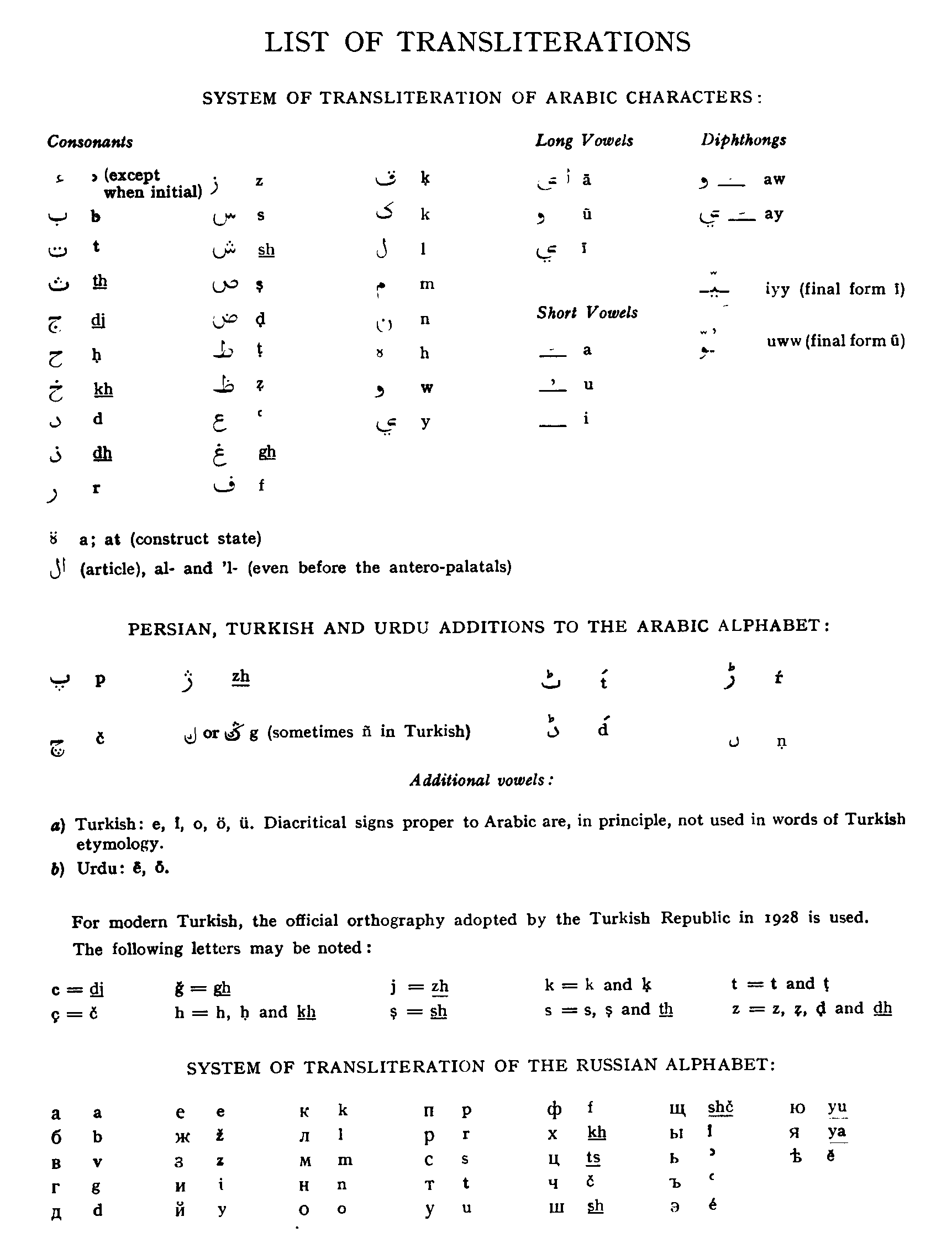
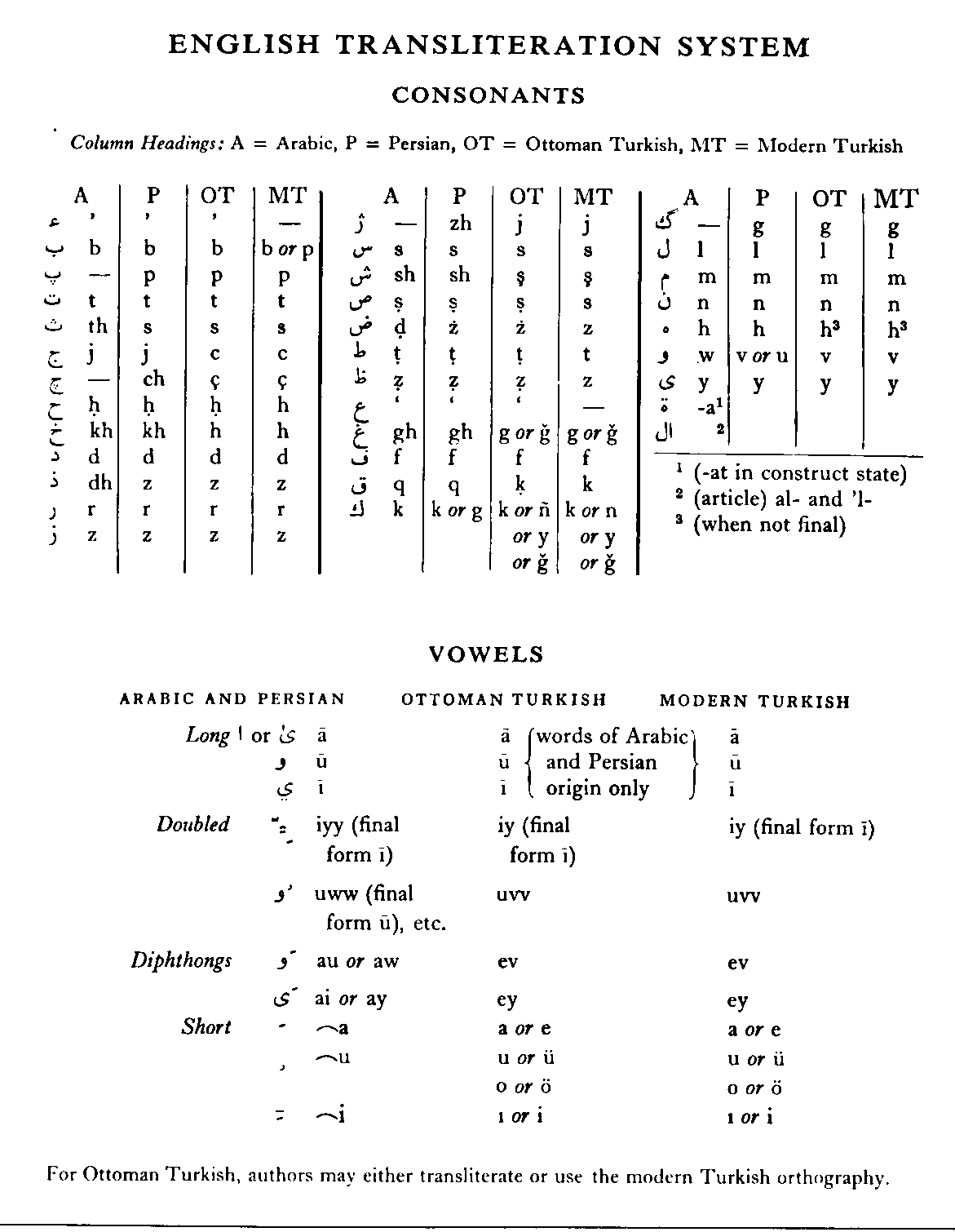
Arabic Transliteration Systems:
Courses:
Curriculum Vitae
|