Neuroscience For Kids
Smart Drugs?
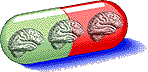
REMEMBER MORE - THINK FASTER - BE WISER
Wouldn't it be nice if you could swallow a pill rather than study for a test? Are there such "smart pills"? Perhaps you could take a pill and get a "mental tune-up" if you are feeling a bit dull.
Actually, researchers are studying substances that may improve mental abilities. These substances are called "cognitive enhancers" or "smart drugs" or "nootropics." ("Nootropic" comes from Greek - "noos" = mind and "tropos" = changed, toward, turn). The supposed effects of cognitive enhancement can be several things. For example, it could mean improvement of memory, learning, attention, concentration, problem solving, reasoning, social skills, decision making and planning.
 In most cases, cognitive enhancers have been used to treat
people with neurological or mental disorders, but there is a growing
number of healthy, "normal" people who use these substances in hopes of
getting smarter. Although there are many companies that make "smart"
drinks, smart power bars and diet supplements containing certain "smart"
chemicals, there is little evidence to suggest that these products really
work. Results from different laboratories show mixed results; some labs
show positive effects on memory and learning; other labs show no effects.
There are very few well-designed studies using normal healthy people.
In most cases, cognitive enhancers have been used to treat
people with neurological or mental disorders, but there is a growing
number of healthy, "normal" people who use these substances in hopes of
getting smarter. Although there are many companies that make "smart"
drinks, smart power bars and diet supplements containing certain "smart"
chemicals, there is little evidence to suggest that these products really
work. Results from different laboratories show mixed results; some labs
show positive effects on memory and learning; other labs show no effects.
There are very few well-designed studies using normal healthy people.
Let's look at the evidence regarding cognitive enhancing
substances.

How might these substances work?
- Increase brain metabolism
- Increase cerebral circulation
- Protection of brain from physical and chemical damage
What are the possible effects of these substances?
- Increased mental "energy"
- Increased alertness
- Decreased depression
- Improved memory
- Improved learning ability
Specific Cognitive Enhancers
- Hydergine - a "smart drug" that dilates the blood vessels of the brain.
- Piracetam
- Aniracetam
- BMY-21502/BMs-181168
- Minaprine
- Oxiracetam
- Pramiracetam
Drugs that Act on Neurotransmitters
- Linopirdine (UP 996)
- Physostigmine - an acetylcholinesterase (AChE) inhibitor - has short lasting effects and has been used to treat patients with Alzheimer's disease and traumatic brain injury
- Sabeluzole (R58735)
- Tacrine (tetrahydroaminoacridine) - an AChE inhibitor, but it may be toxic
- Vasopressin - a neuropeptide released by the pituitary
- Methylphenidate (Ritalin) and dextroamphetamine - stimulants used to treat attention deficit hyperactivity disorder. These drugs affect multiple neurotransmitter systems.
- Amantadine - dopamine agonist
- Nicotine and Caffeine - could be considered "smart drugs" by increasing alertness
Nutrients

- Acetyl L Carnitine
- Choline - precursor to acetylcholine; eggs, meat and milk are good sources of choline.
- Cytidine-5'-diphosphate choline
- L-alpha-glycerylphosphorylcholine
- 2-Dimethylaminoethanol (DMAE) - found in the brain and in anchovies and sardines; appears to increase acetylcholine production.
- Phospatidylserine - found on the surface of neuronal membrane and synapse.
Other Substances Including Herbs
- BR-16A - a herb from India
- Ginkgo Biloba - an extract from a tree that has been used as medicine in China and Europe. This herb increases cerebral circulation, increases glucose utilization by the brain and increases choline reuptake. It has been used to treat patients with Alzheimer's disease, but other studies show it has no effect on healthy males.
- Ma-huang - a herb from China
- Oxymethacil - reduces oxidation of molecules in the brain.
- Pyritinol - similar to vitamin B6; also increases cerebral blood flow.
 Some smart drugs can be found in health food stores; others
are imported or are drugs that are intended for other disorders such as
Alzheimer's disease and Parkinson's disease. There are many Internet web
sites, books, magazines and newspaper articles detailing the supposed
effects of smart drugs. There are also plenty of advertisements and
mail-order businesses that try to sell "smart drugs" to the public.
However, rarely do these businesses or the popular press report results
that show the failure of smart drugs to improve memory or learning.
Rather, they try to show that their products have miraculous effects on
the brain and can improve mental functioning. Wouldn't it be easy to
learn something by "popping a pill" or drinking a soda laced with a smart
drug? This would be much easier than taking the time to study. Feeling
dull? Take your brain in for a mental tune up by popping a pill!
Some smart drugs can be found in health food stores; others
are imported or are drugs that are intended for other disorders such as
Alzheimer's disease and Parkinson's disease. There are many Internet web
sites, books, magazines and newspaper articles detailing the supposed
effects of smart drugs. There are also plenty of advertisements and
mail-order businesses that try to sell "smart drugs" to the public.
However, rarely do these businesses or the popular press report results
that show the failure of smart drugs to improve memory or learning.
Rather, they try to show that their products have miraculous effects on
the brain and can improve mental functioning. Wouldn't it be easy to
learn something by "popping a pill" or drinking a soda laced with a smart
drug? This would be much easier than taking the time to study. Feeling
dull? Take your brain in for a mental tune up by popping a pill!
User Beware
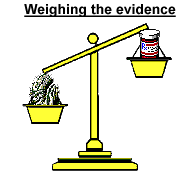 Some data suggest that cognitive enhancers do improve some
types of learning and memory, but many other data say these substances
have no effect. The strongest evidence for these substances is for the
improvement of cognitive function in people with brain injury or disease
(for example, Alzheimer's disease and traumatic brain injury). Although
"popular" books and companies that sell smart drugs will try to convince
you that these drugs work, the evidence for any significant effects of
these substances in normal people is weak. There are also important
side-effects that must be considered. Many of these substances affect
neurotransmitter systems in the central nervous system. The effects of
these chemicals on neurological function and behavior is unknown.
Moreover, the long-term safety of these substances has not been adequately
tested. Also, some substances will interact with
other substances. A substance such as the
herb ma-huang may be dangerous if a person stops taking it suddenly; it
can also cause heart attacks, stroke, and sudden death. Finally, it is
important to remember that products labeled as "natural" do not make them
"safe."
Some data suggest that cognitive enhancers do improve some
types of learning and memory, but many other data say these substances
have no effect. The strongest evidence for these substances is for the
improvement of cognitive function in people with brain injury or disease
(for example, Alzheimer's disease and traumatic brain injury). Although
"popular" books and companies that sell smart drugs will try to convince
you that these drugs work, the evidence for any significant effects of
these substances in normal people is weak. There are also important
side-effects that must be considered. Many of these substances affect
neurotransmitter systems in the central nervous system. The effects of
these chemicals on neurological function and behavior is unknown.
Moreover, the long-term safety of these substances has not been adequately
tested. Also, some substances will interact with
other substances. A substance such as the
herb ma-huang may be dangerous if a person stops taking it suddenly; it
can also cause heart attacks, stroke, and sudden death. Finally, it is
important to remember that products labeled as "natural" do not make them
"safe."
 Many of the positive effects of cognitive enhancers have been
seen in experiments using rats. For example, scientists can train rats on
a specific test, such as maze running, and then see if the "smart drug"
can improve the rats' performance. It is difficult to see how many of
these data can be applied to human learning and memory. For example, what
if the "smart drug" made the rat hungry? Wouldn't a hungry rat run faster
in the maze to receive a food reward than a non-hungry rat? Maybe the rat
did not get any "smarter" and did not have any improved memory. Perhaps
the rat ran faster simply because it was hungrier. Therefore, it was the
rat's motivation to run the maze, not its increased cognitive ability that
affected the performance. Thus, it is important to be very careful when
interpreting changes observed in these types of animal learning and memory
experiments.
Many of the positive effects of cognitive enhancers have been
seen in experiments using rats. For example, scientists can train rats on
a specific test, such as maze running, and then see if the "smart drug"
can improve the rats' performance. It is difficult to see how many of
these data can be applied to human learning and memory. For example, what
if the "smart drug" made the rat hungry? Wouldn't a hungry rat run faster
in the maze to receive a food reward than a non-hungry rat? Maybe the rat
did not get any "smarter" and did not have any improved memory. Perhaps
the rat ran faster simply because it was hungrier. Therefore, it was the
rat's motivation to run the maze, not its increased cognitive ability that
affected the performance. Thus, it is important to be very careful when
interpreting changes observed in these types of animal learning and memory
experiments.
 One symptom of Alzheimer's disease is a reduced brain level
of the neurotransmitter called acetylcholine. It is thought that
an effective treatment for Alzheimer's disease might be to increase brain
levels of acetylcholine. Another possible treatment would be to slow the
death of neurons that contain acetylcholine. Two drugs, Tacrine and
Donepezil, are both inhibitors of the enzyme (acetylcholinesterase) that
breaks down acetylcholine. These drugs are approved in the US for
treatment of Alzheimer's disease.
One symptom of Alzheimer's disease is a reduced brain level
of the neurotransmitter called acetylcholine. It is thought that
an effective treatment for Alzheimer's disease might be to increase brain
levels of acetylcholine. Another possible treatment would be to slow the
death of neurons that contain acetylcholine. Two drugs, Tacrine and
Donepezil, are both inhibitors of the enzyme (acetylcholinesterase) that
breaks down acetylcholine. These drugs are approved in the US for
treatment of Alzheimer's disease.
Moral and Ethical Questions about the Use of Smart Drugs
Here are some questions for you to think about IF and WHEN smart drugs are developed:
- What would happen if people got smarter? Is this a good thing or a bad thing?
- What are the possible advantages and disadvantages of short-term and long-term "smartness"?
- If such drugs existed, should they be manufactured, distributed and used?
- If they can be used, who should get them?
- Should they be banned like some drugs in athletics (e.g., stimulants, steroids)?
- Is going to a special school or class or getting a tutor different from taking a "smart drug"? What about learning a trick to solve a math problem? Isn't this like taking a special drug? What about getting a computer to help with homework? Isn't this like using technology to help you get smarter and learn more?
- Should it be illegal to pop a smart pill before a spelling test or before you take the SAT? Would this be like taking a stimulant before a track meet or swimming race? Would this be cheating?
- As people got smarter, would their personality change?
- What would happen to people's emotional and social behavior?
- We have drugs to improve our mood (antidepressants) and to look better (weight loss drugs). We even have a drug to increase the height of children (growth factor). What is wrong with a drug that makes us smarter?
- What about the benefits of such drugs? Couldn't these substances make people better drivers, workers and teachers?
- Could important new discoveries and cures for diseases be made faster if we were smarter?
Copyright © 1996-2020, Eric H. Chudler, University of Washington
