| Genetic Algorithms - Advanced Topics |
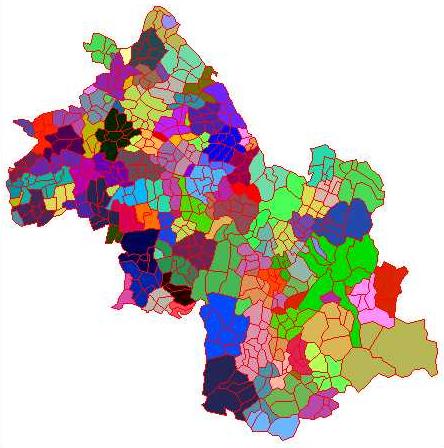
Partitioning an area into territories is an essential part of such activities as business marketing, voter district reapportionment, and resource allocation, to mention a few. In most cases, natural groupings--whether it's population centers that are close together, farms using the same water resource, or voting districts--are most desirable and the least expensive to service. Genetic algorithms can be used to group areas together based on whatever unifying criteria is identified. |
| More about Genetic Algorithms: An online book about evolutionary algorithms presents a comprehensive treatment of the topic.
The ACM (Association for Computing Machinery) SIGEVOlution (Special Interest group on Genetic and Evolutionary Computation) has made all of its issues available at its website. For articles on genetic algorithms and programming, this specialized search engine is the best. Many of the articles that are indexed by this search engine are available on-line. Further DNA explorations:
Games on the Nobel Prize website: [ 1 |
2 | 3 | 4 | 5 ].
Nobel Prizes for DNA discoveries: [ 1 | 2 | 3 | 4 | 5 | 6 | 7 | 8 | 9 ]. GAs for the programming-inclined: The Field Guide to Genetic Programmingprovides
a great deal of how-to detail that is within reach of even a
beginning programmer. It is written in very straightforward
English and is a useful book to read just to find out how genetic
algorithms work.
This is a simple introduction to programming a GA application in C, with lots of detailed explanations. More information and code examples can be found here: [ 1 | 2 | 3 ]. Pick your language, pick your environment--there's some chance it will be here. Interested in writing a GA applet in Java? Here's an article complete with source code that explains how to do it. And to top it all off, programmer Peter Bentley believes that most software development at some point in the future will be based on evolutionary algorithms. He sees this as the way to create bug-free software. |
| Home
|
Overview
|
History
|
Tutorials
|
Multimedia and
Lectures Examples and Simulations | Advanced Topics |