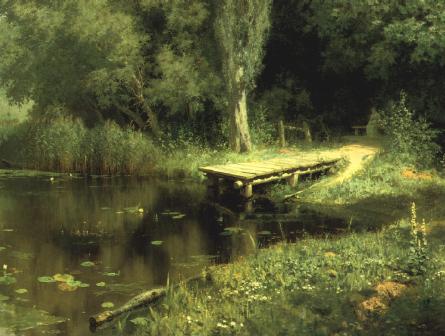
 The painting on the right is an intensive landscape composition, of a kind that was often employed during the rediscovery of the national landscape that took place in Russian painting in the latter part of the nineteenth century. To explore the features highlighted in yellow, you can click on them in the picture. Click on the bottom left corner for a full-screen enlargement. Once again water is the focus, and trees provide the framing, but several things are different:
- Instead of the majestic expanse of a large river, reflecting an open sky as it winds through a flat countryside, we see the weed-choked surface of a stagnant pond, closed off from the sky by overhanging trees.
- The human presence is barely visible: a lone woman reading, almost concealed in the shade beyond the water that occupies most of the foreground.
- The composition, anchored by a wooden jetty whose perspective recedes into the darkness of the painting's background. The lighting draws the eye up to the seated figure, but not onto her, and a well-lit but nondescript wildflower in the right foreground is more prominent than the human figure.
This type of landscape composition owes something to the Romantic taste for intimate scenes of human communion with nature, but here it is in the service of a new kind of poetic realism, linked to an intense exploration of the Russian landscape, often at its most mundane. The pond seen here was painted in 1879 by Vasilii Polenov (1844-1927), who dedicated himself to intimate portraiture of the Russian landscape after returning from a stay abroad. His vision is national in a number of respects:
-
It focuses on a corner of the estate that defies the aesthetic of the grand European landscape. On a scale of Russian country mansions extending from imitations of Versailles down to Goncharov's fictional Oblomovka, the overgrown pond is definitely closer to the latter. It was a real feature of the grounds of many Russian manor houses, foreign to the idealized projection that is more familiar from earlier estatescapes.
- There are none of the usual cultivated flowers. The closest thing is the weed in the right foreground, so plain that it hardly contrasts with the surrounding grass, but a handsome plant in its context. Russian painters often included in their paintings common wildflowers and even field weeds.
- The picture is dominated by a dense, opaque covering of trees. Even the pond, by reflecting the trees, is drawn into the prevailing dark green, which contrasts only with the lighter green of the sunlit grass and the greenish grey of the jetty. To most European painters, unrelieved, impenetrable forest lacked interest as a landscape. To their Russian counterparts it was an imposing feature of the the national landscape.
- The wooden jetty, built out of logs, is old, mossy and weathered. Neglected wooden structures are another detail that caught the imagination of late nineteenth-century painters and joined the visual vocabulary of the essential Russian scene.