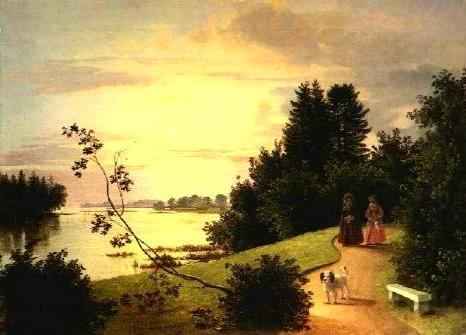
The painting on the left is an extensive landscape composition, rooted in the eighteenth-century European tradition, but with some features that reflect Romantic landscape conventions, and other features that are characteristically Russian. Both composition and lighting invite the viewer to look out of the picture and beyond it, across an expanse of water to a sky that occupies a large proportion of the pictorial space. The water is framed by land in the foreground, by trees with reflections on the left, and by a distant line of trees and an even more distant view of a city at the point where water, sky and city blend in aerial perspective. The surface of the water reflects both trees and sky, mingling heaven and earth in pictorial metaphor. In the foreground the human presence, and the human scale, are provided by a pair of figures and their dog, strolling on a neatly trimmed path. Also in the foreground, there is an irregular, isolated sapling reaching up from land to sky. To explore the features highlighted in yellow, find them in the picture and click on them. A click on the bench gives a full-screen enlargement.
This painting combines several different properties:
- It is local in the sense that it is a view of a particular place outside St. Petersburg: the park on Elagin Island designed by Bouchard for the Empress Maria Fedorovna. It was painted in 1839 by Ivan Khrutsky, the son of a Uniate priest from Belarus who, unlike most Russian artists of the gentry class, never had the opportunity to travel and study in Europe.
- It is international in two respects:
- The reality depicted here is a typically European aristocratic estate created to order on the banks of the Neva.
- The painting follows the widespread convention of the European celebratory estatescape. This was essentially a genre painting involving people (always well-dressed, and usually the proprietors) in an extensively viewed park setting, very often with their favorite dogs or horses.
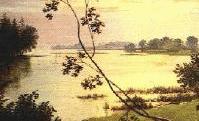
- At the same time it is national in that it brings together a cluster of natural features that came to be used by nineteenth-century Russian painters as emblematic of Russia: a large river, in a flat landscape, dominated by the sky, a dense stand of forest reflected in the water, and a distant view of some place of human habitation. Any of these features can be found in the landscapes of any country in Europe: their relative scale and the way they are combined are where a distinct national culture may show.
- The composition is a European landscape cliché developed in response to neo-Classical thinking about the relationship between humankind and nature, but later modified to reflect characteristically Romantic thinking: the well-kempt park bespeaks the taming of nature for human amenity and aesthetic pleasure, while the dominant skyscape and the devices that draw the eye into it bespeak the human striving for something that lies beyond the here and now. All these devices, and especially the flimsy but upward-striving branch, are frequently found in Romantic landscapes, both Russian and European. In the Russian tradition it is usual to ascribe to them a religious or philosophical agenda.