What makes a landscape painting "national", in the sense of being unmistakably characteristic of the culture to which it belongs?
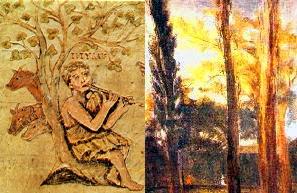
Contrary to popular wisdom, location isn't everything. Landscape paintings do a great deal more than just picture an aesthetically pleasing locality in the artist's native land:
- To represent the physical features of a landscape, there needs to be a set of pictorial conventions that are shared to a reasonable degree by artist and viewer. For example, no artist has ever rendered a whole tree by depicting every single one of its leaves: the viewer learns either to regard a depiction of a few entire leaves as a reduced symbol of the whole tree, or to read nothing more than smudges of paint as an impression of a mass of foliage. Click on the pair of images in the top right corner to explore the conventional depiction of foliage in more detail.
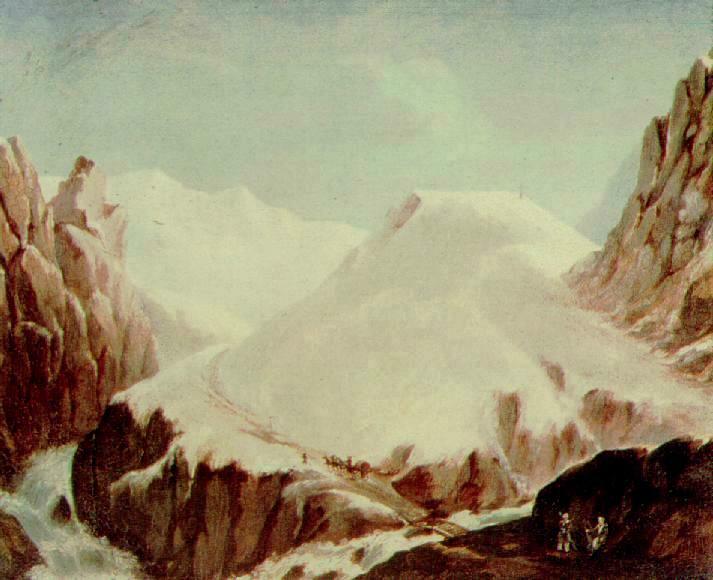 To make the landscape a work of art, some particular physical elements need to be selected and arranged into a composition, which supposes in its turn a particular way of seeing and understanding the natural world. On the right is a painting of a mountain scene in the Caucasus by the Russian poet Mikhail Lermontov. Its composition is a metaphorical expression of the Romantic state of mind: towering crags aspire heavenwards while raging rivers plunge downwards in their ravines, and on a perilous road that slants across the scene a group of travelers, dwarfed by the landscape, toils over a precarious-looking bridge and up a snow-covered slope. Put the cursor on the picture to diagram the composition.
Pictorial composition is best understood by analogy with language. In fact, it is a language phenomenon in the general sense: visual communication, like verbal, develops vocabulary, grammar and idioms. In this context, the "nationality" of a landscape can be suprisingly difficult to define, for a number of reasons:
- The "language" - the conventions of landscape depiction in a given age - generally holds over an area wider than a single nation. In eighteenth century Europe, for example, including Russia from shortly after its Westernization under Peter I, a basic repertoire of techniques for the depiction of landscape features was widely shared.
- A great deal of the "content" is also shared, in the form of a repertoire of idealized landscapes embodying religious, philosophical and literary visions. The painting by Lermontov above is an example: it reflects the philosophy common to Romantic writers and painters, and it matches closely a scene described in Lord Byron's The Giaour.
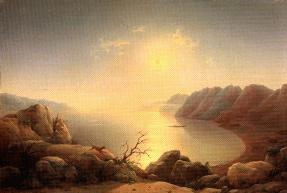
- Some geographical locations have become fashionable at various times with European painters and their public, most notably Italy, the Alps and the Biblical lands, which artists of many nationalities visited and painted in the nineteenth century. At the right is the Dead Sea painted in 1850 by a Russian, Grigorii Chernetsov.
- These conventions and fashions superimposed themselves to some degree on landscape painting throughout Europe.
 As a result, a painting that is clearly of an Italian locality might be the work of a Russian artist, but a Russian painting that appears to depict an Italian, Dutch or English scene might actually portray a locality in Russia. Click on the picture at the left to see two examples.
Even though in the modern period the visual language of European landscape depiction was common property, both individual and national visions of landscape reveal themselves in the handling of details, and it is often possible to detect a national idiom in a landscape painting that at first looks conventionally pan-European in style. The following pages present three Russian examples. Two depict the grounds of country houses, but are very different in kind, and the third portrays the open country in a way that blends the characteristics of the first two. Many of their details have a special significance deriving from their associations in the Russian context, and you can explore these associations by clicking on the relevant details in the pictures.