
Combining the equations
These equations

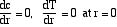

can be reduced to a single equation in the following steps. We multiply the first equation by b and add it to the second, giving

Integrate this once to obtain

The boundary conditions ar r = 0 make both derivatives zero so that the constant is zero. We integrate once more to give

and evaluate at r = 1.

We also have from Eq. (4) evaluated ar r = 1

Multiply the first boundary condition (3) by b and add it to the second boundary condition.

The left-hand side according to Eq. (6) is zero, so that we get

with

Now the constant K2 can be evaluated solely in terms of c(1).

The temperature is then given by

The original problem can be rewritten as

If the reaction is n-th order and irreversible, the reaction rate expression is
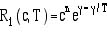
Then

where T(r) is given by Eq. (8).
One special case is important, namely when the Biot numbers for heat and mass transfer become large. Then the boundary conditions are simply

and the relation between temperature and concentration is

Eq. (9) also holds when d = 1 or Bi = Bim.
Before solving these equations, consider their implications. If the reaction is external mass transfer-limited (i.e. small Bim) the concentration change occurs primarily from the bulk stream value (here one in nondimensional form) to the value on the surface of the pellet c(1). If the reaction is irreversible and very fast, the concentration on the surface of the pellet is very small. Letting c(1) -> 1 in Eq. (7) gives

Also, c(0) = 0 if c(1) = 0. Thus, the maximum temperature rise is 1 + bd and the pellet temperature is constant. If the reaction is very slow, however, then c(r) is very close to the bulk-stream value. This case is isothermal and can also be brought about by having a small heat of reaction b.
Continue on to: Effectiveness Factor, Linear Problem, Nonlinear Problem.
Back up: Formulation, Non-dimensional problem