Research |
|
 |
Pi-Conjugated semiconducting polymers are actively under development for use in organic light-emitting diodes, thin-film transistors, and solar cells. However, the understanding of their performance in many applications is limited because of the difficulty in establishing detailed structure-property relationships, which arises from the disconnect in our understanding of microstructure development. The lack of a unified understanding in microstructure formation, in turn, partly comes from our inability to precisely control defects in pi-conjugated semiconducting polymers. Additionally, due to our limitations in controlling the synthesis of these polymers, the majority of studies related to these classes of materials have focused on linear polymers with broad molecular weight distributions. While it is widely recognized that, for traditional insulating coiled polymers, the topology and architecture of the polymers will greatly affect their properties, a detailed structure-property relationship for how the topology of rigid rod polymers such as pi-conjugated semiconducting polymers affects the microstructure and thus their optoelectronic properties has remained limited. With these factors in mind, the primary goal in our group has focused on the development of controlled polymerizations to synthesize precise polymeric structures and hybrid materials, to enable us to perform structure-property relationships that have not been possible to date. For most up-to-date information about our research, please visit our publications page. Please refer to the Clean Energy Intitute (CEI) website for University wide energy-related initiatives. The Luscombe group is also a member for the NSF Center for Stereoselective CH Functionalization and the Molecular Engineering and Sciences Institute. Below is our 2016 Group Poster. 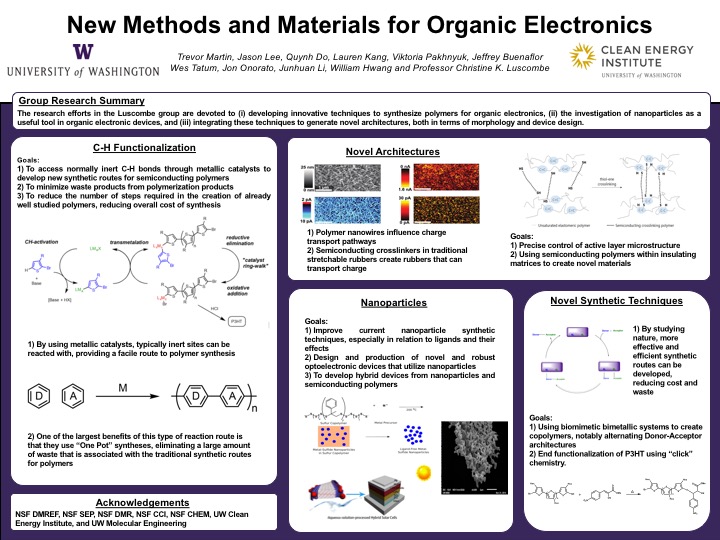 |
||
Copyright ©
C. K. Luscombe |
Last Updated
6/29/16
|
|
| | |