Molecular Analysis of the Evolution and Development of the Chordates
My research is focused on a complex, interdisciplinary biological question. When and how did chordates evolve? If you are reading this, you are a chordate. You are a special chordate, a vertebrate, and likely a member of the species Homo sapiens. You have a central nervous system on your dorsal (back) side and your internal organs are arranged on the front (ventral) side. You have sensory organs primarily located in your anterior (head) region – eyes, ears, nose, and tongue. 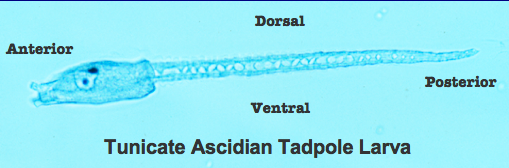 You share this unique body plan with all other vertebrates and a couple of invertebrates – tunicate tadpoles, and lancelets. I study the genes and genomes of these invertebrate chordates to gain insight into our invertebrate ancestors. What did they look like? What did they eat? How did they live?
My research suggests that our earliest ancestors were worms, living in the mud and eating plankton and detritus. These worms also filtered water for plankton and probably also for oxygen. The closest living representatives of these ancestors are hemichordates, marine worms that are related to the better known echinoderms, such as sea stars and sea urchins. Echinoderms and hemichordate worms have similar embryonic development and become ciliated larvae, which float and feed in the plankton. However, after metamorphosis, echinoderms have a hard, spiny endoskeleton and are bottom dwellers, while the soft-bodied hemichordates burrow into the marine sand or mud. My research compares the genes and genomes of these invertebrates, which are related to us. We look at similarities as a way of telling which groups are related to the other groups, and examine the expression of homologous genes in order to see how genes may be used in a similar way, or co-opted for different functions. These questions do have relevance for human health and development because echinoderms and hemichordates are able to do remarkable adult regeneration.
Our collective goal is to understand the evolution of the chordate body plan, a complex problem that requires interdisciplinary research. We combine methods and approaches in phylogenetics, development, ecology and evolution to study the evolution of this unique body plan from a deuterostome ancestor. We believe that the deuterostome ancestor was a burrowing worm, with gill slits and a cartilaginous skeleton (Swalla and Smith, 2008).
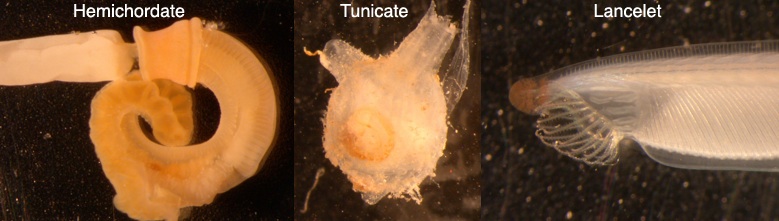
The major project in my laboratory is aimed at understanding the evolution of chordates. One part of this project is to figure out the phylogeny of tunicates (urochordates) and hemichordates in order to understand phylogenetic relationships of the different families in these groups. Because the phylogenetic analysis suggests that enteropneust worms may be basal hemichordates, we are studying the development of direct developing saccoglossid hemichordates and also ptychoderid worms that have a larvae similar to echinoderm larvae. We first focused on the gill slits and cartilage of the gill bars in hemichordates and cephalochordates and found that the gill slits between hemichordates and chordates are homologous, but the cartilage gill bars are not (Rychel and Swalla, 2007). We are now looking at anterior structures, including the stomochord, central nervous system, and heart-kidney complex in an effort to understand possible homologies with either chordates or echinoderms.
The second major research project is aimed at understanding the phylogeny and evolutionary diversity of hemichordates, in collaboration with Dr. Ken Halanych at Auburn University. We are specifically interested in the evolution of the nervous system and the anterior structures and how they vary morphologically between the different families of hemichordates. We are comparing solitary and colonial hemichordates to see how gene expression changes influences adult morphology. This project has just been funded by NSF.
Finally, our third major research project to study the evolution of coloniality in ascidians. We have identified a clade of stolidobranch ascidians that contains species with solitary, social and colonial lifestyles (Zeng et al. 2006). We are looking at the molecular basis of coloniality by examining genes that are turned on during metamorphosis, especially in germ cells and somatic stem cells. One set of genes that is activated at metamorphosis are the innate immunity genes. The innate immune system appears to be critical for remodeling the body plan during metamorphosis. We are also examining the role of stem cells and cell division in bud formation in colonial larvae. Collectively, this research may allow insight into the amazing regenerative powers of colonial ascidians.