Identifying Horizons of Soil Profiles

Select a box below if you wish to try a soil profile different from soil profile No. 2:

Profile 1

Profile 3

Profile 4

Profile 5


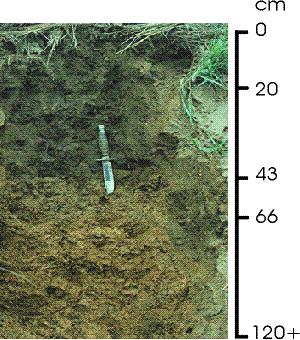
Soil Profile No. 2. Found in southeastern Washington; deep, well drained soils formed in layered loess. Widely used for agriculture. Slopes are 2 to 40%. Average annual precipitation is 50 cm and mean annual temperature is 9 degrees centigrade. Colors are for moist soil.

Profile Description

  1. 0-20 cm; very dark brown (10YR2/2) silt loam; weak thick platy breaking to granular structure; slightly hard, friable, slightly sticky, slightly plastic, many roots; pH=6.6; abrupt smooth boundary
  2. 20-43 cm; very dark brown (10YR2/2) silt loam; weak coarse prismatic structure; hard, friable, slightly sticky, slightly plastic; many roots; pH=6.4; clear wavy boundary
  3. 43-66 cm; dark brown (10YR4/3) silt loam; moderate fine prismatic structure; hard, firm, sticky and plastic; many roots; few, thin clay films present; pH=6.6; gradual wavy boundary
  4. 66-120+ cm; dark brown (10YR4/3); silty clay loam; prismatic; very hard, very firm, very sticky, very plastic; common roots; thin clay films present; pH=6.8

Choose the correct master and subordinate horizon designations for each horizon from the options below, then click on 'answer' to check your determination.

Horizon No. 1: A O< Oa Ap
Horizon No. 2: Oa2 Oe 2A A
Horizon No. 3: A2 AB BA Bw
Horizon No. 4: Bw2 Bt Bt1 Bs

Can you determine the Order, Suborder or Great Group of this soil?

Order:

Order and Suborder:

Order, Suborder and Great Group:

Try another?

Profile 1

Profile 3

Profile 4

Profile 5