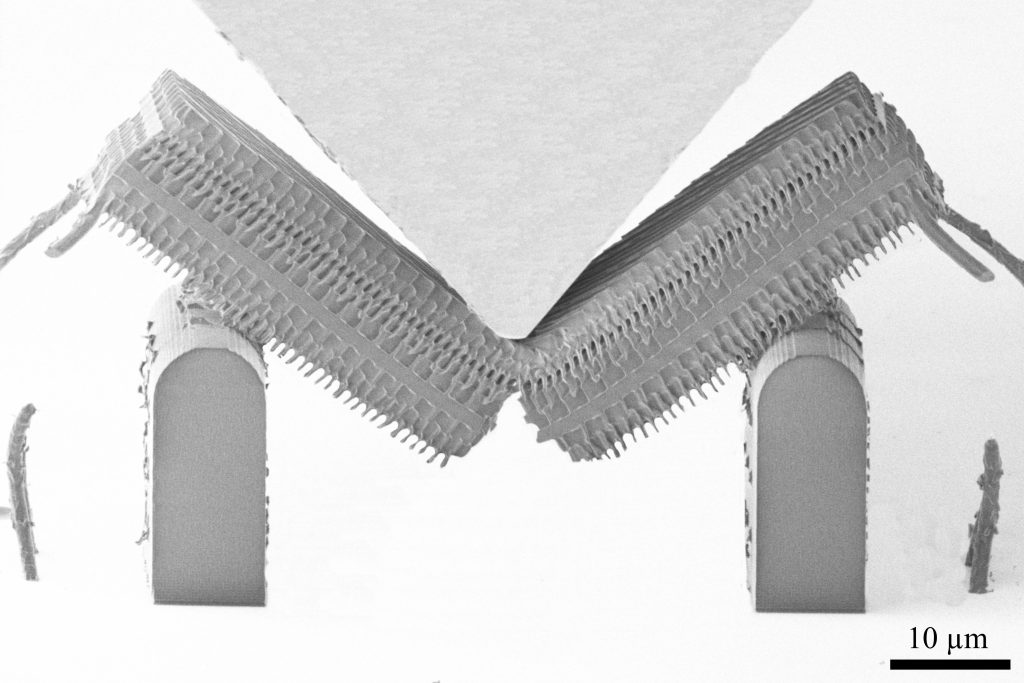
Creating Tough, Sustainable Materials Using Fracture Size-Effects and Architecture
Team Members: Abdulaziz Alrashed, Kush Dwivedi, Bassam Khan, Michael Richeson, Andrew Gladnick
Past Members: Zainab Patel
Collaboration Partners: Eleftheria Roumeli
Funding Agency: NSF
Related Publications: Toughness Amplification via Controlled Nanostructure in Lightweight Nano-Bouligand Materials, Rethinking ductility—A study into the size-affected fracture of additively manufactured polymers
Primary Goal: Uncover the relationship between toughness and nanostructure. Develop architectures that use nanomaterials with size-enhanced properties to improve their toughness.
Broader Impacts: This work creates fundamental knowledge into how materials break starting at the nanoscale. The aim is to design tougher materials from sustainable sources, much like those already found in nature.
Nanoscale Fracture Toughness of Interpenetrating Lattices (IPL)
Team Members: Abdulaziz Alrashed, Kush Dwivedi
Past Members: Zainab Patel
Collaboration Partners: Ben White, Bryan Kern
Funding Agency: Sandia CINT User Facility Grant
Related Publications: Toughness by Design: Multi-Scale Interpenetrating Lattices with Size-Enhanced Fracture Resistance
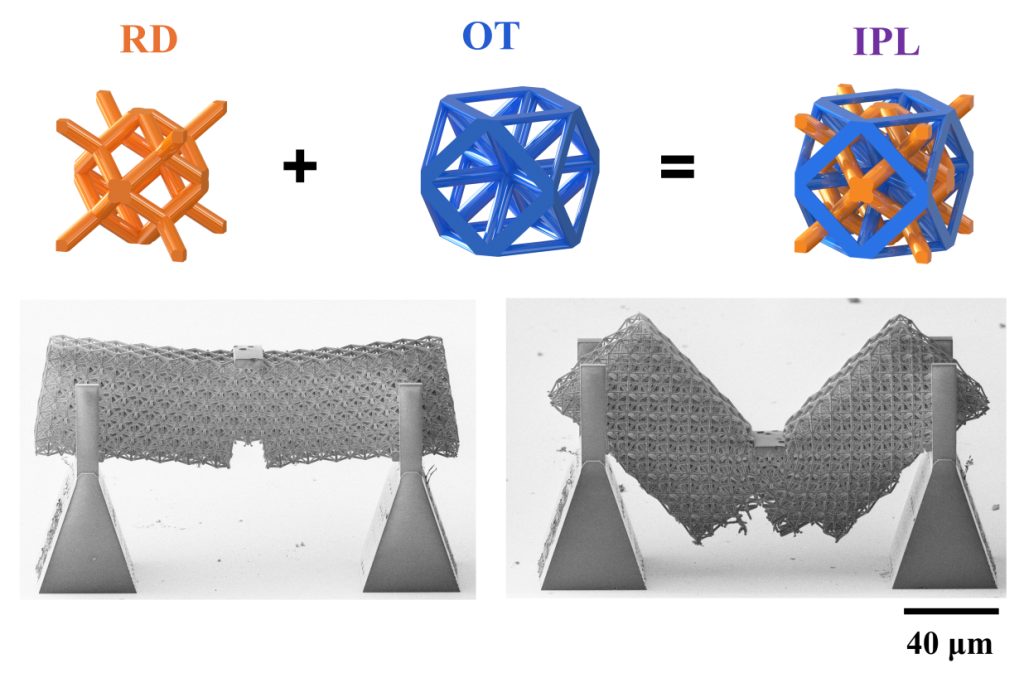
Project Description: Exploring the influence of lattice architecture and nano size effect on material fracture toughness. The goal is to capitalize on engineered lattice designs to minimize weight (70% reduction or 30% relative density) while enhancing the material toughness response. Single lattices have shown to demonstrate a deteriorating behavior as relative density is reduced. To overcome such phenomenon, two separate inter-penetrating lattices (IPL) that don’t contact yet occupy the same volume are used, consisting of a Rhombic Dodecahedron (RD) lattice and a Face-centered cubic (FCC) lattice. Further enhancement can be achieved when coupled with the micro- and nano-scale size effect.