Chapter 4
Two-Dimensional Problems
In two-dimensional problems,
displacement, strain, and stress components of interest, all lie in a plane.
Taking that plane as the (x, y) plane, the variables of interest are functions
of x and y only, and consists of:
Displacements: u, v
Strains:
ex,
ey, gxy
Stresses: sx,
sy, txy
The other variables are not necessarily zero, but
are determined in terms of the variables above. Two types of
two-dimensional problems seen earlier, Plane Stress and Plane Strain, are
discussed in what follows for linearly elastic isotropic materials.
1. Plane Stress or
Stretching of Plates
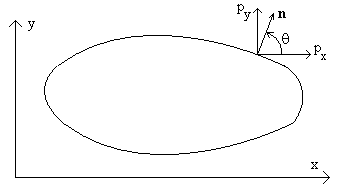 The figure shows the middle
plane of a plate , bounded by a curve of arbitrary shape, and typical tractions
px and py at a point of the boundary. The plate
has a thickness t in the z direction, assumed to be small compared with the
linear dimensions in the (x, y) plane. The faces of the plate are stress-
free. A state of plane stress is one in which the
loading is in the (x, y) plane, and is uniform in the z direction. Body
force components Fx and Fy, functions of x and y only, may
act, but Fz and pz are zero. Since the faces of the
plate are stress free, it is reasonable to assume, subject to verification,
that sz , tzx,
and tzy are zero throughout the
plate, and thus also gzx, and
gzy. From the stress-strain
relations ez is not zero, because of
Poisson's ration, but is determined in terms of ex
and ey.
The figure shows the middle
plane of a plate , bounded by a curve of arbitrary shape, and typical tractions
px and py at a point of the boundary. The plate
has a thickness t in the z direction, assumed to be small compared with the
linear dimensions in the (x, y) plane. The faces of the plate are stress-
free. A state of plane stress is one in which the
loading is in the (x, y) plane, and is uniform in the z direction. Body
force components Fx and Fy, functions of x and y only, may
act, but Fz and pz are zero. Since the faces of the
plate are stress free, it is reasonable to assume, subject to verification,
that sz , tzx,
and tzy are zero throughout the
plate, and thus also gzx, and
gzy. From the stress-strain
relations ez is not zero, because of
Poisson's ration, but is determined in terms of ex
and ey.
If one checks whether the six
strain compatibility equations can be satisfied by the preceding assumptions, it
turns out that some stress variation in the z direction, symmetric about the (x,
y) plane, is required. However, for a thin plate, a small variation
in that direction can be neglected, and the stresses may be considered constant
along the thickness.
An
example
of a state of plane stress was given in the chapter 'Analysis of Stress'.
The governing equations of plane stress were
presented in Chapter 3, and are re-written below.
Equilibrium
sx,x
+ tyx, y + Fx
= 0
(1)
txy,x
+ sy,y + Fy
= 0
Strain-Displacement Relations -
Compatibility
ex
= u,x
ey
= v,y
(2)
gxy
= u,y + v,x
Elimination of the displacements from the above
equations yields the compatibility equation
ex,yy
- gxy,xy +
ey,xx = 0
(3)
Stress-Strain Relations
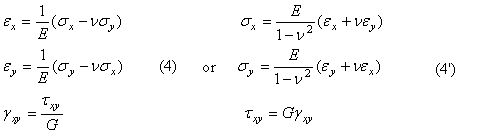
Auxiliary Equation
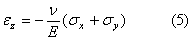
ez
is obtained from the condition sz
= 0 as
Boundary conditions
Typical boundary conditions are of stress type or
of displacement type. In a condition of stress type, a traction is
prescribed on a boundary segment, and in a condition of displacement type, a
displacement component is prescribed on a boundary segment. For a well
defined problem, two conditions are needed at each boundary point, one for each
of two directions at that point. These can be the (x, y) directions,
or the normal and tangential directions to the boundary. Conditions
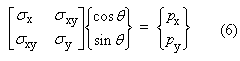
prescribing tractions px and py have the form
2. Plane
Strain
A state of plane strain is one in
which w = 0, and u and v are functions of x and y only. A typical
illustration is that of a long prismatic body of arbitrary cross sectional
shape, whose length is in the z direction, and whose loading on the longitudinal
boundary and in the domain does not vary with z, and has zero z-components.
A gravity dam would fit such a description. Assume further that the end
cross sections have smooth contact with planar support planes, so that w,
tzx, and tzy
are zero at the end cross-sections. It is reasonable to assume, subject to
verification, that w, tzx, and
tzy are zero throughout the plate, and
thus also gzx, and
gzy. Since w = 0, ez
= w,z = 0. From the stress-strain relations,
sz is not zero, because of Poisson's ration, but is determined
in terms of sx and sy.
The preceding assumptions turn out to be fully consistent with the
three-dimensional governing equations.
For a structure such as a gravity
dam, actual boundary conditions at the end cross sections do not fit the plane
strain assumptions. However, by St-Venant's principle, a state of plane
strain exits away from the ends.
The variables of the governing
equations of plane strain are the same as those of plane stress. The
equilibrium and the strain-displacement relations are also the same. The
stress-strain relations are different, however. In plane strain,
ez = 0, whereas in plane stress,
sz = 0. With ez
= 0, sz is obtained form the stress-strain
relations as
sz
= n(sx
+ sy)
(1)
and the stress-strain relations
take the form
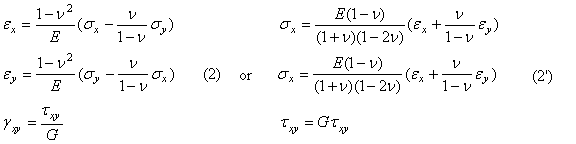
Eqs. ( 2) and (2') may be obtained from those of
plane stress by substituting in the latter
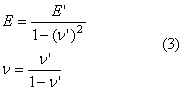
then renaming E' and
n', E and n respectively.
3. Stress
Method
The stress method determines the stresses first.
Its governing equations consist of the two equilibrium equations and of the
compatibility equation expressed in terms of the stresses, which form a system
of three differential equations in three unknown stresses. The
compatibility equation expressed in terms of the stresses by means of the
stress-strain relations will be referred to as the stress compatibility
equation. The equation may be simplified with use of the equilibrium
equations to yield, in the case of plane stress,

If the body force is zero, the equation reduces
to

Functions that satisfy Eq. (2) are called
harmonic. Since the elastic constants do not appear in the equation, it is
applicable to both plane stress and plane strain.
A general approach to the stress method known as
the Airy stress function method is presented in Sec. 5. In this section,
inverse and semi-inverse approaches are used to solve simple but fundamental
problems, some of which will be used both to justify and to shed some light on
the limitations of engineering beam theory.
Exercise 3.1
Obtain Eq. (1) by following the procedure
described above.
Hint: Group and adjust terms in the
compatibility equation to obtain the terms in Eq. (1), then look in the
remaining terms for expressions that are derivatives of the left hand sides of
the equilibrium equations, and replace such expressions in terms of the body
force components.
Solution by the Inverse and Semi-Inverse
Approaches
The inverse approach consists in guessing the
solution, based on insight or previous experience, and to check whether that
guess satisfies the governing equations. If some equation is violated, an
improved guess may be tried. The semi-inverse approach consists in making
a partial guess, and trying to use the governing equations to solve for the
remaining unknowns.
 Example
1 - Wall Subjected to its Weight
Example
1 - Wall Subjected to its Weight
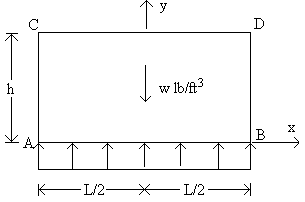
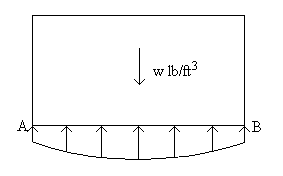
A rectangular wall ABCD is in equilibrium under
its weight w lb/ft3, and a uniform reaction along its bottom edge as
shown. Determine the stresses.
The body force components are
Fx = 0
Fy = -w
On the bottom edge, the uniform traction balances
the weight of the plate, and is thus equal to
py = wh
A solution by an inverse method is attempted,
based on the assumption that any vertical wall strip is in a uniaxial state of
stress. Thus at any level y, sy
balances the weight of what's above, as is the case at the bottom edge.
There is no apparent need for sx and
txy. We thus assume, subject to
verification, that
sy = -w(h -
y)
sx = 0
txy = 0
We may verify that these stresses satisfy the
boundary conditions and the equilibrium equations (Sec. 2, 1). By
inspection they also satisfy the compatibility equation (Sec. 4, 1). The
proposed solution is thus the exact solution for the stresses.
Determination of the displacements in the next section will shed additional
light on this problem.
Example 2 -
Thin Plate Acting as a Cantilever Beam
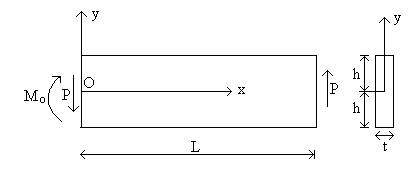 The
figure shows a rectangular plate of thickness t, subjected to the load P at x =
L, and to balancing reactions P and Mo = PL at x = 0. These are
relaxed
boundary conditions on the edges, x = 0 and x = L. On the top and
bottom edges the boundary conditions are sy
= 0 and tyx = 0.
The
figure shows a rectangular plate of thickness t, subjected to the load P at x =
L, and to balancing reactions P and Mo = PL at x = 0. These are
relaxed
boundary conditions on the edges, x = 0 and x = L. On the top and
bottom edges the boundary conditions are sy
= 0 and tyx = 0.
A semi- inverse method of solution is attempted
based on the normal stresses of engineering beam theory. Considering the
plate as a beam spanning in the x direction, the bending moment is
M = P(L - x)
Letting I be the moment of inertia, we have
I = 2th3/3
and the normal stresses of engineering beam
theory are
sx = -My/I
= -(P/I)(L - x)y
sy = 0
It is verified that (sx
+ sy) satisfies the compatibility
equation, Eq. (2). There remains to determine txy,
and to satisfy the equilibrium equations and the boundary conditions.
The equilibrium equations yield
sx, x
+ tyx,y = (P/I)y +
tyx,y = 0
txy,x
+ sy,y =
txy,x = 0
From the last equation, txy
is independent of x, and from the preceding equation
tyx =
∫-(P/I)ydy = -(P/2I)y2 + C
The boundary conditions,
tyx = 0 at y = h and y = -h, yield
C = (P/2I)h2
To summarize, the proposed solution for the
stresses is
sx = -My/I
= -(P/I)(L - x)y
tyx =
(P/2I)(h2 - y2)
sy = 0
sy
and tyx satisfy the boundary conditions at
the top and bottom edges, sy = 0 and
tyx = 0. There remains to check
whether the relaxed boundary conditions at x = 0, and x = L are satisfied.
Since the stresses are the same as in engineering beam theory, it may be
concluded that they do satisfy the relaxed boundary condition.
For a direct check of the relaxed boundary
conditions, the stress resultants are evaluated in what follows at a general
cross-section, which can be specialized to the ends x = 0, and x = L. We
have,
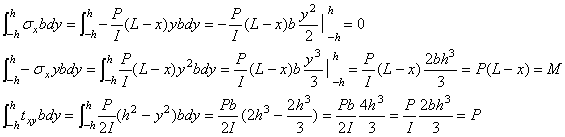
The first equation is the condition of zero axial
force, the second equation verifies that the resultant moment over a cross
section is the computed bending moment, and the last equation verifies that the
resultant shear over a cross section is P.
It is concluded that the stresses of engineering
beam theory in this example form an exact elasticity solution, provided we adopt
relaxed boundary conditions at the ends. The displacements are obtained in
a later example, where it will be seen that they differ in certain respects from
those of engineering beam theory.
Example
3 - Thin Plate Acting as a Simple Beam
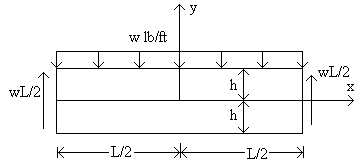 The
problem shown in the figure consists of a rectangular plate of thickness t,
subjected on its upper edge to a uniform load w lb/ft, and at the left and right
edges to balancing forces wL/2. The boundary conditions are:
The
problem shown in the figure consists of a rectangular plate of thickness t,
subjected on its upper edge to a uniform load w lb/ft, and at the left and right
edges to balancing forces wL/2. The boundary conditions are:
At y = h, sy
= -w/t, tyx = 0
At y = -h, sy
= 0, tyx = 0
At x = L/2 and x = -L/2, we adopt the relaxed
boundary conditions
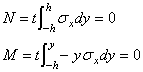
There are also two conditions expressing that the
resultant of the shear stress at each end acts upward and is equal to wL/2 .
These conditions will automatically be satisfied however, once the conditions M
= 0 at the ends are satisfied, and the differential equilibrium equations are
satisfied in the domain.
We will apply again a semi-inverse approach,
using the stresses of engineering beam theory. The shear force and bending
moment are found as
V = wx
M = w(L2/8 - x2/2)
and the stresses according to beam theory are
(sx)b
= -My/I = - (w/2I)(L2/4 - x2)y
(txy)b
= VQ/tI = (w/2I)x(h2 - y2)
where subscript b refers to beam theory, and
I = 2th3/3
It is readily verified that the stresses above
satisfy the first differential equation of equilibrium, and the boundary
conditions at the ends of the plate. The shear stress also satisfies its
boundary conditions at the top and lower edges. Since
sy is ignored in beam theory, we can obtain it by means of the
second differential equilibrium equation, from which
sy,y
= -txy,x = -(w/2I)(h2
- y2)
Integrating with respect to y yields
sy =
-(w/2I)(h2y - y3/3 + C)
where C is an arbitrary function of x, which will
turn out to be a constant. The condition, sy
= 0 at y = -h, yields
C = 2h3/3
and
sy =
-(w/6I)(3h2y - y3 + 2h3)
At y = h,
sy =
-(w/6I)(3h3 - h3 + 2h3) = -2h3w/3I =
-w/t
The sy
condition at the top edge is thus satisfied.
Except for the compatibility equation, which
remains to be checked, all governing equations and boundary conditions are
satisfied. The compatibility equation yields
(sx +
sy),xx + (sx
+ sy),yy = (w/I)(y + y) = 2wy/I
The stresses are thus not compatible, and need to
be modified.
To satisfy the compatibility equation, let us
superimpose on the preceding solution a stress (sx)'
such that
(sx)',xx
+ (sx)',yy = - 2wy/I
while continuing to satisfy the equilibrium
equations and the relaxed boundary conditions. We can do that by choosing
(sx)' as a function of y only. Thus
(sx)',yy
= - 2wy/I
Integrating twice yields
(sx)' = -
(w/I)(y3/3 + Cy + D)
The relaxed boundary conditions at the ends,
which are satisfied by (sx)b
must also be satisfied by (sx)'. It
is found that the condition N = 0 yields D = 0, and the condition M = 0 yields C
= -h2/5.
The final solution is thus
sx = -
(w/2I)(L2/4 - x2)y - (w/I)(y3/3 - h2y/5)
sy =
-(w/6I)(3h2y - y3 + 2h3)
txy =
(w/2I)x(h2 - y2)
Actual support conditions cannot provide the
stress distributions at the ends that are required by the solution. By St
Venant's principle, however, the solution becomes valid away from the
ends, at distances comparable to the depth. The maximum correction to
sx is of the order (h2/L2)
compared to the engineering theory value, and is thus negligible except for deep
beams.
 Exercise 3.1
1. Find out whether the stress field
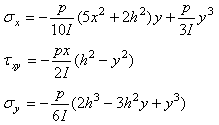
where

is a valid solution of the plane stress problem shown in the
figure.
2. How does this solution differ from that of engineering beam
theory?
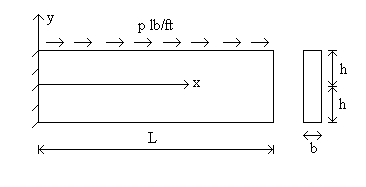 Exercise
3.2
Exercise
3.2
Apply the semi-inverse method to determine the stresses in the
plane stress problem shown. Assume relaxed boundary conditions at x = 0,
and x = L.
Hint: Obtain the axial force N and bending moment M on a
general section, as functions of x, and start with the normal stress
sx of engineering beam theory.
Exercise 3.3
The problem of Exercise 3.1 may be formulated as the
superposition of the problems of Examples 2 and 3. Obtain the solution on
that basis. Note that the solutions of examples 2 and 3 need to be
represented in the same axes of reference before superposition can be made.
 Exercise
3.4
Exercise
3.4
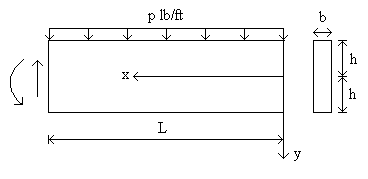
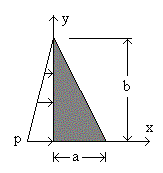
Use a semi-inverse method to determine the stresses in the
plane stress problem shown. The pressure p is defined per unit area.
Assume relaxed boundary conditions at the bottom boundary.
Hint: Assume sy to be
linear in x, so it is obtainable by a beam flexure formula on a section y =
constant.
4.
Determining the Displacements in the Stress Method
Having determined the stresses, the strains are
determined using the stress-strain relations, and the displacements are obtained
by integration of the strain-displacement relations. The integration is
possible, because one of the governing equations insures that the strains are
compatible. Since there are no support conditions in the stress method,
the solution for the displacements contains an arbitrary rigid body
displacement. Recall, however, that the linear theory is
limited to small rotations. An example of determining displacements from
strains may be seen in Chapter 2, Sec. 7, Example 2. The displacements of
two preceding examples are determined in what follows.
Example 1. (Sec. 3, Example
1)
The displacements for Example 1, Sec. 3,
are determined in what follows. Substituting the solution for the stresses
into the strain-displacement-stress relations yields
u,x = -nsy/E
= nw(h-y)/E
v,y = sy/E
= -w(h-y)/E
u,y + v,x =
txy/G = 0
Integrating the first two equations yields
u = nwx(h-y)/E + f(y)
v = -w(hy-y2/2)/E + g(x)
Substituting into the third equation, and putting
all terms on one side, yields
f '(y) + g '(x) - nwx/E
= 0
The left hand side of this equation is a sum of a
function of y and a function of x, which must be zero for all x and y. For
this to be possible the two functions must be constant and add up to zero. Thus
g '(x) - nwx/E
= c
f '(y) = -c
then
g(x) = nwx2/2E
+ cx + b
f(y) = - cy + a
and
u = nwx(h-y)/E - cy +
a
v = -w(hy-y2/2)/E +
nwx2/2E + cx + b
 where
a, b, and c are integration constants representing a rigid body displacement. a
and b are translations in the x and y directions, respectively, and c is a
rotation about the origin.
where
a, b, and c are integration constants representing a rigid body displacement. a
and b are translations in the x and y directions, respectively, and c is a
rotation about the origin.
Any support conditions against rigid body
displacements, without over-constraining the body, can be prescribed without
changing the solution for the stresses. We can for example set the
displacements of the mid-point of AB to zero, and set the rotation of the
horizontal fiber at that point to zero.
Thus, at (x = 0, y = 0),
u = a = 0
v = b = 0
 v,x
= c = 0
v,x
= c = 0
The displacements reduce to
u = nwx(h - y)/E
v = w(y2 - 2hy + nx2)/2E
It is seen that if n
is not zero, material lines, y = constant, have a vertical displacement that
varies as x2, and a horizontal displacement linear in x. Such
lines deform into parabolas. Vertical lines also deform as parabolas. The
deformed horizontal and vertical lines remain orthogonal, since the shear strain
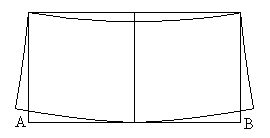
is zero in the domain. The deformed shape of the wall is shown in the
figure, which shows that if the wall is supported along AB, a uniform reaction
is impossible since it implies lifting of the wall edge, and this in turn is
inconsistent with the support exerting a reaction. The proper formulation
of support conditions along edge AB is to prescribe v = 0 on that edge instead
of a uniform reaction. The solution of the problem becomes more
complicated, and may need to be found by numerical methods. Qualitatively,
in order to maintain contact with a rigid support along AB, we need to
superimpose on the previous problem a new one in which the traction along AB
tends to straighten the edge while having a zero resultant. The resulting
reaction would decrease near A and B, and would increase near the center, and
would look as shown in the figure.
Example
2. (Sec. 3, Example 2.)
To determine the displacements for the present
example, we substitute the solution for the stresses of Sec. 3, Example 2, into
the strain-displacement-stress relations. This yields
u,x = sx/E
= -(P/EI)(L - x)y
v,y = -nsx/E
= (nP/EI)(L - x)y
u,y + v,x =
txy/G= (P/2GI)(h2 - y2)
Integrating the first two equations yields
u = -(P/EI)(Lx - x2/2)y + f(y)
v = (nP/EI)(L - x)y2/2
+ g(x)
Substituting into the third equation, and putting
all terms on one side, yields
-(P/EI)(Lx - x2/2) + f '(y) - (nP/EI)y2/2
+ g '(x) - (P/2GI)(h2 - y2) = 0
The left hand side of this equation is a sum of
an expression function of x and another expression function of y, which must be
zero for all x and y. For this to be possible the expressions must be
constant and add up to zero. Thus
g '(x) -(P/EI)(Lx - x2/2) = c
f '(y) - (nP/EI)y2/2
- (P/2GI)(h2 - y2) = -c
then
g(x) = (P/EI)(Lx2/2 - x3/6)
+ cx + b
f(y) = (nP/EI)y3/6
+ (P/2GI)(h2y - y3/3) -cy + a
and
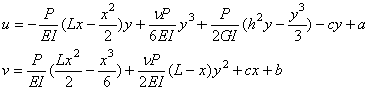
where a, b, and c are integration constants
representing a rigid body displacement. As in the previous case, a and b are
translations in the x and y directions, respectively, and c is a rotation about
the origin.
Any support conditions against rigid body
displacements, without over-constraining the body, can be prescribed without
changing the solution for the stresses. For the purpose of
comparison with a cantilever, let the origin point be fixed, and the
rotation of the vertical material fiber at that point, (u,y), be
zero. The conditions u = 0, and v = 0 at point (x = 0, y = 0) yield a = 0, and b
= 0. The condition u,y = 0 at the same point yields
c = Ph2/2GI
Thus, finally
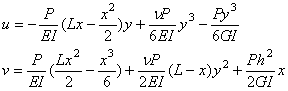
Comparison with a Cantilever Beam
The solution of the preceding problem offers some
points for comparison with the beam-theory solution of a cantilever fixed at the
edge x = 0.
a) The stresses are the same in both solutions,
but the displacements differ. For example, at x = L, we have
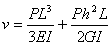
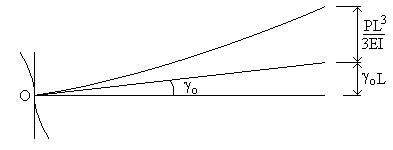 The
first term coincides with the deflection of beam theory. The second term
is associated with shear deformation, as the presence of the shear modulus
indicates. The shear strain at the origin is
The
first term coincides with the deflection of beam theory. The second term
is associated with shear deformation, as the presence of the shear modulus
indicates. The shear strain at the origin is
go = Ph2/2GI
and the term Ph2x/2GI in the
expression of v, is equal to gox, which is
a rotation about the origin by the angle go.
The figure shows the deflection of the centerline and the part due to shear.
It also shows the distorted shape of the cross section at x = 0.
b) The edge x = 0 is fixed in the beam-theory
model of a cantilever, whereas in the present solution the edge has a non zero
strain ey due to Poisson's ratio, and it
distorts out of the plane of the cross section because of shear deformation, as
shown in the figure. At x = 0,

c) The present solution is valid if the stresses acting on the
left and right edges are in fact distributed as found. If not, by St-Venant's
principle, the stresses are valid away from the ends. Beam theory by
contrast ignores such details. For a long plate, a different stress
distribution near the ends causes only a local change in strains, and thus
should not significantly affect the maximum deflection. The deflection due
to shear is an improvement over the usual engineering beam theory, which ignores
such a term. However, the distortion of the left edge does not satisfy the
fixity of an actual cantilever. The deflection due to shear may thus be
expected to be larger than would occur if the edge were fixed, since such fixity
would further restrain the deformation. A shear deflection term that more
accurately describes an actual cantilever may be based on an energy method, and
is found to be 5/6 of the term found by the elasticity solution for a
rectangular cross section.
Exercise 4.1
Determine the displacements in the problem of Sec. 3,
Example 3. Keep the symbol G for the shear modulus so that the terms
associated with shear deformation can be traced. Assume support conditions that
try to represent a simply supported beam. Compare the deflection at mid
span of the centroidal line with that of engineering beam theory.
Exercise 4.2
Determine the displacements in the problem of Sec. 3, Exercise
3.1. Keep the symbol G for the shear modulus so that the terms associated
with shear deformation can be traced. Assume support conditions that try to
represent a cantilever fixed at x = L, by requiring the vertical material
fiber to have a zero rotation. Compare the deflection at (x = 0, y = 0)
with that of engineering beam theory.
5.
Solution by Airy's Stress Function
Assuming the body force is zero,
the equilibrium equations are solved by the expressions
sx
= F,yy
sy
= F,xx
(1)
txy
= -F,xy
where F is an
arbitrary differentiable function, called Airy's stress function. This may be
verified simply by substituting into the equilibrium equations, and noting that
in mixed partial derivatives the order of derivations is commutable. The
compatibility equation yields the differential equation governing
F. We have, in the case of zero body force,

and the compatibility equation takes the form

This is known as the biharmonic equation,
and functions satisfying it as biharmonic functions. The equation occurs
frequently in mathematical physics, and has various forms of analytical
solutions applicable to two-dimensional elasticity problems, among which
solutions in the forms of polynomials and Fourier series. See for example
'Theory of Elasticity' by Timoshenko and Goodier.
Example
1
Solve the problem shown by Airy's stress
function.
Using beam behavior as a guide, the bending
moment is equal to p(L-x)h, which is linear in x. let us try a stress
function that yields sx as linear in x and
y, and txy as independent of x and
parabolic in y. Since sx
= F,yy,
F should contain
terms of the form y3(ax + c) + dy2, and since
txy = -F,xy,
F
should contain terms of the form
x(c'y3 + ey2
+ fy). Let us try then
F =
y3(ax + c) +
dy2 + x(ey2
+ fy)
First, check whether
F
satisfies Eq. (3). It is seen that all fourth derivatives that appear in
Eq. (3) are zero, and Eq. (3) is thus satisfied. The stresses given by
F are
sx
= F,yy = 6y(ax + c) + 2d + 2ex
(E1)
sy
= F,xx = 0
(E2)
txy
= -F,xy = -3ay2 - 2ey -
f
(E3)
What remains is to
satisfy the boundary conditions. At the top and bottom edges, the
condition sy = 0 is
satisfied. The other boundary conditions consist of:
a) Top and bottom edges: txy
= p/b at y = h, and txy = 0 at y = -h.
Thus
-3ah2 - 2eh - f
= p/b
(E4)
-3ah2 + 2eh - f
= 0
(E5)
b) At x = L, using relaxed boundary
conditions,
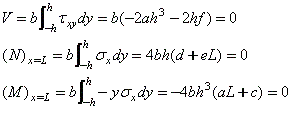
or,
ah2 + f = 0
(E6)
d + eL = 0
(E7)
c + aL = 0
(E8)
Eqs. (E4) to (E8) form 5 equations to determine
the 5 constants a, c, d, e, and f.
Subtracting and adding Eqs. (E4 and E5) yields
e = -p/4bh
(E9)
-3ah2 - f
= p/2b
(E10)
From Eqs. (E6) and (E10)
a = -p/4bh2
f = p/4b
and from Eqs. (E7) and (E8)
d = pL/4bh
c = pL/4bh2
Finally, substituting into Eqs. (E1) and (E3)
sx
= 6y(ax + c) + 2d + 2ex = (3p/2bh2)y(L - x) + (p/2bh)(L
- x)
txy
= -3ay2 - 2ey - f = (p/4bh2)(3y2
+ 2hy - h2)
Exercise 5.1
a) Show that any polynomial in (x, y) of combined
degree less than 4 is a valid Airy stress function.
b) Show that terms x3y and xy3
are valid in any Airy stress function.
c) Given the 4th order homogeneous polynomial ax4
+ bx2y2 + cy4, what relationship must exist
between the coefficients for the polynomial to be a valid Airy stress function?
Exercise 5.2
In Example 1, let the load on the top edge be
perpendicular to the edge, and vary linearly from 0 at x = 0 to po at
x = L. Using beam behavior as a guide, what polynomial terms would you
include in an Airy stress function in an attempt to solve the problem?
6. Thermal Problems
The stress strain relations considered so far are
assumed to hold at a reference temperature at which the undeformed geometry is
defined. If a temperature change, T = T(x, y, z), takes place, the
stress-strain relations need to be modified to take into account the effect of
temperature. It will be assumed that the temperature change is not of such
a magnitude as to affect E and n, and that
the material has a constant coefficient of thermal expansion
a. A small, unrestrained, and
isotropic material element, subjected to a temperature increase T, undergoes a
free thermal expansion, which consists of an extensional strain
eT
= aT
(1)
in all directions, and no shear strain for
any pair of orthogonal directions. eT
is called the free thermal strain. A free thermal deformation is by
definition one that is stress-free. If the material element is also
subjected to stresses, elastic strains take place in addition to the thermal
deformation. Typical stress-strain-temperature relations have then the
form
ex
= aT + (sx
- nsy - nsz)/E
(2)
gxy
= txy/G
with similar relations for the remaining strains
and stresses.
Plane Stress
For plane stress, sz
= 0, and T = T(x, y). The stress-strain-temperature relations take the
form
ex
= aT + (sx
- nsy)/E
ey
= aT + (sy
- nsx)/E
(3)
gxy
= txy/G
The inverse relations may be obtained by
substituting (ex -
aT) for
ex, and (ey
- aT) for
ey in Eqs.
(Sec. 1, 4'). This yields
sx =
[E /(1-n2)](ex
+ ney) - EaT /(1-n)
sy =
[E /(1-n2)](ey
+ nex) - EaT /(1-n)
(3')
txy = Ggxy
The state of zero strain, referred to as the
fixed state, plays an important role in understanding and analyzing thermal
effects. If ex,
ey, and
gxy are constrained to be zero, stresses are set up as given
by Eqs. (3'). Using subscript F to refer to the fixed state, Eqs.
(3) yield
(sx)F
= (sy)F = - EaT/(1
- n)
(4)
(txy)F
= 0
If a free thermal deformation is first allowed,
the stresses required to cause elastic strains equal and opposite to the free
thermal strains, thus resulting in the fixed state, are those given by Eqs. (4).
Another consideration for understanding thermal
effects is to describe under what conditions a free thermal deformation is
possible in a finite body.
To answer that question consider an unrestrained
body subjected only to a temperature change T = T(x, y). If a free thermal
deformation is possible, the stresses would be zero, and the strains would be
ex = aT
, ey
= aT , and gxy
= 0. These strains are geometrically possible if they satisfy the
compatibility equation, Eq. (Sec.1, 3), which yields, after dividing through by
a,
T,xx + T,yy = 0
(5)
Thus T(x, y) must be a harmonic function.
If T satisfies Eq. (5), the displacements of the unrestrained body,
obtained from the free thermal strains, contain an arbitrary rigid body
displacement. Thus, if the body is supported against such displacements,
without additional restraints, a free thermal deformation remains possible.
If either T(x, y) is not harmonic or the body is
over-supported, a free thermal deformation cannot take place. Stresses are
then set up that cause elastic strains, which when superimposed on the free
thermal strains, result in compatible strains. Note that if T(x, y) is not
harmonic, neither the elastic strains nor the free thermal strains are by
themselves geometrically possible, but only their sum is.
In three-dimensional elasticity, exact
conditions for a free thermal deformation require that the six compatibility
equations be satisfied, and this leads to the requirement that T must be linear
in (x, y, z). The reason Plane Stress does not require such a stringent
condition is that, from the point of view of three-dimensional elasticity, Plane
Stress is an approximation that satisfies geometric compatibility only in the
(x, y) plane. The error involved in violating other compatibility
equations may be shown to be negligible for thin plates.
In Engineering Theories, thermal problems
need to be formulated within the context of such theories, as will be seen for
beams.
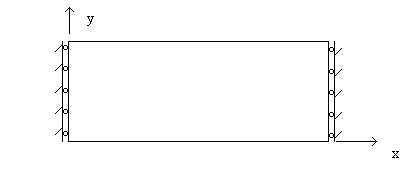 Exercise
6.1
Exercise
6.1
The rectangular plate shown has properties E,
n, and a. It is
subjected to a constant temperature increase T, and is restrained in the x
direction at the edges perpendicular to the x axis. Obtain the stresses and the
displacements.
Hint: Try a semi inverse approach.
Exercise 6.2
Let the sides of the plate of Exercise 6.1 be
a in the x direction, and b in the y direction, and let
the temperature increase in the plate be linear in y, with values T = T1
at y = 0, and T = T2 at y = b.
a) Obtain a complete solution for stresses and
displacements.
b) Obtain the normal force N and moment MC
at the restrained edges, where MC is the moment at the mid-point C of
an edge.
.
7. Formulation in Polar Coordinates