Chapter 1
Analysis of Stress - Part 1
1.
Fundamental Concepts
Analysis of Stress, Analysis of Strain, and
Stress-Strain Relations are the three building blocks of the field of Mechanics
of Solids. This chapter deals with the analysis of stress from the point
of view of its engineering applications in structural mechanics. A first
course in Mechanics of Materials is assumed.
1.1 Stress Vector.
Normal and Shear Stresses.
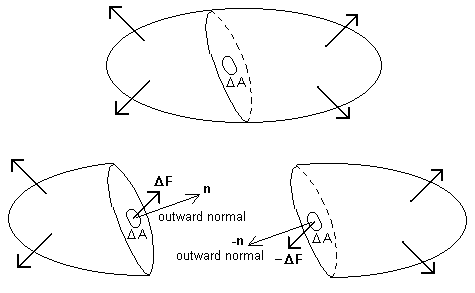 The concept
of stress is one of interaction between parts of a body. The upper figure
shows a body subjected to some forces, and the lower figure shows the body
separated into two parts by an arbitrary section. Over an area element
DA in that section, the interaction
between the two parts of the body is postulated to consist of a pair of opposite
forces DF and -DF,
as shown. (Vectors are indicated by bold face letters). The
orientation of the area element is defined by means of a unit vector n
oriented arbitrarily along the normal to DA.
n points outward relative to one part of the body, and inward relative to
the other. By convention, DF
is defined as the action on the part having n as outward normal, and the
area DA belonging to that part is referred to as a
positive face. -DF acts
then on the other part, which has n as inward normal or, equivalently,
-n as outward normal, and the area DA
belonging to that part is referred to as a negative face. The
average stress vector acting on DA
is defined as
The concept
of stress is one of interaction between parts of a body. The upper figure
shows a body subjected to some forces, and the lower figure shows the body
separated into two parts by an arbitrary section. Over an area element
DA in that section, the interaction
between the two parts of the body is postulated to consist of a pair of opposite
forces DF and -DF,
as shown. (Vectors are indicated by bold face letters). The
orientation of the area element is defined by means of a unit vector n
oriented arbitrarily along the normal to DA.
n points outward relative to one part of the body, and inward relative to
the other. By convention, DF
is defined as the action on the part having n as outward normal, and the
area DA belonging to that part is referred to as a
positive face. -DF acts
then on the other part, which has n as inward normal or, equivalently,
-n as outward normal, and the area DA
belonging to that part is referred to as a negative face. The
average stress vector acting on DA
is defined as
(sn)av
= DF/DA
(1)
It is postulated that, for a fixed n,
DF tends to zero as
DA tends to zero, and that the ratio
DF/DA
tends to a limit,
sn =
(limit as DA -> 0)DF/DA
sn
is called the stress vector for the outward normal n at the
point under consideration.
The stress vector corresponding to -n as outward normal
is then
s-n
= -sn
(2)
sn
is a vector-valued function of position and orientation, i.e
sn varies from one
material point to another, and it also varies as n varies at a point.
It will be seen subsequently that three stress vectors at a point,
corresponding, respectively, to three distinct unit normals, allow to
determine the stress vector for an arbitrary n at that point.
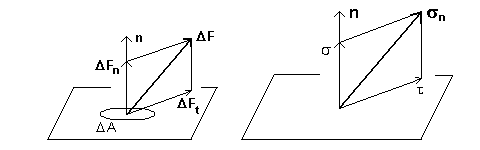
Normal and Shear Stresses
The normal stress s
is the component of sn
on n, or
s =
sn.n
(3)
Shear stresses are components of
sn on two orthogonal
axes in the plane of DA. The
total shear stress t is the
component of s in the plane of
the area element,
t = sqrt(|sn|2
-s2)
(4)
Note that a positive s
acts in the direction of n on the body having n as outward normal,
and is thus tensile. For a shear stress to have a sign convention, an axis
needs to be defined in its plane of action. If two reference axes are defined in
the area element, then shear stress components on these axes would have the sign
convention of vector components.
A stress has the physical dimension of [Force]/[Area].
In hydrostatics, the shear stress is zero, and the pressure is a compressive
normal stress that remains unchanged if the orientation of the area element
changes at a point.
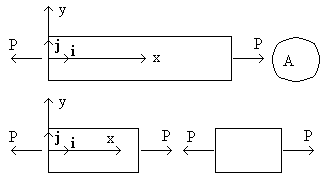 Example 1.1
A straight bar of cross sectional area A is subjected to a
tensile force P. A cross section isolates the bar into two parts.
By equilibrium, the force vector acting on the positive cross section is Pi,
and the force vector acting on the negative face is -Pi. From Eq.
(1), the average stress vector on the positive cross section is
(si)av
= (P/A)i. Since i is the outward normal, the average normal
stress is (s)av = P/A, and
the average shear stress is (t)av
= 0.
If the material is homogeneous, it will be seen that the
stresses away from the ends are constant. In that case
si =
(si)av
= (P/A)i, s = P/A, and
t = 0.
 Exercise
1.1
Exercise
1.1
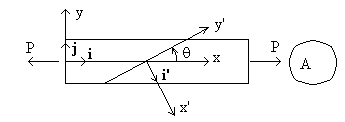
The bar of Example 1.1 is cut into two parts by a plane
inclined to the x axis by an angle q, as shown.
a) Draw a free body diagram of each part.
b) Let A' be the area of the section by the inclined plane.
Obtain A' in terms of A and q.
c) Assuming the stresses are constant, express the stress
vector si'
acting on the inclined area of the left part in terms of P, A, and i.
d) Obtain the normal stress
s' and the shear stress t'
on the inclined area.
1.2 Stress Components
Let (x, y, z) refer to three right-handed Cartesian axes, and
(i, j, k) be unit vectors, or base vectors, orienting these axes. Let
si,
sj , and sk
be the stress vectors at a point, corresponding to i, j,
and k as outward normals, respectively. We adopt the component
representation
si
= sxi +
txyj +txzk
(1-1)
sj
= tyxi +
syj +tyzk
(1-2)
sk
= tzxi +
tzyj +szk
(1-3)
In Eq. (1-1), sx
is a normal stress acting on a material face perpendicular to the x axis,
and txy and
txz are shear stresses
in the y and z directions, respectively. A similar interpretation holds in
the other two equations. The letter
s with a single subscript denotes a
normal stress, and the letter t with
two subscripts denotes a shear stress. The subscript of a normal stress, and the
first subscript for a shear stress refer to the face on which the stress acts.
The second subscript of a shear stress refers to its orientation. This notation
is referred to as Engineering Notation.
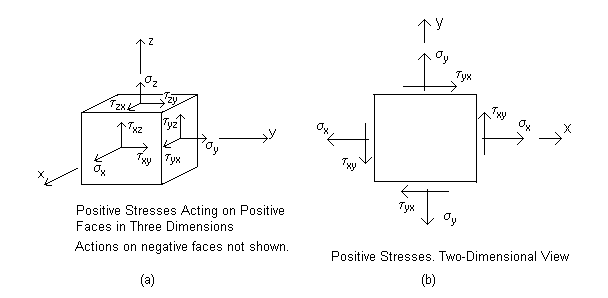
In Fig. (a), positive stresses are shown acting on the faces
of a small volume element having (i, j, k) as outward normals,
respectively. Such faces are referred to as positive faces. The face
parallel to a positive face has an outward normal pointing in the negative
direction of the axis, and is referred to as a negative face. The sense of
action of any one stress, viewed as acting on a negative face, is opposite to
that of its action on a positive face. This is shown in a
two-dimensional view in Fig. (b). Note that, whereas a minus sign is
needed to define the stress vector acting on a negative face, a stress
component is a scalar, which represents the actions on both a positive
and a negative face, as shown in (b).
 Example 1.2
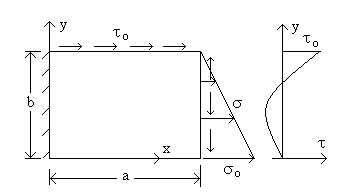
A rectangular plate of sides a and b, and thickness t is
subjected on its top edge to a uniform shear load of intensity
to lb/ft2, and on its right
edge to distributed normal and shear loads with varying intensities as shown.
The left edge is fixed. The normal load intensity s
is linear, and the shear load intensity is given as
t = to(-2y/b
+ 3y2/b2)
a) What are the stresses acting on the top edge, right
edge, and bottom edge of the plate?
On the top edge: sy = 0,
tyx = to
On the bottom edge: sy
= 0, tyx = 0
On the right edge: sx =
so(1 - y/b), txy
= to(-2y/b + 3y2/b2)
 b)
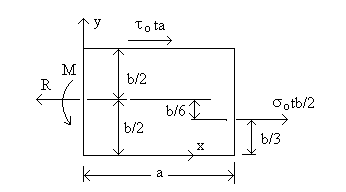
What are the resultant forces and moment acting on the left edge?
b)
What are the resultant forces and moment acting on the left edge?
The forces and moment acting on the left edge are found by the
equilibrium equations of the plate. First, the resultants of the
distributed edge loads are computed:
Top edge:
Ftx = tota
Right edge:
Frx = sotb/2
applied at b/3 from the bottom.

Equilibrium of the plate yields
R = tota +
sotb/2
M = (tota)b/2 - (sotb/2)b/6
= totab/2 - sotb2/12
Exercise 1.2
Draw a figure in the (x, y) plane showing a rectangular plate
having edges of lengths a and b parallel to the x and y axes,
respectively, and let the origin be at the center of the plate.
1. Show on the figure stress diagrams as
indicated below:
a) a positive stress sy
acting on the top edge, and varying linearly from zero to a given value
so.
b) a negative stress sy
acting on the bottom edge, and varying linearly from zero to -so.
c) a negative stress txy
acting on the right edge, varying parabolically between zero values at the top
and bottom, and having a given value -to
at the mid-point.
2. Let t be the plate thickness, and
assume that the stresses are constant within the thickness. What are the
resultant force components and moment at the left edge of the plate required for
equilibrium?
1.3 Indicial and
Matrix Notations. Summation Convention.
In the indicial notation, indices ranging over (1,
2, 3) are used to refer to coordinates, unit base vectors, and vector and stress
components. The symbol taking the index is of lesser importance.
Correspondence between engineering and indicial notations is shown in the
table below
An arbitrary coordinate from the set (x1,
x2, x3) may be referred to as xi, and the set
may be referred to as (xi), where the index i ranges over (1, 2, 3).
ei, si,
and sij may be used in a
similar way. Thus we can define the stresses and the sign convention as
follows:
|
x, y, z |
x1, x2, x3
or (xi) |
|
i, j, k |
e1,
e2, e3 or
(ei) |
|
si,
sj,
sk |
s1,
s2,
s3
or (si) |
|
sx,
txy,
txz |
s11,
s12,
s13
or (s1i) |
or (sij) |
|
tyx,
sy,
tyz |
s21,
s22,
s23
or (s2i) |
|
tzx,
tzy,
sz |
s31,
s32,
s33
or (s3i) |
si
= stress vector having ei as outward normal

sij
= stress component acting on face i in direction j
sij
is positive if it acts on a positive face in the positive direction of the axis.
It then acts on a negative face in the negative direction of the axis.
An arbitrary vector v of components (v1,
v2, v3) has the representation
v = v1e1 +
v2e2 + v3e3
(2)
The base vectors, being unit mutually orthogonal
vectors, satisfy the properties
ei.ej =
dij
(3)
where dij
= 1 if i = j, and dij = 0 if
i ≠ j. The set dij is
referred to as the Kroenecker deltas.
Summation Convention
The expression of
si in Eq. (1)
above holds for each value of i. Such an index, for each value of which an
expression is valid, is referred to as a free index. By contrast,
index j in (1) is used to represent the sum of like terms, which are obtained by
giving the index its possible values. Such an index is called a dummy
index, and it occurs typically as a repeated index in the expression to be
summed. The summation convention is to dispense with the summation
sign, and to rely on the repetition of the index to indicate that a sum is to be
made. If a quantity such as sii
is to be referred to for a particular value of i, it is written as
sii (no sum). Thus the
three definition equations of the stress components may be summarized with the
single indicial equation
si
= sijej
(4)
With the summation convention, a vector v
of components (v1, v2, v3) has the
representation
v = viei
(5)
The scalar or dot product of the two sums viei
and wiei distributes into the double sum v.w =
viwjei.ej = viwjdij.
Since dij = 0 if i ≠
j, the double sum reduces to the single sum,
v.w = viwi
(6)
Exercise 1.3.1
a) Develop the double sum S = aijxiyj,
letting the range of the indices be (1, 2, 3).
b) Form ∂S/∂x1, then re-write the
expression so obtained using the summation convention. Write an expression for
∂S/∂xi.c) Repeat the preceding questions with S = (1/2)aijxixj.
Matrix Notation
Matrix notation is another useful device both for
shortening the amount of writing as well as for computation purposes. A
column matrix will be denoted by the brackets {}, and a rectangular matrix by
the brackets []. Define the following column matrices of vector elements
{s}
= {s1
s2 s3}
(7)
{e} = {e1 e2
e3}
(8)
The definition equations of the stress components
take the form
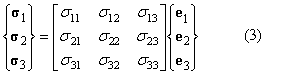
or,
{s}
= [s]{e}
(9')
[s] is
sometimes referred to as the stress tensor.
A vector v of components {v} = {v1
v2 v3} has the representation

or,
v = {v}T{e} = {e}T{v}
(10')
The property ei.ej
= dij takes the matrix
form
{e}.{e}T= [I] = 3 x 3
identity matrix (11)
Note that {e}T.{e} = 3.
Exercise 1.3.2
Show the details of the results concerning {e}.{e}T
and {e}T.{e}.
Exercise 1.3.3
Let aij (i,j = 1, 2, 3) be the elements
of matrix [a], and consider column matrices {x} and {y} of elements (xi)
and (yi), respectively.
a) Show that the sum S = aijxiyj
has the two matrix representations S = {x}T[a]{y}= {y}T[a]T{x}
b) Specialize the preceding formulas to the case S =
(1/2)aijxixj.
c) Show that if [a] is antisymmetric, i.e. if aij
= -aji, then S in part b) is zero.
d) For the sum of part b), can [a] be always
replaced by a symmetric matrix without changing the value of S?
 1.4
Differential Equations of Equilibrium
1.4
Differential Equations of Equilibrium
Two types of forces may act on a body: a body force of
intensity F per unit of volume, and surface forces acting on the boundary
of the body. A typical F is the specific weight (Force/Volume].
In general, F is a vector-valued function of position. Equilibrium
of a body occupying a certain domain requires that any isolated part of the body
be in equilibrium. This is insured by requiring every differential element
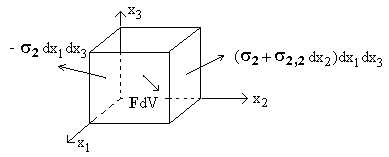
(dx1, dx2, dx3) such as shown in the figure to
be in equilibrium. In the figure, the force vectors acting on the pair of
faces perpendicular to the x2 axis are shown, using the indicial
notation. Similar forces, not shown, act on the other two pairs of faces.
The body force is FdV, where dV = dx1dx2dx3
is the element volume. The partial derivative of a function ( ) of (x1,
x2, x3) with respect to xi is indicated by a
comma followed by index i, as ( ),i. Thus as x2
varies by dx2, s2
varies by s2,2dx2.
The x2-faces have the area dx1dx3. The
sum of the forces on the x2-faces is thus
s2,2dx2(dx1dx3)
+ h.o.t. (higher order terms). Setting to zero the sum of the forces
acting on the element, and dividing through by dx1dx2dx3,
yields the vector differential equation
s1,1
+ s2,2 +
s3,3 + F = 0
(1)
or, with the summation convention,
si,i
+ F = 0
(1')
The k th component of the vector equation is
sik,i +
Fk = 0
(1'')
In detail,
s11,1 +
s21,2 +
s31,3 + F1 = 0
s12,1 +
s22,2 +
s32, 3 + F2 = 0
(1''')
s13,1 +
s23,2 +
s33,3 + F3 = 0
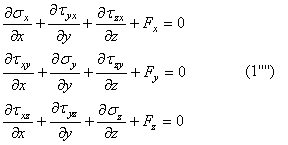
In the engineering notation, and the traditional symbol for
partial derivatives
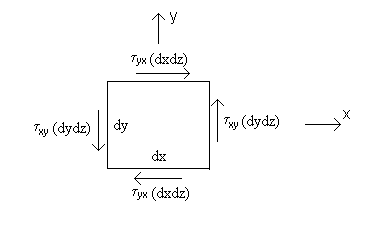
Now consider the moment equilibrium equations of a
differential element. The figure shows a two-dimensional view of such an
element, with only those forces that have a moment about the z axis.
In this instance, the forces due to variations of stresses between parallel
faces are infinitesimal of higher order, which do not affect the moment
equilibrium equation to be derived. The shear forces acting on the
two x- faces form a counterclockwise couple whose force is
txydydz + h.o.t, and
whose moment arm is dx. Similarly, the shear forces acting on the two y-
faces form a clockwise couple whose force is tyxdxdz,
and whose moment arm is dy. These are the only forces which have a moment
about the z axis. The sum of these moments is (txydydzdx
- tyxdxdzdy) + h.o.t., and
should be zero for equilibrium. Dividing through by dxdydz, and taking the
limit as dx, dy, and dz tend to zero, yields
 txy
= tyx
(2)
txy
= tyx
(2)
Similarly, it is established that
tyz =
tzy and
tzx =
txz . In the indicial
notation, sij =
sji. The stress tensor
is said to be symmetric, and the matrix representing the stress tensor is
symmetric.
The differential equations of equilibrium form then a system
of 3 equations in 6 unknown functions of (x, y, z). The system can be
solved relatively easily in terms of arbitrary functions. In the
language of structural analysis it is statically indeterminate, with arbitrary
functions replacing in the present context the concept of statical redundants.
Beyond satisfying differential equilibrium, the difficulty of solving a given
problem has two parts:
a) The deformations caused by the stresses must be
geometrically compatible. This requirement will be the subject of
subsequent study.
b) The stresses must satisfy the boundary conditions of the
given problem. This topic will be discussed following the next section.
Two-Dimensional Problems
In a two-dimensional state of stress in the (x, y) plane, (tzx,
tzy) = 0, (sx,
sy, txy
) = functions of (x, y) only, and sz is
either zero, or does not depend on z. It is seen then that the third
differential equation of equilibrium is satisfied, and the first two reduce to
s11,1 +
s21,2 + F1 ≡
sx,x +
tyx,y + Fx = 0
s12,1 +
s22,2 + F2 ≡
txy,x +
sy,y + Fy = 0
(3)
 Example
1.4-1
Example
1.4-1
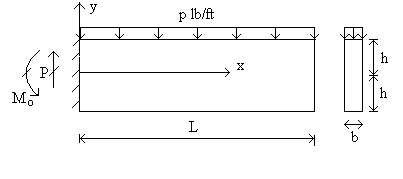
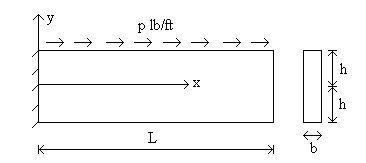
The figure shows a rectangular plate in a two-dimensional
state of stress, acting as a cantilever beam fixed as the edge x = 0.
Using your previous knowledge of engineering beam theory,
a) Obtain expressions of sx
and txy as functions of x and y. Check
that the stresses satisfy the differential equation of equilibrium in the x
direction.
The shear force V at x is evaluated as the resultant of the
y-forces to the right of the cross-section at x, positive if upward. The
bending moment at x is evaluated as the moment at x of the forces to the right
of the cross-section at x, positive if counter-clockwise. Thus,
V = -p(L - x)
M = -p(L - x)2/2
According to beam theory,
sx = -My/I
= p(L - x)2y/2I
txy = VQ/bI
= -p(L - x)(h2 - y2)/2I
where
I = 2bh3/3
Substituting into the first of Eq. (3), with Fx =
0,
sx,x +
tyx,y = -2p(L - x)y/2I - p(L
- x)(-2y)/2I = 0
b) Stresses other than those found in part a) are
ignored in engineering beam theory. However, it is clear that at the top
edge there is a compressive sy
= -p/b. Determine a stress distribution sy
that satisfies the differential equation of equilibrium in the y direction, and
is equal to zero at the bottom face of the beam, and to -p/b at the top face.
From the second of Eq. (3), with Fy = 0,
txy,x +
sy,y = p(h2
- y2)/2I + sy,y
= 0
Solving for sy,y,
and integrating with respect to y,
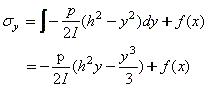
where f(x) is an arbitrary function of x. At the bottom
of the plate, y = -h, sy
= 0. Thus,
(sy)y=-h
= -(p/2I)(- h3 + h3/3) + f(x) = -(3p/4bh3)(-2h3/3)
+ f(x) = p/2b + f(x) = 0
At the top of the plate, y = h,
sy = -p/b. Thus,
(sy)y=h
= -(p/2I)(h3 - h3/3) + f(x) = -(3p/4bh3)(2h3/3)
+ f(x) = -p/2b + f(x) = -p/b
These two conditions are satisfied by a constant f(x) equal to
f(x) = -p/2b
Exercise 1.4.1
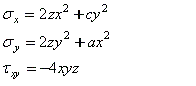
Are the following stresses in equilibrium? a and c are
constants, other stresses are zero, and the body force is zero.
1.5 St-Venant's Principle
St-Venant's principle states that if the boundary tractions
over a small area A of a body are changed in a statically equivalent way, i.e.
in a way that maintains the same resultant force and the same resultant moment,
then the stresses and deformations of the body will change in the vicinity of
the area A, but they remain essentially unchanged away from that area, at
distances of the order of magnitude of linear dimensions of the area. For
example, consider a bar made of a homogeneous and isotropic material, of uniform
cross-section A, subjected at its ends to a uniform normal stress equal to P/A,
where P is the resultant axial force. It is to be expected that the normal
stress on any cross-section will be the same as at the ends. According to
St-Venant's principle, if the axial loads P at the end cross-sections are not
applied as a uniform stress, but in some other way, as concentrated forces along
the bar axis for example, then the normal stress distribution makes a transition
from the one prescribed at the ends to a uniform distribution, and this
transition takes place over a distance into the bar of the order of magnitude of
linear dimensions of the cross-section.
1.6 Engineering Theories
There are nine physically distinct stress components at a
point, but, because of the symmetry of the stress tensor, only six distinct
values. Thus to determine the state of stress in a body requires the
determination of six functions of position in the domain of that body. The
development of governing equations and solution methods for this general problem
form several sub-fields of Mechanics, the most basic of which is Elasticity.
Governing equations are based on the requirements of equilibrium,
compatibility of deformation, and material constitutive stress-strain relations.
Engineering theories such as beam, plate and shells theories
are approximate from the point of view of elasticity. They are developed
in order to focus on the important aspects of behavior of these particular
structural elements. A study of elasticity provides the basis for
'exactness', and, by obtaining some fundamental solutions, it also provides a
basis on which to construct models for engineering theories. Once an
engineering theory is developed, however, one may consider exact and approximate
solutions of the equations of that theory.
Planar Behavior of Beams
To illustrate some of the preceding concepts, a review of the
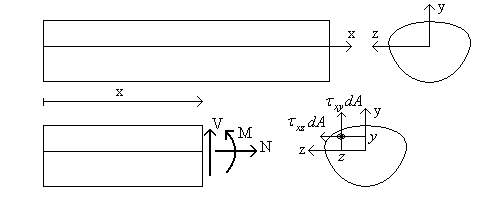
planar behavior of beams is made in what follows. The figure shows a beam,
and a portion of it isolated by a cross section at x. External forces are
not shown. The stresses acting on the cross section are
sx,
txy and
txz. Over a
differential area dA, act sxdA,
txydA, and
txzdA.
sxdA is perpendicular to the
cross section, and is shown as a dot.
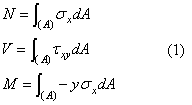
 In general,
the stresses acting on across section, like any force system, have
three force resultants and three moment resultants. Assuming symmetry with
respect to the (x, y) plane, the z resultant force, and the x and
y resultant moments are zero. The stress resultants to be
considered consist then of a normal force N in the x direction, a shear
force V in the y direction, and a bending moment M about the
centroidal z axis. These are
In general,
the stresses acting on across section, like any force system, have
three force resultants and three moment resultants. Assuming symmetry with
respect to the (x, y) plane, the z resultant force, and the x and
y resultant moments are zero. The stress resultants to be
considered consist then of a normal force N in the x direction, a shear
force V in the y direction, and a bending moment M about the
centroidal z axis. These are
The conditions for zero z resultant force and
zero moments about the y and x axes are
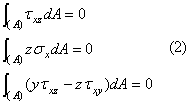
Note that symmetry with respect to the (x, y) plane does not
necessarily imply that txz is zero, as may
be seen by considering the flexural shear stresses in the flanges of an I beam.
As a review, stress formulas in combined axial behavior and
planar bending are given below. They will be derived within the context of
a more general beam theory in a subsequent chapter.
sx = N/A - My/I
(3-1)
(tnx)av
= (txn)av
= VQ/bI (3-2)
In these equations, I is the moment of inertia of the cross
section about the centroidal z axis, and Q and b depend on
the particular application of the shear stress formula, Eq. (3-2).
Let an arbitrary line AB be drawn in the cross-section, as shown in Fig. (a),
and let the perpendicular to AB be oriented and labeled axis
n. Let A1 be the part of the cross-section into which
axis n points. Eq. (3-2) gives the average over
line AB of the shear stress component txn.
In Eq. (3-2),
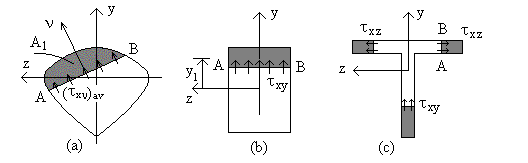
b = length (AB)
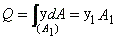
Q is the moment of area A1 about the z axis, and is
equal to the product of A1 by the y coordinate of the centroid C1
of A1. Typical applications are shown in Figs. (b) and (c),
where in each case the shear stress may be considered constant over line AB. For
thin-walled sections, AB is chosen along the thickness, so that
txn
runs parallel to the wall. Thus for the T section, with the y axis along
the web, txn
becomes txz in the flanges, and
txy in the web.
We have tnx
= txn.
txn acts in the
plane of the cross-section, and is thus referred to as a transverse shear
stress. tnx
acts in the x direction on the cut by a plane containing AB and the x
direction, and is thus referred to as a longitudinal shear stress.
The sign convention for txn
conforms to the general sign convention for stresses by which a
positive stress acts on a positive cross section in the positive
n direction, i.e. into the partial area A1.
Since the moment of the total area of the cross section about a centroidal axis
is zero, if the partial area is changed from one side of line AB to the other, Q
changes sign, txn
changes sign, axis n reverses its orientation, and
thus txn
continues to point correctly relative to the new partial area, i.e. outward.
Eqs. (3-1) and (3-2) may also be applied for bending in a
principal plane of inertia that is not a plane of symmetry. In that case
however, a shear force lying in the principal centroidal plane causes both
flexural and torsional shear stresses. In order that there be no torsional
shear stresses, the line of action of the shear force must pass through a point
called the shear center, which is different from the centroid of the
cross-section. This topic as well as the general engineering beam bending
theory will be seen in a subsequent chapter.
Exercise 1.6.1
As a review of beam theory, consider a T section formed of an
8 x 1 inch flange glued to an 1 x 8 web, bending in the plane of the web.
For V = 600 lb,
a) determine the shear stress transmitted by the glue.
b) determine the transverse shear stress parallel to the
flange at 2 inch from the edge. Show on a sketch the direction of V and
that of the shear stress.
2.
Stresses and Tractions on Inclined Plane Elements
 2.1
Stress Vector on an Inclined Plane Element
2.1
Stress Vector on an Inclined Plane Element
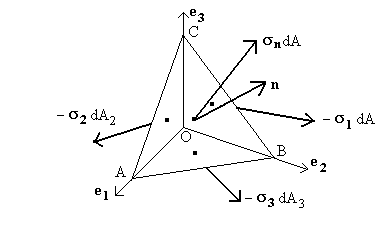
The figure shows an infinitesimal tetrahedron having
three faces in the coordinate planes, of respective areas dA1, dA2,
and dA3, and the fourth face ABC, of area dA, having a unit outward
normal,
n = n1e1 +
n2e2 + n3e3
= niei = {n}T{e}
(1)
The force vectors acting on the four faces are also shown. Faces dA1,
dA2, and dA3 are negative, so the stress vectors acting on
them take the minus sign as shown. Area dA1 is the orthogonal
projection of dA on the coordinate plane perpendicular to e1.
Thus
dA1 = dA
cos(n, e1) = dA n.e1 = n1dA
and similar relations hold for dA2 and
dA3. Thus
dAi = nidA
(2)
The body force is proportional to the volume of
the tetrahedron, and is thus an infinitesimal of higher order than the surface
forces. The force equilibrium equation is thus sndA
-s1n1dA -
s2n2dA -
s3n3dA + h.o.t. =
0. Dividing through by dA, and rearranging, yields
sn
= n1s1 + n2s2
+ n3s3 =
nisi = nisikek
(3)
or, in matrix form,
sn
= {n}T{s} = {n}T[s]{e}
(3')
A usual engineering notation for the direction
cosines (ni) is (l, m, n). Thus, in engineering notation,
sn
= lsx + msy
+ nsz
(3)''
Exercise 2.2.1
Given two unit normals n and n' at a
point, show that sn.n'
= sn'.n
Normal and Shear Stresses
The normal stress is
s =
sn.n. Thus
s =
ninjsij
= {n}T[s]{n}
(4)
Letting
m = miei = {m}T{e}
be a unit vector orthogonal to n, the shear
stress component on m is tnm
= sn.m. Thus
tnm
= nimjsij
= {n}T[s]{m}
= {m}T[s]{n}
(5)
The last equality above is deduced from the
symmetry property, sij =
sij or [s]
= [s]T.
Tractions
The components {p}= {p1, p2,
p3}of sn on the
coordinate axes are referred to as tractions. Eq. (3) is of the form
sn
= pkek = {p}T{e}
(6)
where
pk = nisik
or {p} = [s]{n}
(7)
In detail,
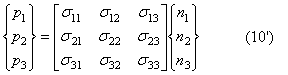
In traditional notation,
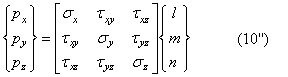
Note that if n is equal to a base
vector ei, tractions (pk) coincide with the
stresses (sik) acting on a positive face.
On the positive face perpendicular to n, pk =
sik, and, on the negative face, pk
= -sik. Whereas for a given n,
sik represents two opposite actions, one
on the positive face, and the other on the negative face, pk
represents only the action on the positive face perpendicular to n.
2.2 Stress Boundary
Conditions
Tractions can be defined at any point within a body, and for
any orientation defined by n. Usually, however, they are considered
on the boundary of a body in conjunction with boundary conditions. In that
context, n is an outward unit vector normal to the boundary surface, and
the tractions are equal to the components on the coordinate axes of the surface
force intensity acting on the boundary. If that force is an applied
loading, i.e. if it has a prescribed value, then the stresses must satisfy
Eq.(7, Sec. 2.1). Using the notation of Eq.(7'', Sec.2.1), the
equation is re-written below so that the prescribed values appear on the right
hand side.
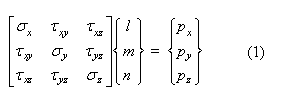
 Example
2.2-1
Example
2.2-1
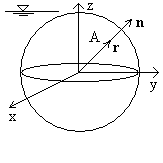
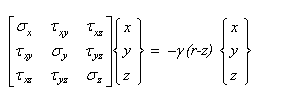
A solid sphere of radius r, centered at the origin of axes (x,
y, z), is submerged just to its top point in a fluid of specific weight
g. Gravity being in the -z direction, the
pressure at a boundary point of the sphere is p = g(r
- z). Write the boundary conditions at a general point (x, y, z) on the
boundary.
Letting r be the position vector of a point A on the
sphere, the unit outward normal is
n = r/r = (1/r)(xi + yj + zk)
The prescribed boundary pressure is
p = -pn = -g(1 - z/r)(xi
+ yj + zk)
Applying Eq. (1), and multiplying through by r, yields
 Stress
Boundary Conditions in Two-Dimensional Problems
Stress
Boundary Conditions in Two-Dimensional Problems
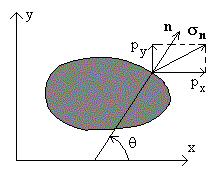
In a two dimensional problem in the (x, y) plane, the boundary
is a curve that encloses a two-dimensional domain, such as shown in the figure.
The outward unit normal n has the components
l = cosq
m = sinq
n = 0
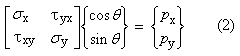
Eq. (1, Sec. 2.2) reduces to
Example 2.2-2
Consider the plate problem of Example 1.4-1, shown again here.
The boundary curve in this case consists of the four edge lines of the plate:
Top Edge: y = h, 0 < x < L
Bottom Edge: y = -h, 0 < x < L
Left Edge: x = 0, -h/2 < y < h/2
Right edge: x = L, -h/2 < y < h/2
The figure indicates that the top edge has a given normal
stress and a zero shear stress, and that the right and bottom edges are free.
These loading conditions on the boundary of the plate are the stress boundary
conditions. They are part of the problem statement, and must be satisfied
by the solution of the problem. The conditions are listed below:
a) Top edge: y = h, 0 < x < L, (n = j,
q = p/2)
tyx =
0
sy =
-p/b
b) Bottom edge: y = -h, 0 < x < L, (n = -j,
q = -p/2)
tyx =
0
sy =
0
c) Right edge: x = 0, -h/2 < y < h/2, (n = i,
q = 0)
sx =
0
txy =
0
On the supported edge, the load distribution is not specified.
However, a solution to the problem, which satisfies the differential equations
of equilibrium and the stress boundary conditions, also satisfies the
equilibrium equations of the plate as a whole. These equations yield
N = 0
P = pL
Mo = pL2/2
where N is the normal force.
Thus, a solution to the problem satisfies on the left edge of
the plate the three equations
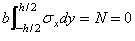
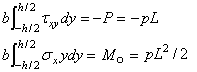
Note that a positive txy
acts on the left edge in the negative y direction , and that a positive
sx at a point y > 0 has a moment at the
origin in the same sense as Mo.
Relaxed Boundary Conditions
Relaxed boundary conditions specify the resultants of
tractions on a boundary segment instead of a point-wise distribution of these
tractions. They are used when it is difficult to obtain a solution
satisfying exact boundary conditions, and when St-Venant's principle may be used
to justify such a simplification. For example, if the plate of Example
2.2-2 is long in the x direction, relaxed boundary conditions for the free edge
would specify that the axial force, shear force, and bending moment are zero
instead of requiring that the two tractions vanish along the edge. By St-Venant's
principle, a solution that satisfies these conditions is equivalent to the
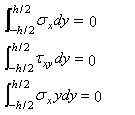
solution for a truly free edge away from the edge. The conditions of zero
resultant forces and moment yield
Exercise 2.2.1
The figure shows a plate in a two-dimensional state. The
shear load at the top edge is uniform, and the bottom and right edges are free.
a) Write the stress boundary conditions on the top and bottom
edges of the plate.
b) Write the relaxed boundary conditions on the right edge.
c) Write the equilibrium equations satisfied by the stresses
acting on the left edge of the plate.
Example 2.2-2
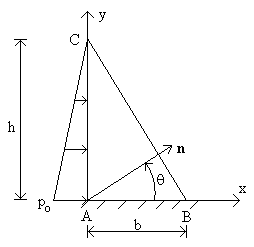 Plate ABC
is fixed along AB, and is subjected along AC to the pressure distribution shown.
Plate ABC
is fixed along AB, and is subjected along AC to the pressure distribution shown.
a) What are the boundary conditions on face BC?
Since face BC is free, px = py = 0.
From Eqs. (1), the boundary conditions on BC are
sxcosq
+ tyxsinq = 0
txycosq
+ sysinq = 0
Angle q is equal to the angle of
triangle ABC at C. Thus
cosq = h/sqrt(b2 +
h2)
sinq = b/sqrt(b2 + h2)
b) What are the boundary conditions on AC?
The pressure distribution on AC is linear, and equal to po(1-y/h).
Since it is compressive, the boundary conditions are
sx = -po(1-y/h)
txy = 0
c) What are the resultant forces and moment on AB,
and how are they related to the stresses along AB?
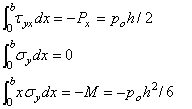
By equilibrium, and considering a unit plate thickness, the
reactions on AB are
Px = -poh/2
Py = 0
M = (h/3)(poh/2) = poh2/6,
counter-clockwise
Note that AB is a negative face, so that a positive
txy acts to the left, and a positive
sy acts downward. The stresses
along AB have the resultants
 Exercise
2.2.2
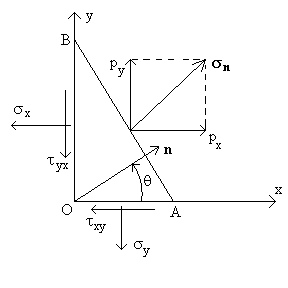
Exercise
2.2.2
Derive Eq. (2) using the equilibrium equations of
the wedge-shaped element. Note that tractions need to be multiplied by
areas in order to obtain the forces acting on the faces of the element.
Exercise 2.2.3
A plate is in a uniaxial state of plane stress in
the x direction in which sx is constant
and equal to so.
a) Determine the tractions px and py
acting on the boundary of a circular cut-out as functions of the
polar-coordinate angle q.
b) Use the answer to part a) to determine the normal
stress and shear stress acting on the cut-out as functions of
q.