Interfacial and Colloid Science
Interfacial and Colloid Science
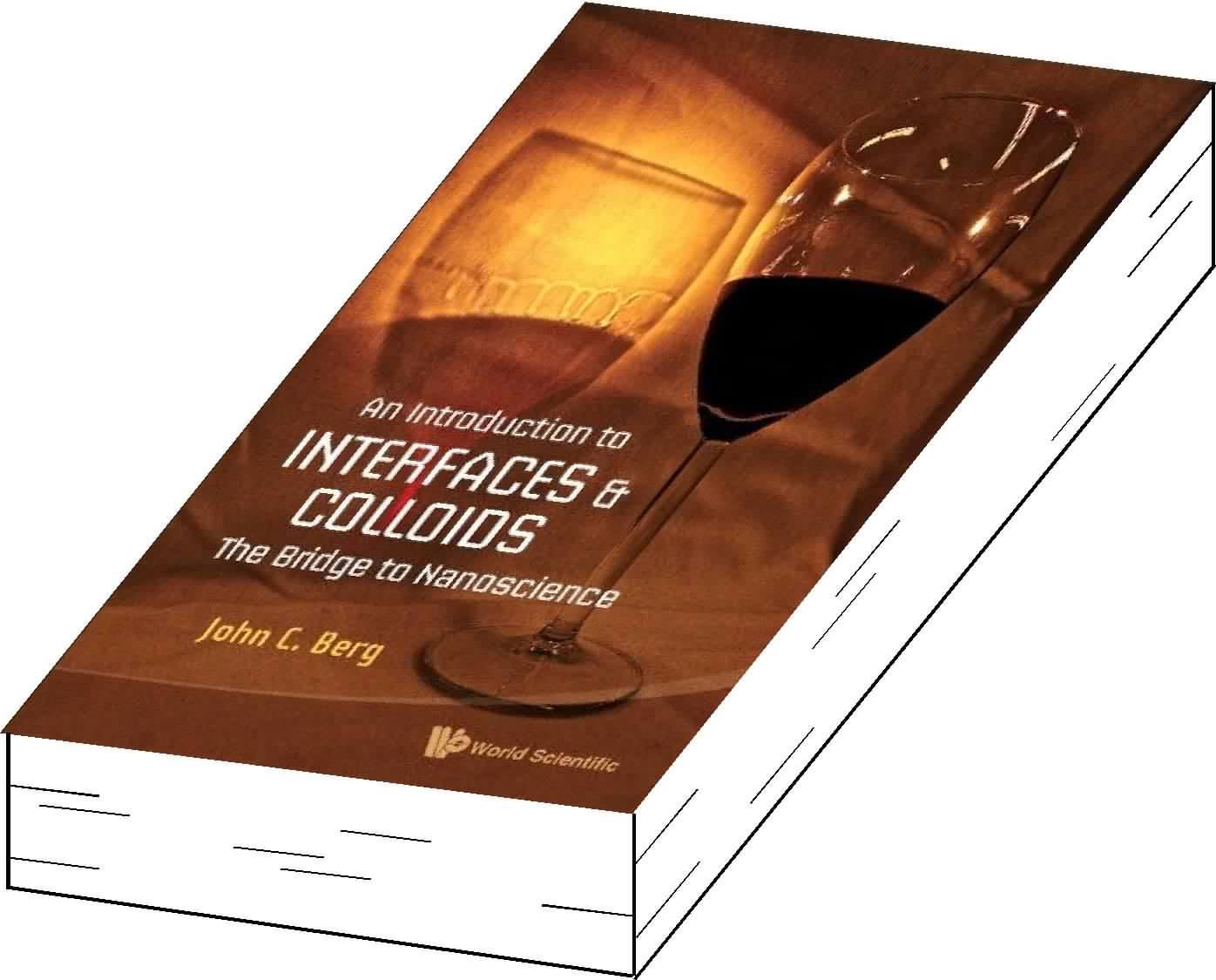
Prof. Berg's textbook: "An Introduction to Interfaces and Colloids: The Bridge to Nanoscience" published in January, 2010, is doing well. It has been adopted as a textbook by at least 50 universities worldwide, and has been listed by the publisher as a "bestseller." The publisher's website for the book is: http://www.worldscibooks.com/nanosci/7579.html. The cover design, Preface, and Table of Contents are given below. A second printing of the book has come out in early 2012, and has incorporated all of the corrections in the Errata, given at the bottom of this page.
PREFACE
The importance of Interfacial and Colloid Science across the spectrum from industrial manufacturing to energy development to biomedical research to everyday activities from cooking to cleaning is beyond dispute. Still, it is to be found in relatively few courses, particularly required courses, in science and engineering curricula in our colleges and universities. More often, it is that chapter in one's physics or chemistry text that is never assigned. The early stirrings of a shift in curricula to include this material is underway, however, particularly as new tools and insights are rapidly emerging and it is recognized as the bridge to the new era of nanoscience and nanotechnology. This text is addressed to both undergraduate and graduate students in science and engineering programs as well as to practitioners, although even high school students should enjoy parts of it. Its evolving versions have been used, I believe successfully, in both undergraduate and graduate elective courses in Chemical Engineering at the University of Washington, as well as in a variety of industrial short courses since the mid 1980's. It is now used as the text for a course in Interfacial and Colloid Science, with a significant laboratory component, that has just become required for undergraduate Chemical Engineering students at Washington as the Department embraces a shift toward molecular engineering and nanoscience.
The text is an Introduction in that it assumes the reader to have no more than the background common to third-year university students in science and engineering and to have no prior experience with the subject. An over-arching goal in preparing the book has been to keep it User-Friendly, but in the end, it seeks to bring the reader to a level permitting comfortable entry into the current scientific literature.
Part of the joy of learning science, I believe, comes from its tangibility and its relationship to everyday experience. Therefore, at the end of each chapter, after the Introduction, are described "some fun things to do," i.e., simple experiments to illustrate some of the concepts of the chapter. They require essentially no instrumentation or expensive, hard-to-get materials, and most are suitable for "Mr. Science" type classroom demonstrations.
Learning does not take place as it did even a decade ago. Now, as soon as students become familiar with the basic concepts and terminology of a topic, their next step is a visit to the Internet. A Google request, using the correct key words, for "images" or "videos" for example, instantly opens a world of information. It also, unfortunately, often produces a world of extraneous material, which only a degree of prior knowledge can sort out.
I must include here a pre-emptive apology for three things: first, the number of topics there wasn't space to cover; second, for the enormous amount of important work that has not been cited, and lastly, for the inevitable number of typographical and other errors the manuscript is sure to contain despite all attempts to minimize them.
The subject of Interfacial and Colloid Science is still one of awe and wonder to me, and it is hoped that this text will help at least in some way to convey this feeling to the reader.
John C. Berg
Seattle, WA
August, 2009
PS - A number of typos and other errors have come to light since the book was published, and an Errata has been attached at the bottom of this page. If the readers find additional errors, I would be very grateful if they could pass them on to me for inclusion. Many thanks in advance!
JCB February 10, 2010
 Table of Contents
The Interfacial and Colloid Science Group at the University of Washington Dept. of Chemical Engineering is headed by Prof. John C. Berg.
The Group presently has 3 graduate students and 5 undergraduate researchers.
Meet them below!
Interfacial and colloid science deals with the behavior of fine-particle dispersions, fibers and thin films, and other systems strongly influenced by the properties of their interfaces. Our group engages in research attempting to acquire fundamental understanding of systems of this type and their application to situations of current practical interest. RECENT AND CURRENT RESEARCH THRUSTS INCLUDE:
Members of the group









 Current Quarter Group
Meetings Recent News
from the group Recent Publications
Current Quarter Group
Meetings Recent News
from the group Recent Publications