Executive Summary
City of SeaTac Personal Rapid Transit (PRT) Feasibility Project: Major Investment Study
August, 1997
Overview of the Study Process
The City of SeaTac Personal Rapid Transit (PRT) Feasibility Project is a Major Investment Study (MIS) that has evaluated alternatives for improving transportation services among various activity centers around the International Boulevard area within the City, and the Sea-Tac Airport.
A MIS is an analytic planning tool which addresses subarea or corridor transportation issues through comprehensive analysis. Specifically, a MIS defines the nature of the transportation problem, develops alternatives to address those problems, assesses the likely impacts of the alternatives and identifies the preferred approach to solving the problems. The product of a MIS is a Locally Preferred Transportation Investment Strategy (LPTIS) which defines the recommended improvement program.
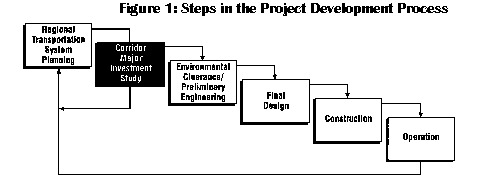
The results assist officials at all government levels who are involved with addressing these issues, in making a more informed decision on potential solutions. The MIS also serves as an element of a region's transportation system planning process by providing the technical support needed for decisions related to significant transportation investments.
The purposes of the PRT Feasibility Project included:
Develop a transit system that is supportive of growth management and consistent with City planning policies and the Puget Sound Regional Council's Vision 2020.
Fulfill all requirements of the Federal MIS process.
Conduct an environmental analysis as part of the evaluation of the alternatives.
Identify system performance and physical parameters consistent with the objectives of PRT.
Assess the economic feasibility of PRT system implementation and operation.
Develop an implementation program and funding approach to move the project into design, construction and operation at the earliest possible time, if the PRT system proves to be feasible.
Generally, the study process encompassed the following steps:
Project Objectives and Work Program Development - Key findings of prior studies and plans relative to the project area were reviewed, and an evaluation methodology for assessing each of the alternatives was developed at the beginning of the project.
Public Involvement Stakeholder Reviews - Representatives of identified stakeholder groups were interviewed to understand their concerns and impressions about a PRT system in SeaTac.
Conceptual Alternatives Definition - the alternatives were initially defined at a conceptual level for public and agency comment.
Scoping Meeting - An Open House was held to receive public comment regarding the proposed alternatives and identify potential environmental issues relating to each of the alternatives.
Alternatives Refinement - The alternatives were further defined by preparing system performance parameters; developing conceptual PRT route alignments, guideway, station design and vehicle design; identifying the Baseline capital elements; and developing an operating plan for a consolidated courtesy van shuttle system.
Ridership Forecasts and PRT Operational Simulation - Forecasts were completed for all the alternatives along with an operational simulation for the PRT alternatives to estimate origin to destination travel times, identify vehicle requirements, and determine the overall performance of the PRT route alignments and station designations.
Environmental Analysis - The impacts of each alternative relative to specific environmental issue areas were assessed along with identifying potential avoidance/mitigation measures where necessary; an environmental clearance document was not part of this MIS.
Cost Estimates - Preliminary cost estimates were completed for the alternatives including capital cost estimates for the PRT alternatives and Operating and Maintenance cost estimates for the baseline, consolidated shuttle and PRT alternatives.
Alternatives Evaluation - Each of the alternatives was evaluated using the criteria and methodology developed in the initial stages of the project prior to development of the alternatives. The evaluation resulted in a preferred alternative being recommended by a majority of the Project's Steering Committee.
Implementation and Funding Analysis - An implementation program for the preferred transportation technology was developed, along with identification of potential funding sources which together comprise the Locally Preferred Transportation Investment Strategy (LPTIS), a required outcome of an MIS.
Public Open House - An open house to present the preliminary LPTIS was held to solicit input from public agencies, local business operators, property owners and other interested members of the public.
Conclusions/Recommendations - On July 22, 1997, the SeaTac City Council voted to accept the report.
Study Structure and Collaboration
A Project Steering Committee (PSC) was formulated at the beginning of the project and included representation of all identified stakeholder groups. The PSC included representation from each of the following:
SeaTac City Council; SeaTac Planning Commission; SeaTac Public Works Staff; SeaTac Planning Staff; SeaTac City Manager's Office; Port of Seattle; Washington Department of Transportation; Puget Sound Regional Council; King County Department of Transportation; Chamber of Commerce; Hotel/Motels; Property OwnersThe purpose of the PSC was to provide advice to the City Council on the feasibility of this project. The PSC met twelve times throughout the study to review and comment on all study assumptions, methodologies and draft work products. A second function was to give general guidance to the study.
The City Council was briefed at a study session and invited to all public meetings.
Public Participation
The public was involved in the project in the following ways:
Stakeholder Interviews - In January 1996, the consultant team interviewed key selected stakeholders, representing local business operators, SeaTac residents, and the Port of Seattle, to identify significant issues, opportunities, and challenges regarding the feasibility of PRT in the SeaTac area.
Scoping Meeting - In April 1996, a scoping meeting was held to provide information on the intent of the PRT Feasibility Project, and stimulate discussions and obtain feedback on desired PRT options and alternatives.
Meeting with Courtesy Van Operators - The consultant team met with courtesy van operators in September 1996 to discuss the feasibility of a consolidated shuttle system and issues associated with current courtesy van operation in the SeaTac area.
Meeting with Area Businesses - Information on the study recommendations was presented in March 1997 to local business operators along with a question and answer session.
Open House - Also in March 1997, a public open house meeting was held to inform interested parties about the preliminary study recommendations and answer questions.
Newsletter/Newspaper - The city newsletter, SeaTac Report, and local newspaper, Highline Times, were used to publish articles on the scoping meeting and Open House.
The major comments received were:
How much would the PRT system cost and who was going to pay for it?
The availability and feasibility of PRT technology?
General opposition by the existing courtesy van operators to the concept of a consolidated shuttle due to the lack of direct service?
Summary of Previous Study
The SeaTac People Mover Study, completed in February 1992, explored the feasibility of a people mover system within the City of SeaTac. The purpose of the study was "to determine if a people mover system could have a worthwhile mitigating effect on present and future traffic within a limited area of the City of SeaTac and Sea-Tac International Airport." The study evaluated the potential of four people mover transit technologies. These technologies included:
Bus; Light Rail Transit (LRT); Group Rapid Transit (GRT); Personal Rapid Transit (PRT).
The study assessed each of these technologies on the basis of capital cost, operation and maintenance costs, ridership, and revenue availability for implementation. The People Mover Study recommended a range of people mover systems that should be pursued. Those technologies and their uses are summarized below:
Shuttle buses should be used in the near-term (at least five years) to fill the people mover function.
When available, PRT could replace many of the current shuttle operations with comparable or superior levels of service. No other technology was found to be as responsive to the diverse internal travel patterns between existing and future land uses in the study area.
GRT was found to be the best technology available to serve airport employee parking facilities to and from the airport terminal area.
Circulation between the proposed Airport light rail station on International Boulevard and the main airport terminal building may not be best served by PRT and should be evaluated in more detail. Alternatives such as a moving walkway connection should be considered further by the Port of Seattle and the RTA.
The study concluded that these four components would likely be staged depending on the rate and occurrence of growth and technology development. The following implementation steps were identified:
PRT People Mover System - conduct a feasibility study to develop a preliminary design, perform a financial planning and funding analysis, conduct an education program, solicit public comment, and monitor PRT technology development.
Airport HOV Access Terminal Facility - Develop a preliminary design and operations plan for HOV access into the Airport terminal area and implement the recommendations of the
International Boulevard Design Study.
GRT Shuttle for Airport Employee Access - Develop and review a plan for the development of a GRT system serving the airport employee parking facilities.
Transit Services - Monitor and assess transit service provided by King County Metro and courtesy van operators and make recommended changes, when needed.
Coordination with Related Programs - Any development of a people mover technology should be coordinated with related programs being implemented in the area, including the
Regional Transportation Plan (light rail development), the 28th/24th Corridor study, SR 509/South Access Corridor EIS, and the South Aviation Support Area (SASA) EIS.
Since the completion of the 1992 SeaTac People Mover Study, the city has implemented improvements to International Boulevard, developed a Comprehensive Plan, and Transit Supportive Land Use Master Plan that includes policies supportive of a PRT system, monitored the results of PRT technology development and applied for and received a federal grant to conduct a PRT feasibility study. This document reports on the results of the feasibility study.
Transportation Problem
Travel patterns within the International Boulevard area are characterized by trips to/from many generators (motels, hotels, remote parking, car rental agencies, etc.) and the airport. In the future, additional focus will be placed on new development nodes such as the Aviation Business Center and the regional light rail system which will increase the need for a greater local distribution of trips.
The existing transportation problems within the SeaTac area include the following:
A congested street system primarily along International Boulevard and along the Airport's curb access roadways;
High frequency of private shuttle trips on surface streets with low shuttle occupancies;
All airport passengers (auto, bus, taxi, courtesy vans,) must utilize the area roadway system for airport access; there is no alternative for access.
Unpredictable travel times, resulting from congestion on the roadway system, during many hours of the day; and,
Regional traffic diversion onto International Boulevard from I-5 to avoid congestion on the freeway facility.
In addition to the development of new business centers within the City and growth consistent with the City's Comprehensive Plan and Transit Supportive Master Plan, future congestion growth in the SeaTac area will also be directly related to airport passenger growth. The Sea-Tac International Airport Master Plan Update, completed in 1996, predicts airport passenger growth will occur at an average annual rate between 2.2%-3.4% during the years 1993 to 2020. In May 1997 the Supplemental EIS for the Proposed Master Plan Update Development Actions revised these forecasts for the years 2000-2010 to an average annual growth rate between 2.7%-3.7%. Assuming there is no change by passengers in their current travel choices to and from the airport, this will result in similar growth rates for courtesy van trip operations. Currently courtesy van operators make approximately 2,500 daily trips to and from the Airport. Given the forecasted airport passenger growth, this number is expected to grow to just over 5,000 daily trips by the year 2020. The increase in courtesy van trip frequencies will have a significant impact on traffic operations on many critical roadway links in and around the airport including International Boulevard.
These problems are important considerations when thinking about a community and region's livability. Transportation is closely linked to many issues which define quality of life including land use patterns, open space, air quality, aesthetics, housing and employment. Because International Boulevard is one of the primary access routes to and from Sea-Tac Airport, it plays a vital role in the region's economy. As a result, maintaining an efficiently operating transportation network in the SeaTac area provides benefits not only to the City, but also to the greater Puget Sound area.
Additional benefits include:
Promotion of efficient land use patterns which in turn reduce trip lengths and the cost of infrastructure, and maintain high quality open space areas.
Improved local air quality resulting from reduced roadway congestion and fewer vehicle miles traveled.
Greater accessibility to housing and employment areas, which will encourage continued economic growth and development.
Transit guideway modes offer a way to get around without being caught in surface traffic.
Project Goals/Objectives and Evaluation Criteria
The three major goals for the people mover system developed by the PSC to guide the evaluation of alternatives were as follows:
Transportation Service/Mobility Goal: Develop a People Mover system within the project study area that maximizes mobility and is safe, efficient and coordinated with other transportation services.Environmental Impacts Goal: Develop a People Mover system which enhances and preserves the physical and natural environment, and is consistent with adopted local and regional land use plans and transportation policies.
Financial Feasibility Goal: Develop a People Mover system which provides the most efficient use of financial resources.
From the goals and objectives, evaluation criteria were developed. The criteria or Measures of Effectiveness (MOEs) provided the data quantifying the impacts of each alternative. To be useful in the evaluation process, the MOEs were selected with the following properties:
Measurable. The data should be readily derived from analyses conducted as part of this study.
The study includes analyses of transportation, environmental, and financial impacts which provide the data needed to generate all performance measures.
Relevant. The presentation of the MOEs should provide a perspective on the magnitude of impacts as well as differences among alternatives.
Understandable. MOEs should be expressed in terms that are readily understood by non-technical decision-makers and the general public.
Initially, twenty-five evaluation criteria were identified at the beginning of the project and assessed for each alternative. These were reduced by the Project Steering Committee after the assessment to a list of twelve which were considered to be the most relevant in making a recommendation to the SeaTac City Council on a Locally Preferred Transportation Investment Strategy (LPTIS). The Study Results section of this report documents how the four alternatives performed when tested against the twelve criteria.
Alternatives Evaluated
As a result of a meeting with Federal Transit Administration officials, the Scoping Meeting, and the study completed in the early 1990s, the Major Investment Study utilized the conclusions of the 1992 study as a base and evaluated four alternatives for the base year 2020. The alternatives considered were:
Baseline - which assumes the existing and planned services including transit priority treatments, infrastructure improvements, and pedestrian enhancements.
Consolidated Shuttle - which assumes all conditions in the Baseline alternatives in addition to a consolidated airport courtesy van system; this alternative serves as the Transportation Systems Management (TSM) alternative as required in the federal planning process.
Personal Rapid Transit (PRT) A - which assumes the development of a PRT system servicing major activity centers/developments and the Sea-Tac Airport. (Alternative B was dropped as described below.)
Personal Rapid Transit (PRT) C - which assumes a reduced PRT System from PRT A, but still provides service to many of the major activity centers within the City of SeaTac and the Sea-Tac Airport.
Baseline Alternative
The Baseline Alternative serves as the base for the environmental analysis of the other alternatives. It also served as the base for developing the Consolidated Shuttle and PRT alternatives. The various elements of the baseline alternative included the following planned/programmed improvements:
Widening of and implementation of an HOV lane along International Boulevard;
Traffic signal control improvements to provide signal preemption for buses and improved signal timings during period of congestion;
A moving sidewalk from International Boulevard to the main airport terminal building at the pedestrian sky-bridge level;
Redirecting Metro bus routes away from the airport terminal access road and onto International Boulevard; and
Increasing courtesy van per trip fees into the airport.
Consolidated Shuttle (see map)
This alternative consolidates the existing courtesy van routes which serve hotels, car rental agencies and park and fly lots in the study area from 36 to ten. The alternative assumes that all conditions present under the Baseline Alternative will also occur.
The consolidated shuttle alternative provides a much less capital-intensive alternative technology option to the PRT alternatives. In the 1992 SeaTac People Mover Study, one of the conclusions regarding choice of technology included a consolidated shuttle system as a near-term (five year) solution to the transportation problems affecting the area. This alternative can be applied either as a near-term solution, preceding implementation of a PRT technology, or as the ultimate and preferred long-term solution.The service criteria goals for the alternative included:
Reduce vehicle miles traveled for existing courtesy van operations.
Reduce inefficient shuttle service.
Reduce airport terminal roadway congestion.
Provide the same level of shuttle service coverage as currently provided by the courtesy van service.
Provide frequent and convenient service for passengers to their destinations and avoid excessive wait times.
Structure shuttle routes so they are convenient and understandable for passengers/customers.
Minimize shuttle stops between the airport and passenger destinations.
Under this alternative, existing courtesy van operations are consolidated or grouped according to the geographical location of existing hotels, car rental agencies, and park and fly lot businesses which currently operate a courtesy van service to the airport. While new businesses would be developed by the year 2020, the consolidated shuttle service is only shown to existing businesses. The geographical groupings are the most practical option for arranging shuttle service, providing the shortest travel times for passengers and fewest vehicle miles traveled.
PRT Alternatives A and C
The two PRT network alternatives were developed using a systematic process which included the following major steps:1. Identification of potentially high trip generators;
2. Development of preliminary PRT network layout connecting each of the generators;
3. Estimation of travel times among the generators;
4. Refinement of the network;
5. Development of system performance parameters;
6. Evaluation and selection of the fundamental network differences between the two PRT alternatives;
7. Conceptual design of the guideway and stations;
8. Conceptual design of vehicles and operations equipment;
9. Forecast of ridership; and
10. Operational simulation of the networks.
Initially two PRT networks were developed; the primary difference was the service to the airport terminal. Alternative A provided direct PRT service to this terminal and Alternative B did not penetrate to the terminal, but provided a connection to the proposed moving sidewalk just west of International Boulevard. After completion of the ridership estimates and operation simulation for the first PRT Alternative, a refinement of the second PRT alternative was made. This refinement was done primarily to reduce the estimated capital costs of the system. The refinement also considered the benefit of the direct access from the PRT system into the central airport terminal area. As stated,Alternative B did not provide direct access into the airport terminal building. With current courtesy van operations providing direct service into the terminal area, Alternative B represented a decreased level of service from the Baseline for airport bound passengers, and was deleted from further consideration. The refined second PRT Alternative, "C", resulted in a reduced guideway length, elimination of several stations with low ridership, but still provided PRT service directly into the central airport terminal area. Figures 5 and 6 show the alignments for Alternative A and C, which are further described below.
PRT Alignment A (see map): The proposed alignment generally follows International Boulevard from north of SR 518 Perimeter Road intersection to South 204th Street. The alignment circulates into the Airport terminal building and south between 24th and 28th Avenues South as well as east of International Boulevard along 32nd Avenue South, and includes 32 stations along 18.2 miles of one-way guideway. It is expected that approximately 265 vehicles would be required to serve the forecasted daily ridership of 36,400. This alignment represents the full development of a PRT system within the City of SeaTac. No shuttle bus service is included in the alternative; however, it is realized that some businesses may continue with shuttle service.
PRT Alignment C (see map): The proposed alignment generally follows International Boulevard from the north at South 170th Street and to the south at South 200th Street. The alignment circulates into the Airport terminal building and south between 24th and 28th Avenues South as well as east of International Boulevard along 32nd Avenue South, and includes 21 stations on 12.1 miles of one-way guideway. It is expected that approximately 210 vehicles would be required to serve the forecasted daily ridership of 24,100. This alignment could also represent a "first phase" of Alignment A. Some bus shuttle service is included in the alternative.
Figure 7: Schematic Diagram of One Alternative Concept for Intermodal Connections shows how the regional light rail service, the PRT service, and buses/pedestrians along International Boulevard could interface with a moving walkway connecting these multiple modes with Sea-Tac Airport. This intermodal connection system would be located east of the parking structures at the Airport.
Study Results
An alternatives evaluation serves several significant purposes. First, the evaluation determines the value of individual alternatives and the desirability of one alternative over another. Second, the evaluation process provides decision-makers with information on the impact of the alternatives, trade-offs, and areas of uncertainty. And third, evaluation provides a method of linking together other relevant plans and studies. Overall, the evaluation should focus on the decisions to be made and key issues to be addressed by decision-makers, and should relate the results of each alternative to the goals and objectives of the project. The evaluation framework of the alternatives is based on the project goals and objectives developed for the study, and input from the Project Steering Committee. A summary of this evaluation is given by Table 1: Summary of Alternatives Evaluation.
As previously stated the evaluation was completed using 25 evaluation criteria which the PSC narrowed to twelve that were the most relevant and resulted in the most differences. Those criteria dropped because the analysis indicated minor impacts or similar results among the alternatives include: change in peak hour vehicular volumes for key intersections, internal daily auto vehicle miles traveled, total daily VMT, daily vehicle emissions, number of sites impacted by noise, number of significant views impacted, transferability to other Urban Centers, number of homes potentially relocated, environmentally sensitive areas affected, accessibility to a stop, roadway maintenance cost, annual operating cost per passenger, and annual operating cost per vehicle-mile.
Explanation of the data in Table 1 is as follows:
To have a consistent basis of comparison, the same study area is used for all alternatives. For PRT Alternative C the data encompasses the PRT network, Airport employee shuttle service, and selected courtesy vans to the geographic areas not served by PRT.
The project capital costs are transformed into annual costs by applying a 0.08 factor, which is the capitalization rate for a market rate, 30-year bond.
The daily ridership forecasts are converted to annual riders by applying a 300 factor; this factor accounts for the expected lower ridership on weekends and holidays.
Findings
The following findings have been derived from this evaluation analysis:
PRT technology is not operational in any location in the world; various private and public efforts over the past 25-30 years have not been successful. There is significant financial and technical risk in the implementation of PRT technology.The primary beneficiary of the system would be the existing private courtesy van operators; those with a PRT station would no longer have to provide van rides to/from the airport.
The consolidated shuttle does not provide non-stop travel between the airport and the place of business, which is felt to be critical in the competitive airport parking, hotel, and car rental businesses.
The "public" transportation problem in the area does not justify a public $300-450 million (1996$) capital expenditure and a $7.5-10 million (1996$) annual operating cost for PRT Alternative A and C.
The cost per passenger for PRT Alternative C is within the range of the current cost being expended by the private shuttle operators on behalf of their patrons.
The PRT alternatives provide superior service compared to the baseline and consolidated shuttle alternatives.
PRT Alternative C is more cost-effective than PRT Alternative A.
Either PRT alternative would provide an excellent circulation/distribution system for the stations on the proposed RTA regional light rail system. (During the course of the study, the RTA ballot passed which included funds for innovative technology.)
The PRT alternatives provide the most positive benefits including a 9% reduction in volume on the airport access roadways.
The speed and convenience of trips between the airport and the airport-related businesses is most improved with the PRT alternatives.
Conclusions
These findings lead to the following conclusions:The private sector should have the main responsibility for the capital cost and the annual operating cost if a PRT system is implemented.
The public sector should contribute to the cost of the PRT relative to the benefits received; dedication of right-of-way is one contribution method.
Residential tax payers in the City of SeaTac receive very few benefits and should have no financial liability or risk.
The technology risks of PRT should be the responsibility of the system supplier.
Although any PRT constructed in the City of SeaTac would be largely a private sector venture, the City needs to maintain a strong partnership role in order to assure quality control and environmental compliance, as well as to ensure that the locations served are coordinated with the City's economic development and community plans for each area
Implementation Methods
Within the above defined evaluation results and conclusions, a range of implementation methodologies were evaluated. They included:
Conventional
Limited Turnkey
Turnkey
Super Turnkey
Four Phase Turnkey
Build/Operate/Transfer
Partnership Franchise
Full Franchise
Those methods toward the top of the list (conventional, limited turnkey) are more commonly used today, and involve a significant design effort by the procuring agency. The owner is in effect acting as architect, engineer, and general contractor, and subcontracting out individual parts of the system, with specifically written specifications. Contracts are generally awarded to the lowest priced qualified bidder (meeting a minimum technical score), although sometimes a "best value" evaluation/selection criterion is used. The owner maintains the maximum amount of control over the project under the conventional procurement methodology. For methods toward the bottom of the list, the supplier does much more of the design work, taking more responsibility for the system integration role and ultimately, the performance of the system. These methods allow the most innovation by the suppliers, and allow a wide range of technologies to be considered for a project. They can be structured to provide at least partial private financing of the project.The conclusion of the alternatives evaluation was that the Partnership Franchise method, which the City of SeaTac would award, best responded to the implementation requirements of a PRT system.
The general responsibilities of the franchisee and public sector under a Partnership Franchise include:
Franchisee Responsibilities
- Provide input to the environmental clearance
- Complete the preliminary engineering and final design
- Negotiate financial arrangements and station siting/cost sharing with the area businesses
- Negotiate financial arrangements with the benefitted public sectors
- Finance the implementation and operation of the PRT system
- Construct the PRT system
- Operate the PRT system, including the interface with the Port, RTA and local business
Public Sector Responsibilities
- Define the transit concept through preliminary design, including locations of major stations
- Develop inputs from all stakeholders that would help frame franchise Request for Proposal (RFP) requirements
- Develop a franchise RFP and design and conduct a franchise selection process
- Award the franchise to a contractor
- Gain environmental clearance
- Provide a portion of the system costs
- Acquire any required right-of-way
- Clear the right-of-way of any utilities and/or hazardous materials
If no system supplier(s) respond to the franchise opportunity or if the selected franchisee fails to develop a feasible financial plan, the PRT system would not be built.
Locally Preferred Transportation Investment Strategy (LPTIS)
PRT Alternative C is the recommended LPTIS, if a private-public partnership using a Partnership
Franchise procurement, as defined above, is used. The reasons for the PSC recommending this LPTIS include:
Superior service
The most cost effective PRT alternative
Positive environmental effects
Potential for significant private sector participation
A complementary potential relationship with the proposed RTA regional light rail system
A potential to serve as a demonstration project for other major activity centers served by the RTA system
A reduction in vehicle volumes on the airport access roadway
Consistency with adopted local and regional plans
Financial Plan
Table 2: PRT Alternative C Capital Costs (below) identifies the capital elements of the recommend system. On an annualized basis, this capital cost is estimated to be $24,600,000. In addition to this capital cost, the estimated annual operations and maintenance cost for Alternative C is estimated at $7,464,000. Thus the total estimated annual cost is $32,064,000. These costs are all in 1996 dollars and would eventually be inflated to the year of initial construction.
Table 2: PRT Alternative C Capital Costs (1996$)
Item
Cost Estimate
Guideway
$114,700,000
Stations
$13,300,000
Electrical and Controls
$11,600,000
Vehicles
$36,600,000
Right-of-Way
$6,700,000
Maintenance Facility
$3,200,000
Contingency (24%)
$44,900,000
Sub-Total
$231,000,000
Sales Tax (8.3%)
$19,200,000
Engineering/Construction Mgmt/Admin.
$50,400,000
Start-up/Testing
$6,900,000
Total Project Capital Cost
$307,500,000
Capital costs for a new technology are difficult to estimate. At the outset, unit costs are high because only a small number of cars etc. are being produced and factory mass production techniques cannot be used. Additionally, the manufacturer's Research and Development (R&D) costs are large in relation to the scale of the system being built.Operating and maintenance costs are also difficult to predict due to the lack of operation experience. Potential franchisees should be encouraged to identify cooperative means to mitigate and eliminate the noted risks as part of their submissions.
Assuming a decision is made to proceed with the PRT project with the City of SeaTac serving as a proving ground, it seems likely that the City would allow the use of public rights-of-way. Also, if the project were to proceed in SeaTac, it would need Port support, and access into the Airport Terminal facility on Port rights-of-way. These in-kind contributions are not quantified in the Table 3: Financial Breakdown for PRT Alternative C but could reduce the private and/or public sector contributions.
Other local funds include potential contributions from the new Regional Transit Authority whose funding base was approved in the fall of 1996. The RTA has $30,000,000 in its budget for innovative technology, and this entire sum has been assumed available for SeaTac PRT. A formal commitment has not yet been sought for these funds. Similarly, a small amount of state funding might be possible, but has not yet been sought.
At the federal level, funding availability is an unknown; however, local U.S. Congressional representatives have sponsored a City request for inclusion of the project in the renewal of the Intermodal Surface Transportation Efficiency Act ("ISTEA"). This renewal legislation is before Congress and the City has asked for $123,000,000 or 40% of the project cost as an "earmarked" amount.
Regardless of the scale of public funding that may be available for the project, due to the startup nature of this technology, the total project capital cost indicates that significant private sector financial participation will be essential as a prerequisite condition of the project. While some of the private sector contribution would come from local businesses providing stations within their buildings and access into buildings, the primary share would come from the vendor under the Partnership Franchise.
PRT in SeaTac is not feasible without a strong private-public partnership. As is shown in the Table 3: Financial Breakdown for PRT Alternative C the project would have costs comparable to the current cost of the courtesy van service.
Regardless of funding, the cost of the project must still be reasonable when translated into "cost per ride." The franchisee must be able to recover at least all private sector annualized capital and operating costs through normal operating revenues (fares, charges to system subscribers). Although additional potential revenue sources are yet to be identified by the potential franchisee, it is likely that activities such as retail and concession development at appropriate station locations will be pursued.
To determine if revenues generated from fares and user charges would be sufficient to cover costs, a best and worst case analysis was performed using varying amounts of private sector funding up to 100%.
Table 3: Financial Breakdown for PRT Alternative C
Item
100% Private
Modest Public Sector
Maximum Public Sector
Public Sector Assumptions (%)
Federal
0%
20%
40%
State funding
0%
1%
3%
City funds
0%
0%
0%
RTA funds
0%
10%
15%
Port funds
0%
0%
2%
Other public sector
0%
0%
1%
TOTAL
0%
31%
61%
Private Sectors Assumptions (%)
100%
69%
39%
Total Capital Cost (millions)
$307.5
$307.5
$307.5
Total Private Sector Capital Cost (millions)
$307.5
$212.2
$119.9
Annualized pvt. sector capital costs (millions)(8%)
$24.6
$16.9
$9.6
Annualized ops. costs (millions)
$7.5
$7.5
$7.5
Total annualized costs (millions)
$32.1
$24.4
$17.1
Annual PRT riders
7,230,000
7,230,000
7,230,000
Pvt. sector cost/rider
$4.44
$3.37
$2.37
Unlike conventional transit, PRT user fees could be administered by not directly charging the riders. For example, an off-airport parking facility could include the cost of the PRT service in the daily fee just as they presently do for the bus service. Hotels could mail registered guests a machine readable PRT ticket (with automatic expiration) as part of their confirmation. The costs of PRT to that hotel's guests could be embedded in room charges. For this reason, the individual rider's sensitivity to higher fares could be a less important factor than with conventional transit. A much more crucial factor on cost recovery would be the user contracts that a successful franchisee would negotiate with key businesses beneficiaries of the system; eliminating the need for the businesses to operate shuttle services is also a benefit.
Information provided by the existing businesses in the area, indicate a current shuttle bus cost of between $1-$7 per ride. Given the current cost, even the scenario with no public sector financing (100% private) appears financially achievable. The detailed financing plan for the project will pursue funding assumptions as identified under "maximum public sector" participation in Table 3, above. The assumptions shown under "modest public sector" and "100% private" participation serve as alternative funding possibilities.
Contractual arrangements for user fees in the $2-$5 range as shown in Table 3 would need to be developed for a financially self-sufficient system. Setting the appropriate fare or user charges and maximizing ridership are issues which will need to be resolved by the successful franchisee and participating agencies.
Implementation Steps
For the project to proceed, the next steps in the process would include:Update Regional Transportation Improvement Program (TIP) - the TIP will be updated to list the next phase of the PRT Project; the major work tasks of the next phase will include design refinements, NEPA/SEPA documentation, and public/private financial planning.
Franchise Implementation - the steps for awarding a franchise encompass the following:
- advertise the availability and solicit letters on vendor capability
- develop RFP and selection process
- prequalify a list of vendors
- solicit technical and financial proposals
- select a franchisee
- award the franchise
Public Agency Participation - negotiation will be required to establish the level of participation, if any, with public agencies. The candidate agencies include, but are limited to: Port of Seattle, RTA, and Washington DOT.
Develop Financial Plan for Private Sector Participation - the successful franchisee would negotiate confidential agreements with private sector participants.
Gain Environmental Clearance - the City of SeaTac would prepare a Draft and Final EIS and Record of Decision under both state (SEPA) and federal (NEPA) environmental regulations for the selected franchisee's technology.
Implement Project - the public sector would implement the project improvements for which it would be committed in the franchise agreement and the franchisee would implement the project components for which it would similarly be committed.The total elapsed time from a "proceed" decision to operation of the system is likely to be between 6-10 years. The selected franchisee will be encouraged to reduce this implementation timeline. The tentative time table required for these steps would be as follows:
Table 4: Expected Timeline
Activity
Time requirements
Create amd Issue Franchise RFP
4-6 months
Select Franchisee
2-6 months*
Franchise Agreement
6-12 months
Negotiation with Public Agencies
4-6 months*
Environmental Clearance
12-18 months
Financial Plan
Concurrent with Envir. Clearance
Engineering
9-15 months
Right-of-Way Acquisition/Agreements
6-18 months*
Utility Relocation
4-8 months
Construction and Testing
36-48 months
Certification for Operation
4-6 months
* Potential for partial completion in parallel with other tasks
List of Technical Appendices
The following technical appendices were completed by individual consultant team members and were used by the study team to present technical data to the Project Steering Committee.
1.0 - Introduction and Background
2.0 - Public Participation
3.0 - Alternatives Definition
4.0 - Ridership and System Performance
5.0 - Cost Estimates
6.0 - Environmental Implications
7.0 - Alternatives Evaluation
8.0 - Implementation Methods
9.0 - Funding Options and Financial Analysis
This Executive Summary was prepared for the City of SeaTac, Washington, by BRW, Inc in Association with: Arai/Jackson, Robert Bernstein, P.E., Berger/ABAM Engineers, Inc., Exceltech, Hewitt-Isley, Hong West and Associates, Inc., Jakes Associates, Inc., JKH Mobility Services, Inc., KJS Associates, Inc., Larson Anthropological/Archaeological Services, Molyneaux Associates, Pacific Rim Resources, Dr. Jerry Schneider. If you have additional questions or requests about this project, contact the City's Programs Manager, at 206-248-6106
Last modified: July 13, 2008
