Kim England
Recent Publications
Books and Edited Special Issues:
Kim England and Kevin
Ward, eds. (2007) Neo-Liberalization: States, Networks,
Peoples International Antipode/Blackwell book 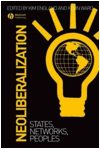 series.
Table
of Contents -- contributions from scholars in geography, anthropology,
health studies, political science, planning and sociology: Mark Beeson; Kim England, Joan Eakin, Denise Gastaldo and
Patricia McKeever; Catherine Kingsfisher;
Wendy Larner, Richard LeHeron
and Nicholas Lewis; Pete North; Nick Phelps, Marcus Power and Roseline Wanjiru; Katharine
Rankin and Yogendra B Shakya;
and Kevin Ward.
Click
here for more information.
 Eleonore Kofman
and Kim England, eds. (1997) “Citizenship and
International Migration: Taking Account of Gender, Sexuality, and ‘Race’,” Environment and Planning A, 1997, 29(2).
Eleonore Kofman
and Kim England, eds. (1997) “Citizenship and
International Migration: Taking Account of Gender, Sexuality, and ‘Race’,” Environment and Planning A, 1997, 29(2).
Papers by Jon Binnie; Kim England and Bernadette Stiell;
and Ruth Fincher.
Click
here for the table of contents.
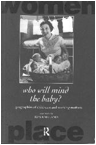
Kim England, ed. (1996) Who Will Mind the Baby? Geographies of Child-Care and Working
Mothers. Routledge:
Lodon and New York: “International Studies of Women
and Place” series.
Contributions from scholars in geography, economics and
planning: David Bloom and Todd Steen, Ellen Cromley,
Isabel Dyck, Kim England, Ruth Fincher, Holly
Myers-Jones and Susan Brooker-Gross, Marie Truelove,
and Ian Skelton.
Click
here for more information
Care and Care Workers
– Nurses, Home Care, Nannies and Child Care:
Kim England (2013) “Nurses across
borders: Global migration of Registered Nurses to the US” Gender
Place and Culture: forthcoming
Kim England and Caitlin Henry (2013) “Care,
migration and citizenship: Nurse Migration to
the UK” Social and Cultural Geography:
forthcoming.
Kim England and Isabel Dyck (2012) “Migrant
Workers in Home Care: Responsibilities, Routes and Respect” Annals of the Association of American
Geographers, 101 (5): 1076-1083
Isabel Dyck and Kim England (2012)
“Homes
for Care: Reconfiguring
Care Relations and Practices” in Christine Ceci,
Kristin Bjornsdottir and Mary Ellen Purkis (eds.) Home,
Care, Practices: Critical Perspectives on Care at Home for Older People. Routledge:
Kim England and Isabel Dyck (2011)
“Managing the Body Work of Home Care” themed issue ‘Body Work’ in Sociology of Health and Illness, 33(2):
206-219. (reprinted in Julia Twigg,
Carol Wolkowitz, Rachel Lara Cohen and Sarah
Nettleton (eds) Body
Work in Health and Social Care: Themes,
New Agendas, 2011, Wiley-Blackwell:
Oxford)
Kim England (2010) “Home, Paid Care Work
and Geographies of Responsibilities” themed issue on ‘Care-full Geographies’ in
Ethics, Place and Environment, 13(2):
131-150.
Kim England (2008) “Welfare Provision, Welfare Reform, Welfare Mothers,” in Kevin Cox, Murray Low and Jennifer Robinson (eds) Handbook of Political Geography Sage:
Kim England, Joan Eakin, Denise Gastaldo and Patricia McKeever
(2007) “Neoliberalizing Home Care: Managed Competition and
Restructuring Home Care in
Kim England (2007) “Caregivers,
Local-Global, and Geographies of Responsibility,” in Pamela Moss and Karen
Falconer Al-Hindi (eds.) Feminisms,
Geographies, Knowledges. Rowman and Littlefield:
Denise Gastaldo, Joan Eakin, Kim England, and Patricia McKeever
(2004) “In Between Friendship and Professionalism,” in Sioban
Nelson (ed.) In Sickness and in Health:
Ethics, Power, and Practice (Vol. 1). Nursing Praxis International:
Kim England (2003) “Towards a Feminist
Political Geography?” Political Geography, 2003, 22(6): 611-616. (reprinted in Kevin R Cox (ed.) Political Geography: Critical
Concepts in the Social Sciences, 2005, Routledge).
Kim England (2000) “‘It’s really hitting home’: The home as a
site for long-term health care,” in the special issue on “Healthy communities
through women’s eyes” in International Women and Environments Magazine (Summer/Fall, 2000, Issue 48/49, 25).
Bernadette Stiell
and Kim England (1999) “Jamaican Domestics, Filipina
Housekeepers and English Nannies: Representations of Toronto’s Foreign
Domestic Workers,” in Janet Momsen (ed.) Gender,
Migration and Domestic Service. Routledge: London
and New York, pp. 42-62.
Employment and
Workplace Diversity:
Kim England (2013) “Clerical Work” in Vicki Smith (ed.) Sociology of Work: An Encyclopedia, Sage,
forthcoming.
Kim England (2013) “Women, Intersectionality
and Workplace Equity” in Carol Agocs, Michael Lynk, and John Craig (eds.) Employment Equity in Canada: 25
Years after the Abella Report, Toronto: University of Toronto Press.
Kim England and Kate Boyer (2009) “Women’s Work: The Feminization and Shifting Meanings of Clerical Work” Journal
of Social History, 43(2):
307-340.
Kate Boyer and Kim England (2008) “Gender, Work and Technology in the
Information Workplace: From Typewriters
to ATMs” Social and Cultural Geography,
9(3): 241-256.
Kim England (2005) “Diversity at work? Employment Equity and
Visible Minorities in Canadian Banking,” Final Report
for the Canadian Studies Grant Program, Canadian Embassy,
Kim England and Victoria Lawson (2005) “Feminist
Analyses of Work: Rethinking the Boundaries,
Gendering and Spatiality of Work,” in Lise
Nelson and Joni Seager (eds.) Companion to Feminist Geography. Blackwell:
Kim England (2003) “Disabilities, Gender
and Employment: Social Exclusion, Employment Equity and Canadian Banking,” The Canadian Geographer, 2003, 47(4): 429-450.
Kim England (2002) “Interviewing Elites:
Cautionary Tales about Researching Women Managers in Canada’s Banking Industry,”
in Pamela Moss (ed.) Feminist Geography in Practice: Research and Methods
Blackwell: Oxford, pp. 200-213.
Kim England and Gunter Gad (2002) Social Policy at
Work? Equality and Equity in Women’s Employment in
Urban Politics, Urban
Spaces and Cities:
Kim England (2012) “‘Everyday
Life is Situated’: Politics, Space and Feminist Theory” in Andrew Jonas
and Andrew Wood (eds.) Territory, The
State and Urban Politics: New Critical Directions, Ashgate:
Burlington, VT, pp. 187-202.
Kim England (2011) “Spatial stories: Belltown, Denny Hill and
Pike Place Market” contribution to Michael Brown and Richard L. Morrill (eds.) Seattle Geographies, University of
Washington Press: Seattle, pp. 144-150.
Kim England and John Mercer (2006) “Canadian Cities
in Continental Context: Global and Continental Perspectives on Canadian
Urban Development” in Trudi Bunting and Pierre Filion (eds.) Canadian
Cities in Transition: Local through Global Perspectives, 3rd
Edition, Oxford university Press: Toronto, pp. 24-39.
Veronica Strong-Boag,
Isabel Dyck, Kim England and Louise Johnson (1999)
“What Women’s Spaces? Women in Australian, British, Canadian, and US Suburbs,”
in Richard Harris and Peter J. Larkham (eds.) Changing
Suburbs: Foundation, Form and Function, Chapman and Hall: London, pp.
168-186.
Feminist
Methodologies and Pedagogy:
Kim England (2006) “Producing
Feminist Geographies: Theory, Methodologies and Research Strategies,” in
Stuart Aitkin and Gill Valentine (eds.) Approaches to Human Geography.
Sage: London and
Thousand Oaks, CA., pp. 286297. Revised and updated versions coming soon in the second edition….
Kim England (2002) “Interviewing Elites:
Cautionary Tales about Researching Women Managers in Canada’s Banking
Industry,” in Pamela Moss (ed.) Feminist Geography in Practice: Research and
Methods Blackwell: Oxford, pp. 200-213.
Kim England (1999) “Sexing Geography,
Teaching Sexualities,” The Journal of Geography in Higher Education,
23(1): 94-101.
Some older papers of
note:
Bernadette Stiell
and Kim England “Domestic
Distinctions: Constructing Difference among paid Domestic Workers in
Kim England and
Bernadette Stiell “‘They think you’re
as stupid as your English is’: Constructing Foreign Domestic Workers in Toronto,”
Environment and Planning A, 1997, 29(2): 195-215. (reprinted in Pamela Moss and Karen Falconer Al-Hindi (eds.) Feminisms in Geography:
Rethinking Space, Place and Knowledges, 2007, Rowman and Littlefield).
Kim England “‘Girls
in the Office’: Job Search and Recruiting in a Local Clerical Labor Market,”
Environment and Planning A, 1995, 27(12): 1995-2018.
Kim England “Suburban Pink
Collar Ghettos: The Spatial Entrapment of Women?” Annals of the Association
of American Geographers, 1993, 83(2): 225-242 (and see exchange with Susan
Hanson and Geraldine Pratt,” Annals of the Association of American
Geographers, 1994, 84(3): 500-504.
Kim England “Getting
Personal: Reflexivity, Positionality and Feminist
Research,” The Professional Geographer, 1994, 46(1): 80-89. (reprinted in
Trevor Barnes and Derek Gregory (eds.) Reading
Human Geography: The Poetics and Politics of Inquiry, 1997, Edward
Arnold AND reprinted in Harald Bauder and Salvatore Engel-Di
Mauro (eds.) Critical Geography: An Introduction and
Reader, Praxis(e)Press.)
Kim England “Gender
Relations and the Spatial Structure of the City,” Geoforum, 1991, 22(2): 135-147.