BLS 347 (LN
7852)
History of
American Documentary Films
Spring
2003
Tuesday/Thursday,
5:45-7:50 p.m., Rm. UW1-051
Click here
<http://depts.washington.edu/ctlt/catalyst/umail/mail.cgi?user=davidgs&form=5>
to contact instructor with or without identifying yourself. (My
e-mail address ____________________ is provided in class. No
telephone calls, please.)
Office: UW1-135
Office hours: Tuesdays and Thursdays,
4:30-5:30 p.m. and by appointment
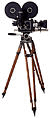
Nonfiction films have been enlightening,
entertaining, teaching, and challenging us for nearly a century. In
this course, we will explore the history of this expressive form of
culture, noting its most important technological and cinematic
innovations. More significantly, we will discuss the cultural
contexts for the films (why they were made and what they tell us
about the social concerns of the period) and the theoretical
questions they raise, including the blurry line between fiction and
nonfiction and the problematic assumption of unbiased
presentation.
By the end of the course, you can expect to
be able to define documentary films and identify their major
components, speak and write critically about a few of the most
important American documentaries ever made, understand the historical
development of documentary films in terms of their technology and
content, develop skills in the critical evaluation of documentaries,
and understand the historical and social forces out of which
filmmakers have created documentaries and upon which the films
comment.
Please note that students in this course
will be required to view one film outside of class, on their own
time, no later than May 26:
Lewis and Clark: Great Journey
West at Seattle Center's Pacific Science Center. For showtimes
and ticket prices, visit <http://www.pacsci.org/imax/default.html#sacajawea>.
For directions to the Pacific Science Center and other
information, visit: <http://www.pacsci.org/gen_info/>.
Some documentary films deal with mature
subject matter that might make some students uncomfortable. Students
who are not easily offended or who feel able to deal with emotional
discomfort for the purpose of learning are welcome in this
course.
Students interested in pursuing other
courses in cinema studies at UWB can visit the Cinema Studies
Pathways page at <http://www.bothell.washington.edu/pathways/cinema_studies.html>.
 Texts
(available in the UWB Bookstore [save your receipts for a
patronage
refund] and in library
reserve). Note:
Click here <http://www.bookstore.washington.edu/>
and click on the "UW Bothell" link to order books online. Enter the
course line number (shown at the top of this page) for "UW SLN Code"
(leave other spaces blank) and hit 'enter.' All items have been
ordered; contact the bookstore if some materials are not
listed.
Texts
(available in the UWB Bookstore [save your receipts for a
patronage
refund] and in library
reserve). Note:
Click here <http://www.bookstore.washington.edu/>
and click on the "UW Bothell" link to order books online. Enter the
course line number (shown at the top of this page) for "UW SLN Code"
(leave other spaces blank) and hit 'enter.' All items have been
ordered; contact the bookstore if some materials are not
listed.
Grading: Your grade will be based on
these assignments, which are described on separate pages online
(links will be activated when ready):
A note about grades: I know that students
often need to juggle school, work, family, and other obligations. I
never second-guess students' priorities, and I never think less of
students who choose to devote more time and effort to one of these
other obligations rather than to an assignment or the course as a
whole. I respect the maturity of students who establish their
priorities, make difficult choices, and accept the consequences of
those decisions. Also, remember that your grade is based solely on my
professional assessment of the quantity and quality of your work, not
on your effort or on my opinion of you as an individual.
Final Course Grade Scale:
|
195-200: 4.0
|
181-182: 3.3
|
167-168: 2.6
|
153-154: 1.9
|
139-140: 1.2
|
|
193-194: 3.9
|
179-180: 3.2
|
165-166: 2.5
|
151-152: 1.8
|
137-138: 1.1
|
|
191-192: 3.8
|
177-178: 3.1
|
163-164: 2.4
|
149-150: 1.7
|
135-136: 1.0
|
|
189-190: 3.7
|
175-176: 3.0
|
161-162: 2.3
|
147-148: 1.6
|
133-134: 0.9
|
|
187-188: 3.6
|
173-174: 2.9
|
159-160: 2.2
|
145-146: 1.5
|
131-132: 0.8
|
|
185-186: 3.5
|
171-172: 2.8
|
157-158: 2.1
|
143-144: 1.4
|
129-130: 0.7
|
|
183-184: 3.4
|
169-170: 2.7
|
155-156: 2.0
|
141-142: 1.3
|
0-128: 0.0
|
For an explanation of the University of
Washington grading system, see <http://www.washington.edu/students/gencat/front/Grading_Sys.html>.
Schedule (readings listed by author;
"Barsam" refers to text listed above; author names followed by an
asterisk are listed below under "Reserves List"):
|
DATE
|
READING/ASSIGNMENTS
DUE
by beginning of class
|
IN-CLASS
WORK
|
|
Tu 04/01
|
|
Introduction: The
Documentary Film; How to Read a Film
|
|
Th 04/03
|
Associated Students*;
Goldberg*
|
NO CLASS MEETING
(Prof.
Goldstein-Shirley at a conference);
recommended:
experiment with How to Read a Film DVD-ROM in
Campus
Media Center
reserves
|
|
Tu 04/08
|
Barsam ch. 1
|
View and discuss Breathing
Lessons: The Life and Work of Mark O'Brien; introduce
scene
analysis assignment
|
|
Th 04/10
|
Renov*
|
Discuss Renov
|
|
Tu 04/15
|
Barsam ch. 2 (except "The
Nonfiction Film and War: 1898-1918")
|
View Nanook of the North;
introduce
film proposal assignment
|
|
Th 04/17
|
Barsam ch. 3 (except "The Soviet
Naturalist Tradition" and "The Western
Avante-Garde")
|
Discuss Nanook of the
North
|
|
Tu 04/22
|
Barsam ch. 7
|
American Nonfiction Film:
1930-1939: View and discuss The Plow that Broke the
Plains
|
|
Th 04/24
|
Barsam ch. 10
|
American Films for World War
II: View and discuss War Comes to
America
|
|
Tu 04/29
|
Barsam ch. 13 (only introduction
and "Television Documentary")
|
American Nonfiction Film after
World War II: View and discuss Harvest of
Shame
|
|
Th 05/01
|
Barsam ch. 14 (except "Canadian
Film")
|
American Renaissance in the
1960s: The New Nonfiction Film: View and discuss Dont
Look Back
|
|
Tu 05/06
|
Barsam ch. 15 (only sections on
the Maysles Brothers, Wiseman, and De Antonio)
|
Tradition and Change in the
1970s: View The Titicut Follies
|
|
Th 05/08
|
Scene
analysis due
|
Tradition and Change in the
1970s: Discuss The Titicut Follies; introduce
learning
portfolio assignment
|
|
Tu 05/13
|
Kopple*
|
Tradition and Change in the
1970s: View Harlan County U.S.A.
|
|
Th 05/15
|
Work on documentary
film proposal
|
Tradition and Change in the
1970s: Discuss Harlan County U.S.A.
|
|
Tu 05/20
|
Barsam ch. 16 (except "Nonfiction
Film in Third World and Non-Western Countries")
|
New Voices of the 1980s:
View Streetwise
|
|
Th 05/22
|
Documentary
film proposal due
|
New Voices of the 1980s:
Discuss Streetwise
|
|
Tu 05/27
|
View Lewis and Clark: Great
Journey West at
Pacific
Science Center
|
Discuss Lewis and Clark: Great
Journey West
New Voices of the 1980s: View Tongues
Untied
|
|
Th 05/29
|
Work on learning
portfolio
|
New Voices of the 1980s:
Discuss Tongues Untied
|
|
Tu 06/03
|
View Startup.com (in Campus
Media Center or rented on your own); learning
portfolio due
|
Documentary Film in the
Twenty-first Century: Discuss
Startup.com
|
|
Th 06/05
|
Study for final
examination
|
NO CLASS MEETING; study for
final
examination
|
|
Tu 06/10
|
|
Final
examination
|
*Additional readings
list:
Media List (only UWB-owned films
will be on reserve at the Media Center <http://www.bothell.washington.edu/media/>):
- Breathing Lessons: The Life and Work
of Mark O'Brien. Dir.
Jessica Yu. 1996. 35 min. Educational Media Center. View in class
on Apr. 8.
- Dont Look Back.
Dir. D. A. Pennebaker.
1967. 96 min. BOT-1764. View in class on May 1.
- Harlan County, U. S. A.
Dir. Barbara Kopple. 1967.
103 min. BOT-178. View in class on May 13.
- Harvest of Shame.
Prod. Bernard Birnbaum.
1960. 55 min. BOT-1246 vol. 4. View in class on Apr.
29.
- Lewis and Clark: Great Journey
West. Dir. Bruce
Neibaur. 2002. 42 min. View on your own no later than May
27.
- Nanook of the North.
Dir. Robert J. Flaherty.
1922. 79 min. DVD BOT-19. View in class on Apr. 15.
- The Plow that Broke the Plains.
Dir. Pare Lorenz. 1936. 25
min. BOT-1774. View in class on Apr.22.
- Startup.com.
Dir. Chris Hegedus and
Jehane Noujaim. 2001. 107 min. DVD. BORES BOT-102. View on your
own no later than Jun. 3.
- Streetwise.
Dir. Martin Bell. 1984. 92
min. BOT-26. View in class on May 20.
- The Titicut Follies.
Dir. Frederick Wiseman.
1967. 84 min. BORES BOT-120. View in class on May 6.
- Tongues Untied.
Dir. Marlon Riggs. 1991.
55 min. BOT-1098. View in class on May 27.
- War Comes to America.
Dir. Frank Capra and
Anatole Litvak. Why We Fight Series. 1945. 65 min.
BOT-1846. View in class on Apr. 24.

This schedule is subject to change. The
most current schedule will always be posted here
<http://faculty.washington.edu/davidgs/DocFilm03Syl.html>
for your reference, and changes will be announced in class, by
e-mail, or both. The final
examination will be an in-class
essay on Tuesday, June 10, which cannot be made up if
missed.
Keep a copy of all submitted work. No extra
credit or paper re-writes will be permitted except as noted, but I
will gladly assist you with your work. In-class exercises cannot be
made up for any reason because the group interaction is
irreproducible. (See below for information on participation.) Late
assignments will be accepted only in extenuating circumstances that
could not have been anticipated, and only as specified; penalties
will apply as specified. Keep all graded materials; IAS and IS majors
will need them for their graduation portfolios.
In accordance with University policy, I
give Incompletes only if you are passing the course and attending
class to within two weeks of the end of the quarter, and then only in
extenuating circumstances that can be proven.
I will do my best to accommodate all
documented disabilities (physical, learning, cognitive, or other).
See <http://www.bothell.washington.edu/students/dss/index.html>
for information. Accommodations are not "extra help"; they are steps
to provide students with disabilities with an educational environment
equivalent to that of students without disabilities.
I am very strict about deadlines, for two
reasons: (1) I have very limited grading time, and late papers make
it hard for me to return graded papers in a timely manner; and (2) I
want everyone to have exactly the same amount of work time for the
sake of fairness. Please do not put me in the position of trying to
decide arbitrarily how late is "late." Take responsibility for
getting work to me at the beginning of class when it is due,
not ten minutes, two hours, or a day later. Rest assured that
everyone is being treated equally.
 IMPORTANT: I insist on academic integrity. You are responsible for
understanding all aspects of University regulations regarding
academic integrity. Breaches of academic integrity, including but not
limited to cheating (e.g., copying another person's work or
obtaining examination answers in a dishonest manner) and
plagiarism (i.e., using another person's words or ideas
without proper acknowledgment), whether intentional or
accidental, will result in a zero for the assignment or
examination; additional sanctions may be imposed by the University
administration. Note that American rules regarding plagiarism might
differ markedly from those in other countries. You can find more
information in the University Handbook and in the document, "Avoiding
Academic Misconduct" <http://faculty.washington.edu/davidgs/Integrity.html>.
I will help you any way I can so you can succeed while maintaining
academic integrity. I truly want you to do well. Visit my office
hours often!
IMPORTANT: I insist on academic integrity. You are responsible for
understanding all aspects of University regulations regarding
academic integrity. Breaches of academic integrity, including but not
limited to cheating (e.g., copying another person's work or
obtaining examination answers in a dishonest manner) and
plagiarism (i.e., using another person's words or ideas
without proper acknowledgment), whether intentional or
accidental, will result in a zero for the assignment or
examination; additional sanctions may be imposed by the University
administration. Note that American rules regarding plagiarism might
differ markedly from those in other countries. You can find more
information in the University Handbook and in the document, "Avoiding
Academic Misconduct" <http://faculty.washington.edu/davidgs/Integrity.html>.
I will help you any way I can so you can succeed while maintaining
academic integrity. I truly want you to do well. Visit my office
hours often!
About class
communication:
Please carefully read the "Class
Communication" document at <http://faculty.washington.edu/davidgs/Communication.html>,
which I consider to be part of this syllabus.
About participation:
Please carefully read the "Class
Participation" document at <http://faculty.washington.edu/davidgs/Partic.html>,
which I consider to be part of this syllabus.
Be considerate of your instructors and
classmates. Please turn off cellular telephones, pagers, and watch
alarms before entering a classroom. Also, be aware that entering a
classroom after class has started distracts your instructor and your
classmates. If you must do it, please try to enter through a back
door, if possible. That probably will distract your instructor (for
which you should later apologize), but at least it will reduce the
disruption you cause your classmates.
If you need to drop: You and I both
invest a significant amount of time and effort having you in this
course, so it is unfortunate when students do not complete a course
that they began, especially when other students were unable to
register for it. Sometimes, however, students need to drop a course
for good reasons. If that should become the case, I ask, as a favor,
that you send me an e-mail message notifying me. Of course, I hope
everyone who starts the course can complete it, so your work and time
and mine are put to good use!
Welcome to the course!

This page last updated May 5,
2003.
 Back
to BLS 347 Gateway
Back
to BLS 347 Gateway