transpcr.gif (812 bytes) Above and Below the Mean

In a positive relationship, if the score on one of the two variables is above the mean, then the score on the other variable is also likely to be above the mean. And of course, if the score on one of the two variables is below the mean, then the score on the other variable is also likely to be below the mean. For example, someone who is taller than average is also likely to be heavier than average and someone shorter than average is also likely to be lighter than average.

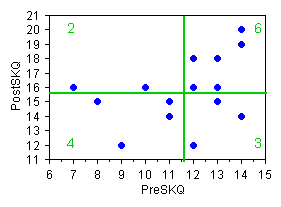
In the graph below, lines are drawn at the means of the two variables to make it easy to see for how many points in the scatterplot both scores are, say, above the mean (in the top-right corner) or both below the mean (in the bottom-left corner).

 
Move the slider and watch how the number of points in each corner of the scatterplot changes.

Switch between positive and negative relationships by clicking on the "Switch Sign" button. Notice that for positive relationships, most points are in the top-right and bottom-left corners while for negative relationships, most points are in the other corners.

 
help.gif (460 bytes)
discover.gif (528 bytes)
The graph to the right shows the pre- and post-SKQ scatterplot divided into SKQ Quadrant scatterplot four sections by the means. Are there more students in the positive diagonal corners (upper-right and lower-left) than in the negative diagonal corners (upper-left and lower-right)? If so, this suggests there is a positive relationship between pre- and post-SKQ scores. That is, students who scored high on the test at the beginning of the semester also tended to be the students who scored high on the test at the end of the semester.

File:
© 1999, Duxbury Press.
t>


File:
© 1999, Duxbury Press.
m name="NULLHYP" value="0">

Find the confidence interval for the slope by finding the range of null hypotheses that are not rejected by the data.

Return to Top


Engineering

DeVore (1995) presents the following example on p. 475:

The paper "A Study of Stainless Steel Stress-Corrosion Cracking by Potential Measurements" (Corrosion, 1962, pp. 425-432) reports on the relationship between applied stress (in kg/sq mm) and time to fracture (in hours) for 18-8 stainless steel under uni-axial tensile stress in a 40% CaCl2 solution at 100C. Ten different settings of applied stress were used, and the resulting data values (as read from a graph which appeared in the paper) were:

Test 1 2 3 4 5 6 7 8 9 10
Stress 2.5 5 10 15 17.5 20 25 30 35 40
FailTime 63 58 55 61 62 37 38 45 46 19

engineering example test of slope from Minitab

Find the confidence interval for the slope by finding the range of null hypotheses that are not rejected by the data.

Return to Top


Biology

Ott (1993) presents this example on p. 452: Fifteen male volunteers ate a low-cholesterol diet for four weeks. Below are the ages and the reduction in cholesterol (in mg per 100 ml of blood serum) for each participant:
Participant 1 2 3 4 5 6 7 8 9 10 11 12 13 14 15
Age 45 43 46 49 50 37 34 30 31 26 22 58 60 52 27
Reduce 30 52 45 38 62 55 25 30 40 17 28 44 61 58 45

biology example of slope test from Minitab

Find the confidence interval for the slope by finding the range of null hypotheses that are not rejected by the data.

Return to Top


File:
© 1999, Duxbury Press.
ange of null hypotheses that