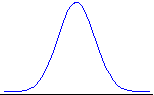
Data often have a normal distribution. The
familiar bell-shaped curve tells us how dense are observations of particular values. Data
values in dense areas of the curve are more likely, that is, more probable.
Origins of Normal Distribution
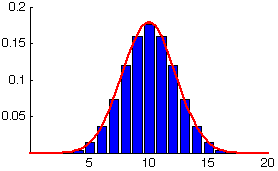
The normal distribution has many different origins, but one of
particular interest is the sum of a number of two-outcome random
choices, such as the number of heads from flipping coins or total score when
guessing on a true-false test.
Size and Shape
The size and shape of the normal distribution is entirely
determined by two parameters: the mean
and standard deviation
.
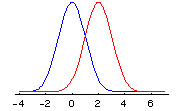
The standard normal distribution has mean
= 0 and standard deviation = 1. The mean
shifts the normal distribution, relative to the standard normal,
left or right.
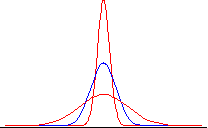
The standard deviation
stretches or squeezes
the normal distribution, relative to the standard normal. Standard deviations larger than
1 increase the spread while those less than 1 decrease the spread.

 and standard deviation
 .
The standard normal distribution has mean
= 0 and standard deviation = 1. The mean
.
The standard normal distribution has mean
= 0 and standard deviation = 1. The mean