US D.O.C. / NOAA / OAR / ERL / PMEL / 1998 Science Review

|
The Annual Cycle of SST in the Eastern Tropical Pacific
US D.O.C. / NOAA / OAR / ERL / PMEL / 1998 Science Review |
|
Goal: To
diagnose the influences on the annual cycle of SST in the East Pacific cold tongue.
Accomplishments:
An ocean general circulation model was used to simulate the response of the tropical Pacific to annual cycle wind and cloud forcing.
The eastern tropical Pacific is an especially problematic region to model because the shallow thermocline traps a wide variety of processes in a thin upper layer, challenging the vertical resolution of level GCMs. The present model (Gent and Cane 1989) uses a recently-developed mixed layer scheme (Chen et al 1995) that explicitly simulates the processes of vertical exchange of heat and momentum with the deeper layers of the ocean; comparison with observations of temperature and currents from the TAO mooring array shows that many important aspects of the model fields are realistic.
As previous studies have found, the heat balance in the eastern tropical Pacific is notoriously complicated, and virtually every term in the balance plays a significant role at one time or another.
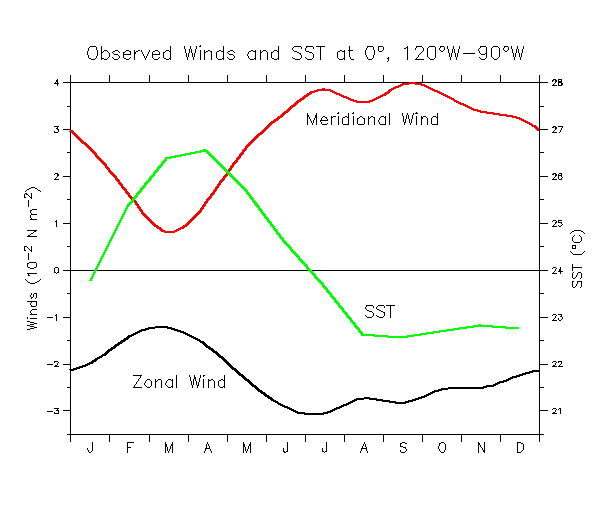 |
Figure 2. The observed annual cycle of zonal and meridional wind components and SST in the central cold tongue region. Note that SST is warm in March when both wind components are weak, and cool in August-September when both are strong. |
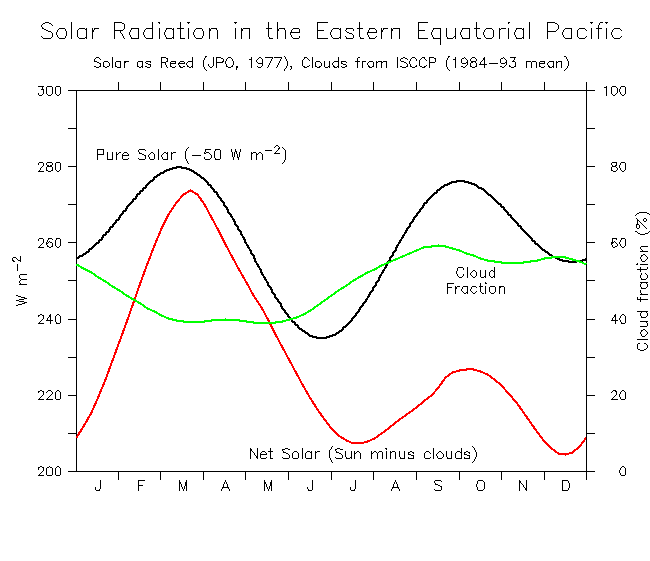 |
Figure 3. Although the clear-sky solar radiation at the equator is semi-annual, no oceanic variable shows significant semi-annual variability in the east. The annual cycle of cloudiness transforms the semi-annual solar cycle into a largely one cycle per year variation of insolation at the sea surface. The net solar radiation at the sea surface is a warming term from about February through May, and an anomalous cooling term from July through December. |
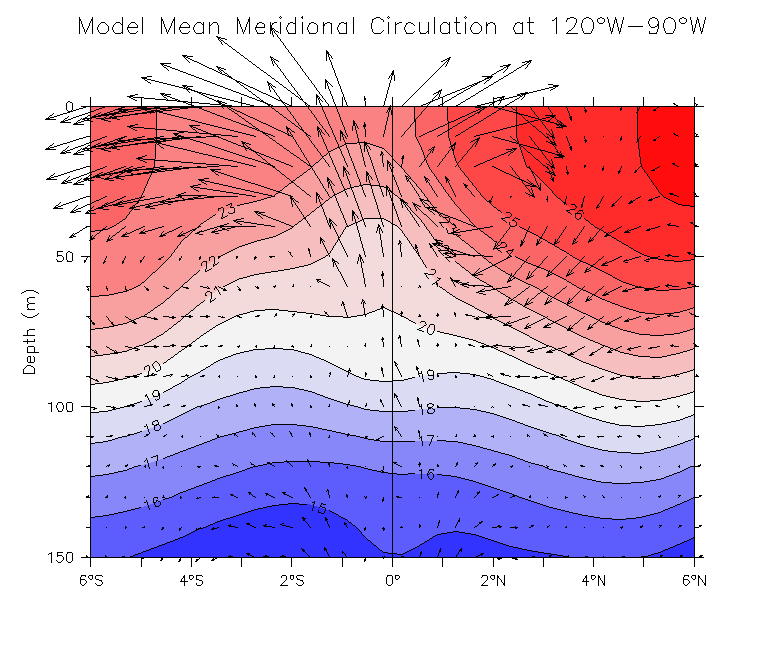 |
Figure 4. Equatorial upwelling is different in the eastern Pacific than in the more familiar central Pacific, due to the presence of strong southerly cross-equatorial winds, and also to the deceleration of the equatorial undercurrent. In the central Pacific, zonal winds are strong and meridional winds weak. This gives the classical symmetric Ekman divergence at the surface, with upwelling fed symmetrically by inflows at thermocline level from both hemispheres; the undercurrent is not changing zonally so it removes about as much water as it brings in to the region. In the east, on the other hand (this figure), southerly winds create a northward cross-equatorial current that distorts the meridional symmetry; in addition upwelling is fed not so much by meridional inflows as by water leaving the slowing undercurrent. |
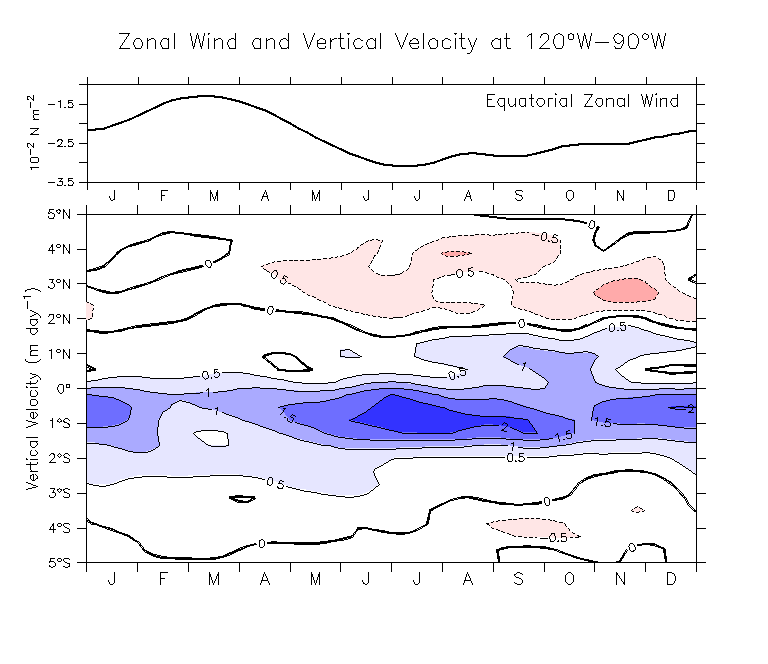 |
Figure 5. Upwelling roughly doubles (to more than 2 meters/day) when the winds are strong, as so is a large cooling term in the second half of the year. Thus upwelling cools the ocean at the same time that solar radiation is blocked by clouds. Strong winds also produce an increase in evaporation at this time, which amplifies the cooling. |
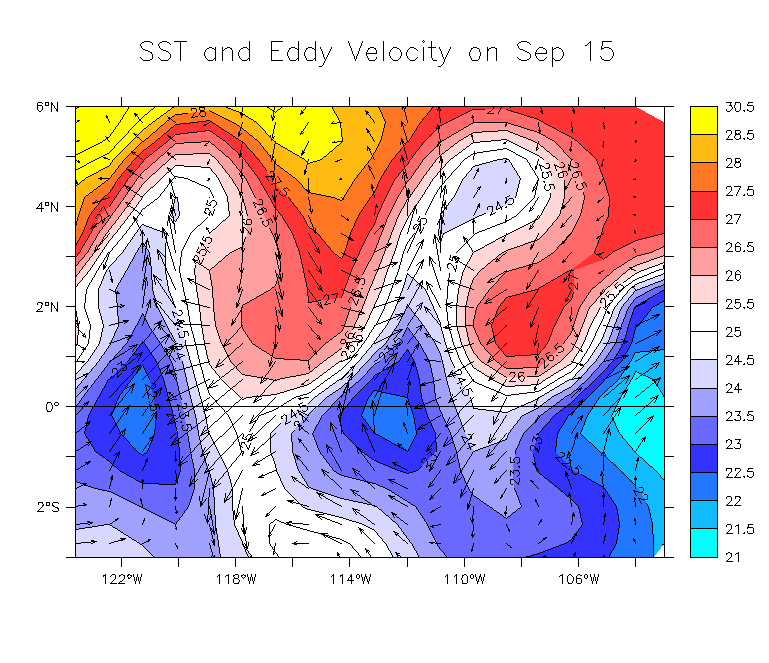 |
Figure 6. The only process which acts to warm the equatorial region is tropical instability waves, which mix warm water equatorward across the SST front north of the equator. Tropical instability waves are due to shear between the zonal currents and are strongest in the second half of the year, and so act to oppose all the other tendencies. |
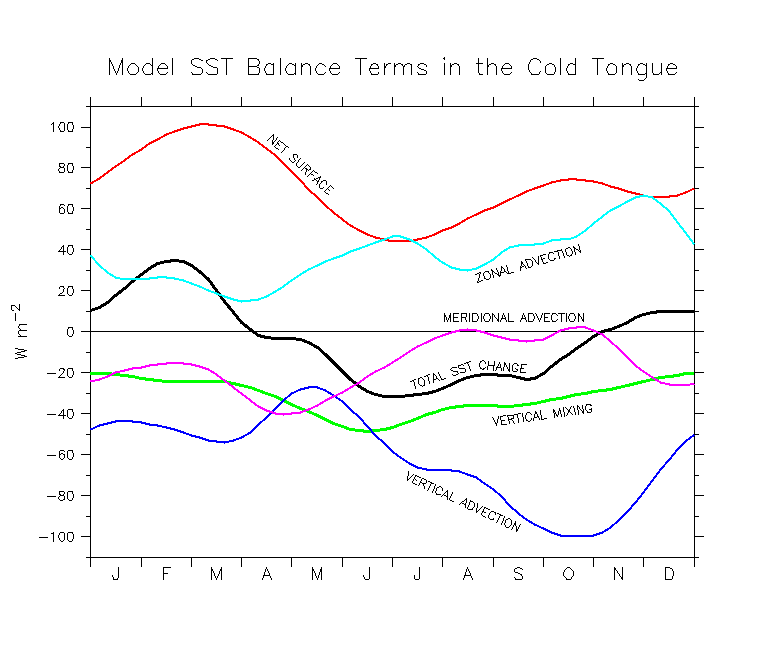 |
Figure 7. The SST balance taking all these effects into consideration shows at first glance a complete jumble of influences, all of which have similar magnitude. It is plainly extremely difficult to simplify this balance, and the prospects for observational confirmation appear hopeless. |
Nevertheless, a streamlined description is possible. One thinks of the entire upper equatorial circulation quickening when the winds are strongest in June-December: the westward South Equatorial Current and eastward North Equatorial Countercurrent are largest, as is equatorial upwelling. All three of these advective tendencies strengthen the cold tongue and the SST front to its north. The strong horizontal currents produce largest meridional shear north of the equator at this time. This increased shear results in the development of stronger tropical instability waves that mix across the SST front, warming the equator and weakening the cold tongue. Therefore the June-December quickening generates opposing SST advective tendencies (upwelling vs eddy mixing) and despite many complicated features the net oceanic effect on cold tongue SST is relatively small. Note in Fig. 7 that the Total SST Change term is well-correlated with the Radiation+Evaporation term, showing that annual cycle SST roughly follows the air-sea flux tendency, which is the result of this net cancellation of all the diverse oceanic influences.
Future Directions:
The apparent net balance between cold tongue SST and air-sea fluxes points to the crucial importance of cloudiness, which produces the observed annual cycle of radiation (1 cycle/year, not the semi-annual cycle of the sun). Qualitatively we know that the stratus clouds which are dominant in this region are involved in a positive feedback with SST. By blocking the sun, stratus cool the SST, but cold SST chills the lower atmosphere and encourages the formation of stratus. Making this relationship quantitative is difficult because satellite AVHRR measurements that are the present means of measuring SST do not see through clouds, and therefore we observe SST only when there are no clouds. In addition we do not have the detailed observations of the oceanic mixed layer vertical structure that would enable us to understand the mechanisms of this feedback. This year, several TAO buoys have been enhanced with higher-vertical resolution temperature instrumentation in the mixed layer, as well as radiometers to measure the incoming solar radiation. As these time series mature, we should be able to diagnose the interrelationships and feedbacks and quantify this crucial process.