Transduction and Transformation
Evolution of bacteria is significantly affected by the ability of the bacteria to exchange genetic information in the absence of sexual reproduction. Genetic material can move from one cell to another via several different mechanisms, either in the form of naked DNA or DNA encapsidated in a virus particle.
One way that is increasingly being recognized as an important mechanism by which bacteria acquire new traits is by the formation of lysogens of temperate bacteriophage. Once a temperate phage has become integrated into the genome of the host cell, there will be a few prophage genes expressed in the host cell. The expression of prophage genes can give the host cell new charateristics, including toxin production or new surface antigens. The ability of a prophage to give a host cell new characteristics is called phage conversion.
Temperate bacteriophages are defined as those with the ability to infect a host cell and then follow a lytic or lysogenic path.
Bacteriophages can also mediate the transfer of chromosomal DNA from one bacterial cell to another in a process know as transduction.
TRANSDUCTION- result of error in phage replication.
Specialized transduction: temperate phage like lambda (host E. coli) in the prophage state. Induction of the prophage causes the prophage to excise from the chromosome and enter a lytic replication cycle.Generation of specialized transducing particle is the result of an incorrect excision of prophage. In a specialized transducing phage, only chromosomal DNA adjacent to the original prophage attachment site can be transduced.Generalized transduction (example: phage P22, host Salmonella typhimurium)- error in packaging phage DNA into capsid structures (bacterial DNA cut and packaged). Any portion of the chromosome can be packaged into the phage capsids as long as it is of the correct size (phage packages DNA using "headful" mechanism)
NATURAL TRANSFORMATION-
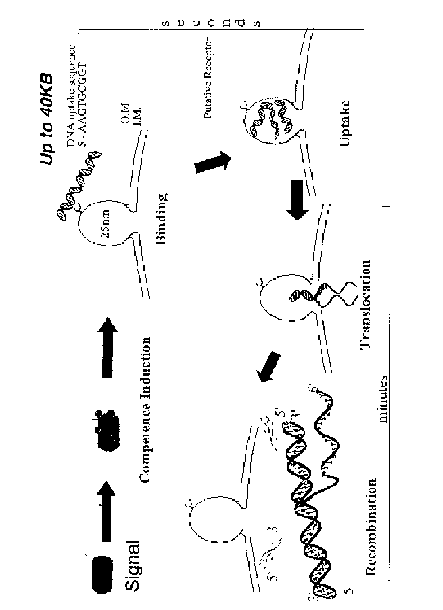
Griffith experimentSteps common to all transformable systems- (1) development of competence, (2) binding of DNA, (3) processing and uptake of DNA, and (4) integration of DNA into the chromosome by recombination and expression.
Gram-positive transformation (Strep. pneumoniae and Bacillus)- competence, DNA binding, processing and uptake. Formation of a heteroduplex and correction (repair of mis-matched bases). DNA fragments that are bound to cell generally about 15 kb in length, processed to about 8-10 kb in length before uptake into cell. On external surface of cell, a nuclease converts dsDNA to ssDNA during DNA entry into cell. In contrast to situation in Gram neg. bacterial, there is not any DNA sequence that affects the ability of the DNA to bind to the cell surface prior to transformation in Gram positive bacteria.
In Bacillus subtilis, the acquisition of competence is requlated by quorum sensing mechanism at entry into stationary phase. The quorum sensing molecule is a small peptide which is sensed in the environment by a 2-component regulatory system. The activated response regulator induces expression of competence (com) genes.
Gram-negative transformation (Haemophilus influenzae/parainfluenzae)- membraneous transformasome structure forms which contains a specific receptor for binding dsDNA of up to 40 kb in length. Specific recognition sequences within the DNA are required for DNA binding and uptake in Gram negative bacteria. In Haemophilus, this DNA binding sequence is 11bp in length (with a 9 bp core sequence shown in the diagram). This specific DNA sequence occurs approximately 1400 times in the Haemophilus chromosome (instead of the 10 times predicted if present by random distribution in the sequence).
The DNA enters the cytoplasm in the ds linear form and is converted to ssDNA after entry into the cytoplasm.
Artifical transformation-
CONJUGATION- See last set of outline notes