FISH CONCERNS
Salmon on the Brink
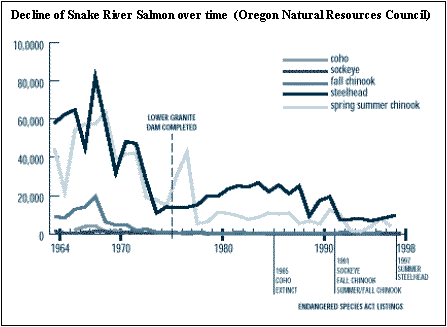 The existence of Columbia River Basin salmon and
steelhead trout hangs in the balance. Historic runs that once numbered in the
tens of millions are down by at least ninety percent, with less than 100,000
fish returning to spawn in the Snake River most years. Of those few that do
return, at least 75% are hatchery fish. Over the past fifteen years, the number
of Coho (now considered extinct) and Sockeye counted over each of the four Lower
Snake dams has often been in the single digits, and in several years there have
been none at all. Since 1991, thirteen Evolutionarily Significant Units (ESU) of
salmon and steelhead in the Basin have been listed as endangered or threatened
under the Endangered Species Act (ESA), four of which are Snake River stocks
(fall and spring/summer run Chinook salmon, sockeye salmon, and steelhead
trout). Despite expenditures in excess of $3 billion since 1985 on various
remediation strategies, these endangered species continue to decline.
The existence of Columbia River Basin salmon and
steelhead trout hangs in the balance. Historic runs that once numbered in the
tens of millions are down by at least ninety percent, with less than 100,000
fish returning to spawn in the Snake River most years. Of those few that do
return, at least 75% are hatchery fish. Over the past fifteen years, the number
of Coho (now considered extinct) and Sockeye counted over each of the four Lower
Snake dams has often been in the single digits, and in several years there have
been none at all. Since 1991, thirteen Evolutionarily Significant Units (ESU) of
salmon and steelhead in the Basin have been listed as endangered or threatened
under the Endangered Species Act (ESA), four of which are Snake River stocks
(fall and spring/summer run Chinook salmon, sockeye salmon, and steelhead
trout). Despite expenditures in excess of $3 billion since 1985 on various
remediation strategies, these endangered species continue to decline.
An
Amazing Life Cycle
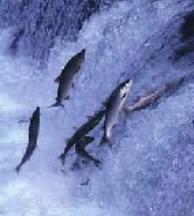 Pacific
Chinook, Coho, sockeye, chum and pink salmon as well as sea-run cutthroat and
steelhead trout are anadromous, that is, they hatch and live as juveniles (also
called smolt) in fresh water, migrate to the ocean to develop, and when sexually
mature, return to where they hatched to spawn. While some sea-run trout can
return to the sea after spawning, most Pacific salmon die after spawning once,
their carcasses providing nutrients for hatchlings. Juvenile salmon typically
reside in fresh water from a few days (pink salmon) to three years (some
sockeye) before migrating to the ocean, where they usually remain for one to six
years before migrating back to their natal stream, sometimes more than 900 miles
inland.
Pacific
Chinook, Coho, sockeye, chum and pink salmon as well as sea-run cutthroat and
steelhead trout are anadromous, that is, they hatch and live as juveniles (also
called smolt) in fresh water, migrate to the ocean to develop, and when sexually
mature, return to where they hatched to spawn. While some sea-run trout can
return to the sea after spawning, most Pacific salmon die after spawning once,
their carcasses providing nutrients for hatchlings. Juvenile salmon typically
reside in fresh water from a few days (pink salmon) to three years (some
sockeye) before migrating to the ocean, where they usually remain for one to six
years before migrating back to their natal stream, sometimes more than 900 miles
inland.
Salmon are
adapted to clean, cool (below 68ºF), low-silt streams, and shady, debris strewn
streamside habitat. While salmon do seem amazingly able to survive changes in
river conditions brought about by natural occurrences such as occasional
droughts, floods or changing ocean conditions, cumulative human impacts are
stressing their populations to the breaking point.
Fish
and People
Human activity has been the
greatest cause of salmon’s decline in the Columbia River Basin. The fall off
in runs was remarked as early as the late 19th century when
Washington Territory and Oregon first imposed a salmon fishing season. Since
then, limitations on ocean and river salmon fishing have grown increasingly
restrictive, and in 1994 the Snake was completely closed to commercial fishing.
At this point, most scientists agree that further reducing harvest levels will
not significantly improve the likelihood survival.
The major dispute now revolves
around the relative impacts of a number other factors, namely hydropower (dams),
hatcheries, and habitat (along with harvest, these are often referred to as the
“four H’s”), and the best ways to mitigate these impacts. Given the
complexity of salmon’s life history and the ecosystem in which they reside, it
is difficult to precisely quantify the relative contribution of each of the
factors. And given the complexity of the human interests that come into play
when attempting to mitigate any of the factors in salmon’s decline, it seems
likely that scientific assessment of remediation strategies has not always
remained unclouded by other considerations. Nevertheless, fish biologists
already know a great deal about the quality, if not always the quantity, of the
primary human impacts on salmon.
Dams
and Fish
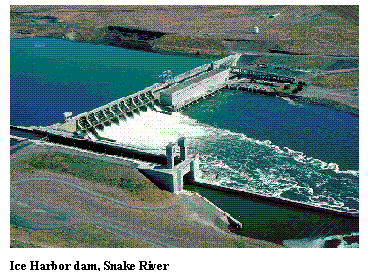 Dams not only contribute directly to both juvenile and
adult salmon mortality, but also alter river habitat in many important ways. For
example, dams:
Dams not only contribute directly to both juvenile and
adult salmon mortality, but also alter river habitat in many important ways. For
example, dams:
·
Kill smolt passing through the turbines.
·
Increase the mortality of smolt going over the spillway due to nitrogen
gas supersaturation disease.
·
Present obstacles to adult returning to spawn.
·
Increase water temperature—salmon need cool water to spawn.
·
Slow smolt passage to the ocean, making them more susceptible to predation and
requiring greater expenditure of effort (with normal flows, smolt generally
float tail-first downstream).
·
Eliminate habitat by filling gravel beds with sediment and by reducing gravel
recruitment and transport of large woody debris—places where salmon lay their
eggs and juvenile salmon seek rest and protection from predators.
Over the last
decade a number of improvements to the dams, such as smolt diversion screens and
better fish ladders, have been put in place to help both juvenile and adult
salmon pass through/over them. These changes to the dams seem to have improved
the survival of fish passing through the hydropower system, yet adult return
rates remain low. The other major effort to mitigate the dams’ impact involves
trucking and barging large numbers of smolt around
the dams. However, some scientists believe that transported fish actually fare
worse in the long run than those passing through the dams. Currently, more focus
is being placed on increasing the “spill” of water over the dams at key
times, helping juvenile fish pass over rather than though the dams, though this
can also injure large numbers of fish.
It is widely
acknowledged that dam breaching will improve survival rates. The big question
now is whether removing the dams is necessary
to prevent extinction, or whether continued efforts in the areas of habitat,
harvest and hatcheries will be sufficient. The National Marine Fisheries Service
(NMFS), which oversees the recovery planning process under the Endangered
Species Act, acknowledges that no single strategy, by itself, is likely to prevent extinction. It also notes that
management actions aimed at harvest and improving downstream survival have
reached a point of diminishing returns. Nevertheless, NMFS does not advocate dam
breaching and asserts that other actions will achieve the needed population
growth. Many other groups, notably local Tribes, disagree with this assessment.
In fact, a coalition of thirteen organizations has just filed suit against the
federal government alleging that the recovery plan is scientifically flawed and
fails to adequately provide for salmon recovery.
Given the
complexities and uncertainties of the salmon survival equation, it seems
unlikely that any amount of scientific study will ever be able to definitively
answer the question of whether dam removal could guarantee the survival of
endangered Snake River salmon. (Though the longer we wait, the less likely it
becomes that dam breaching will prevent extinction.)
Breaching the dams would undoubtedly improve the likelihood of survival,
but at great cost to a number of other river users represented elsewhere in this
paper. The question therefore becomes: do we value salmon enough to take a
chance and hope that breaching the dams will do the trick, understanding that
even such an extreme measure may ultimately fail? How do we balance the
interests of salmon and those who stand to benefit from its continued existence
against those who stand to lose if the dams are removed? Since science cannot
provide us with any assurances, the decision will ultimately have to arise from
our answers to these questions.
Salmon
and the Endangered Species Act
Passed by
Congress in 1973 and amended many times since, the Endangered Species Act (ESA)
is the only federal law expressly designed to save wild species and the
ecosystems on which they depend. The Act specifically prohibits the taking of
listed species, with the definition of “take” interpreted as both direct
harm as well as actions that destroy or alter essential habitat. The ESA
requires that decisions to list a species as endangered or threatened be made
“solely on the basis of the best scientific and commercial data available.”
Economic considerations may not play a part in the listing decision, but are
permitted at every other step in the Act’s protection process.
Under ESA, federal agencies must ensure that any
actions they authorize, fund or carry out are not likely to jeopardize the
continued existence of any listed species or result in the destruction or
adverse modification of the species’ habitat. If an agency action is likely to
adversely impact a listed species, Fish and Wildlife Service, or National Marine
Fisheries Service (NMFS) in the case of marine species, must issue a
“biological opinion” that officially declares whether the action is likely
to jeopardize the continued existence of a listed species. In December of 2000,
NMFS reversed its previous opinion and concluded that the four dams on the lower
Snake, which are owned and operated by the Army Corps of Engineers, are in fact
“likely to jeopardize the continued existence of this ESU [all four ESU
received the same assessment] and to adversely modify its designated critical
habitat.” In conjunction with this biological opinion, NMFS approved a
“reasonable and prudent alternative” (RPA)—a host of efforts designed to
further salmon recovery without removing any dams. These strategies are laid out
in the extensive Basin-Wide Salmon Recovery Strategy, which includes performance
standards by which NMFS will evaluate whether the strategy is working at three,
five and eight years out. The ultimate goal of the plan is to return species to
healthy and sustainable population levels, though some groups argue that the
plan is not well designed to attain this goal due to inadequate funding, lack of
centralized authority and faulty scientific assessment of the risks.
Whether or not the provisions of ESA will ultimately
be able to achieve the goal of salmon recovery, it is interesting to note that
we have mandated such an effort at all. In deciding that endangered species are
worth trying to preserve, sometimes at significant economic cost, we acknowledge
that they hold some non-use value for us—value that may be spiritual,
aesthetic, cultural or ecological in nature. By conferring rights upon non-human
species, ESA may also be interpreted to mean that non-human species possess
intrinsic value and a right to exist for their own sake. Nevertheless, in the
application of the law, the interests of humans are still balanced against the
right of other species to continued existence.
An Ethical Dilemma
The question of how to protect the Snake River’s
salmon populations raises many thorny ethical issues. As this paper shows, there
are myriads of users who benefit from uses of the river that are in direct
conflict with the fish’s survival. Any changes from current use patterns are
likely to help some while hurting others, so how do we arrive at the most
equitable distribution of those costs and benefits? The fish stand to lose their
very existence. Some will reasonably
argue that human interests trump those of fish, and that loss of jobs, economic
hardship and increased costs of power and other goods are too high a price to
pay. Others will argue that the fish do have a right to continued
existence—based in law, ethics or religion—that requires us to at least
weigh the interests of the fish against those of humans.
Resources
and Links
American Fisheries Society Western Division, Comments on
the Draft Biological Opinion: http://www.fisheries.org/wd/news/2000/Comments_on_Draft_Biological_Opinion_Columbia_River_etc.htm
American Rivers: http://www.americanrivers.org/
Army Corp of Engineers, NW
Division: http://www.nwd.usace.army.mil/ps/
Cumulative Risk Initiative (NMFS):
http://www.nwfsc.noaa.gov/cri/
Federal Caucus (Basin-Wide Salmon Recovery Strategy): http://www.salmonrecovery.gov/index.shtml
National Marine Fisheries Service
(Biological Opinion): http://www.nwr.noaa.gov/1hydrop/hydroweb/fedrec.htm
NMFS Office of Protected Resources
(ESA info): http://www.nmfs.noaa.gov/prot_res/overview/es.html
Northwest Power Planning Council: http://www.nwcouncil.org/
Oregon Natural Resources Council
(economics of dam removal): http://www.onrc.org/wild_oregon/salmonriver98/salmonriver98.html
Save Our Wild Salmon, Columbia
& Snake Rivers Campaign: http://www.columbia-snake.org/sos-site/index.cfm
Seattle Aquarium: http://www.salmoninfo.org/
Taxpayers for Common Sense
(economics of dam removal): http://www.taxpayer.net/snake/
Trout Unlimited: http://www.snakeriversalmon.org/
Washington State Salmon Recovery
Home: http://www.governor.wa.gov/esa/index.htm