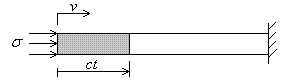
HH Problem 3.38.
A long straight rod of uniform cross-sectional area is initially at rest. One end of the rod is suddenly given a velocity v, by the application of a load which sets up a uniformly distributed stress s lb/in2 over the end of the rod. At a time t later, a length ct of the bar will be compressed, where c is the velocity of propagation of the stress wave along the rod. It will be assumed that the stress in the rod is below the elastic limit of the material so that Hooke's Law can be used; hence, s = Ee, where E is the modulus of elasticity of the material, and e is the strain, or unit deformation, of the rod.
By applying the principle of impulse and momentum to the strained element of the rod, find the velocity of propagation of the elastic wave in the rod. Find also the relationship between the velocity of the end of the rod and the applied stress. Examine Problem 3.37 from this point of view.
At time t, a compressed portion of the bar of length l = ct has acquired velocity v. Applying the impulse-momentum equation, let A be the cross-section area of the bar, and r be the material density. We then have
sAt = rA(ct)v
Thus
s = rcv (1)
Also, at time, the loaded end of the bar has moved by u = vt, which is equal to the decrease in length of the compressed zone of length l = ct. The strain of the compressed length is thus
e = u/l = v/c
and, by Hooke's law,
s = Ee = Ev/c (2)
equating the expressions of s in (1) and (2) yields c2 = E/r, or
c = sqrt(E/r) (3)
The relation between v and s is obtained from (1) with c given by (3). Thus
v = s /sqrt(Er)