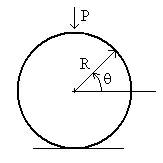
 Derive the stress formula
Problem 5.37 - By the differential equation method for determining the displacements.
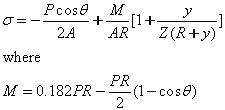
Derive the stress formula
---------------------------------------
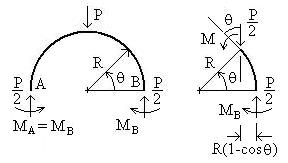 To obtain N and
M as functions of q, isolate the part of the ring
above the horizontal diameter. The shear forces at A and B are zero
because line AB is an axis of symmetry of the ring. The half ring is
symmetric with respect to the vertical diameter. Thus the bending
moments at A and B are equal, and the normal forces are equal to P/2, as shown.
From the second free-body diagram we obtain,
To obtain N and
M as functions of q, isolate the part of the ring
above the horizontal diameter. The shear forces at A and B are zero
because line AB is an axis of symmetry of the ring. The half ring is
symmetric with respect to the vertical diameter. Thus the bending
moments at A and B are equal, and the normal forces are equal to P/2, as shown.
From the second free-body diagram we obtain,
for 0 < q < p/2,
N = -(P/2)cosq
M = MB - (P/2)R(1-cosq)
The formula to be established is the general stress formula (Text: Eq. 5.72, Notes: eq. 24, Sec.2.2) in which N and M are the expressions found above, with
MB = MA = 0.182PR
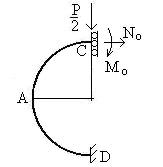 The problem is
reduced to determining MB or MA and finding it as stated
above. MB is a statical redundant, which is to be determined by
the differential equation method for the displacements. To do so, the
half-ring on the left side of the vertical diameter is chosen for analysis.
By symmetry with respect to the vertical diameter, the rotations and horizontal
displacements at C and D are zero. Thus D is fixed, and the conditions at
C are represented by a guided roller. It is noted that the reaction No
at C is equal to the shear force at A, and this was found above to be zero.
Instead of implementing this in the equations, we will find it as part of the
solution. The displacements of a half ring fixed at one end, and subjected
to forces and a moment at the other end are determined (Notes, Sec. 4, Example
1) in the form of the flexibility relations
The problem is
reduced to determining MB or MA and finding it as stated
above. MB is a statical redundant, which is to be determined by
the differential equation method for the displacements. To do so, the
half-ring on the left side of the vertical diameter is chosen for analysis.
By symmetry with respect to the vertical diameter, the rotations and horizontal
displacements at C and D are zero. Thus D is fixed, and the conditions at
C are represented by a guided roller. It is noted that the reaction No
at C is equal to the shear force at A, and this was found above to be zero.
Instead of implementing this in the equations, we will find it as part of the
solution. The displacements of a half ring fixed at one end, and subjected
to forces and a moment at the other end are determined (Notes, Sec. 4, Example
1) in the form of the flexibility relations
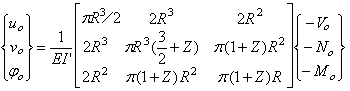
In the present problem,
Vo = P/2
vo = 0
jo = 0
The second and third flexibility equations yield, after dividing through, respectively, by R2 and R,
- RP - pR(3/2 + Z)No - p(1+Z)Mo = 0
- RP - pR(1 + Z)No - p(1+Z)Mo = 0
The solution of these equation is
No = 0
Mo = - RP/p(1+Z)
From the figure above, the bending moment at A, MA, is computed as
MA = Mo + PR/2 = PR[1/2 - 1/p(1+Z)]
To find the desired result, MA = 0.182PR, we need to neglect Z with respect to 1. The result is then
MA = PR[1/2 - 1/p] = 0.1817PR ≈ 0.182PR