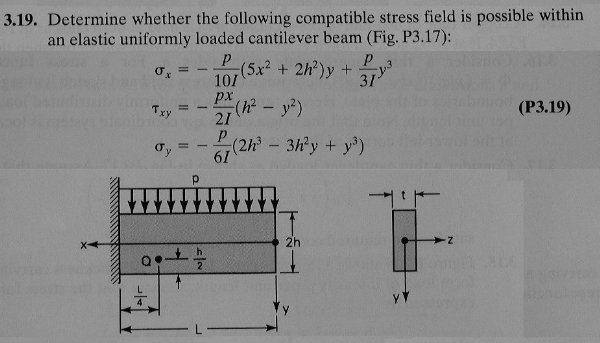
Problem 3.19
Omit the numerical part of the problem, as stated in the text.
In the equations below, I is the moment of inertia of the cross section.
Addition to problem: The stresses of Problems 3.19 and 3.17 pertain to the same body, loading, and boundary conditions.
a) Which of the two solutions if any is correct?
b) Discuss whether the difference between the two solutions is numerically significant, depending on the ratio L/h.
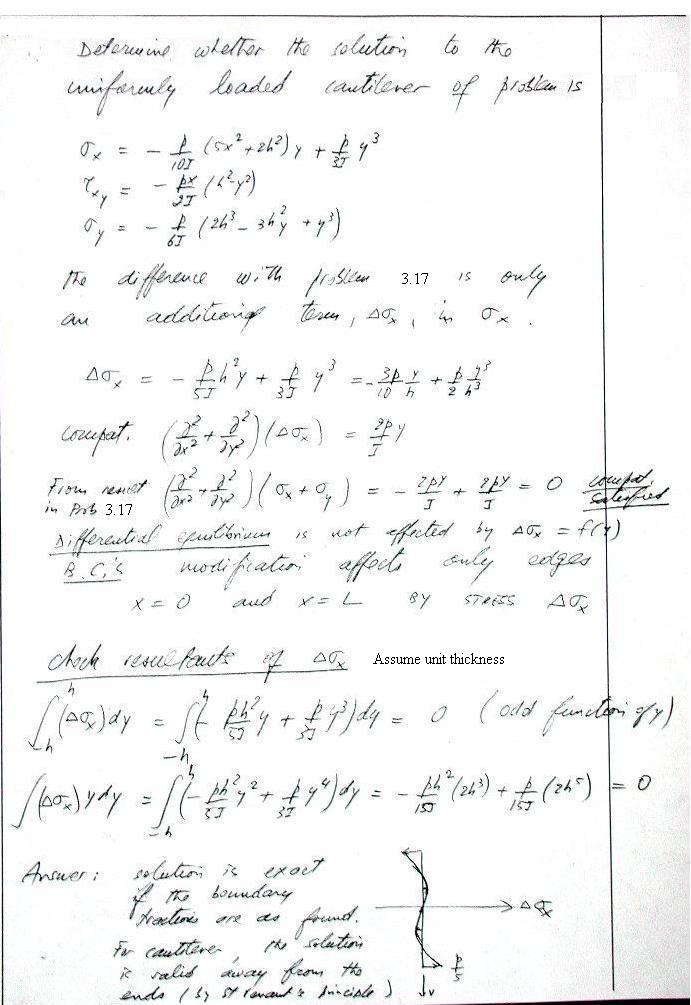
a) The solution to problem 3.17 is not correct since it does not satisfy the compatibility equation.
b) From the graph above, the additional sx stress in problem 3.19 does not exceed Ds = p/5. The maximum sx due to the remaining terms occurs at (x = L, y = ± h), and is equal in magnitude to
s = pL2h/2I
where
I = (1)(2h)3/12 = 2h3/3
Thus
s = 3pL2/4h2
Ds/s = (4/15)h2/L2
For h/L < 2, Ds/s < 0.067