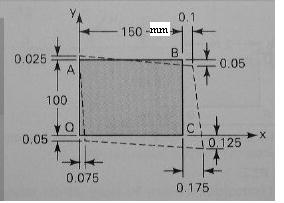
Problem 2.6
2.6. Please do not answer the questions in the text. Use the data of Fig. P2.6 to do the following:
a) Show that the displacement data is consistent with constant strains in the linear theory, and determine the strains.
b) Compute the strain of diagonal QB using the displacement data in the figure, and the linear theory.
c) Compute the strain of diagonal QB using a strain transformation formula.
Matlab .m file
% Problem 2.6
% a) Show that the displacement data is consistent with constant
% strains in the linear theory, and determine the strains.
format compact;
qc = 150; ab = 150; qa = 100; cb = 100;
uq=0.075; vq=-0.05; uc=.175; vc=-.125; ua=0; va=.025; ub=.1; vb=-.05;%mm
% dlqc = change in length of QC
dlqc = uc - uq; dlab = ub - ua; dlqa = va - vq; dlcb = vb - vc;
% roqc = rotation of QC, + cntr-clckwise. roqa = rotation of QA, + clckwise
roqc = (vc-vq)/qc; roab = (vb-va)/ab;
roqa = (ua-uq)/qa; rocb = (ub-uc)/cb;
% check consistency with constant strain
err = 1.e-15;
if((abs(dlqc-dlab)+abs(dlqa-dlcb)+abs(roqc-roab)+abs(roqa-rocb))<err)
disp('Data is consistent with constant strain')
end
disp('x-strain, y-strain, (x,y)-shear strain x 1.e3:')
ex = 1000*dlqc/qc
ey = 1000*dlqa/qa
gxy = 1000*(roqc + roqa)
disp('b)Strain of QB x 1.e3, using the displacements in the figure:')
% th = angle(x-axis, QB)
th = atan(cb/qc);
c = cos(th); s = sin(th);
lam = [c -s; s c];
% transform displacements to axes (x', y'), x'along QB
disb = lam'*[ub; vb]; disq = lam'*[uq; vq];
eqb = 1000*(disb(1)-disq(1))/sqrt(qc^2 + cb^2)
disp('c)Strain of QB x 1.e3, using a strain transformation formula:')
eqbalt = ex*c^2 + gxy*s*c + ey*s^2
----------------------------------------
Output
Data is consistent with constant strain
x-strain, y-strain, (x,y)-shear strain x 1.e3:
ex =
0.6667
ey =
0.7500
gxy =
-1.2500
b)Strain of QB x 1.e3, using the displacements in the figure:
eqb =
0.1154
c)Strain of QB x 1.e3, using a strain transformation formula:
eqbalt =
0.1154