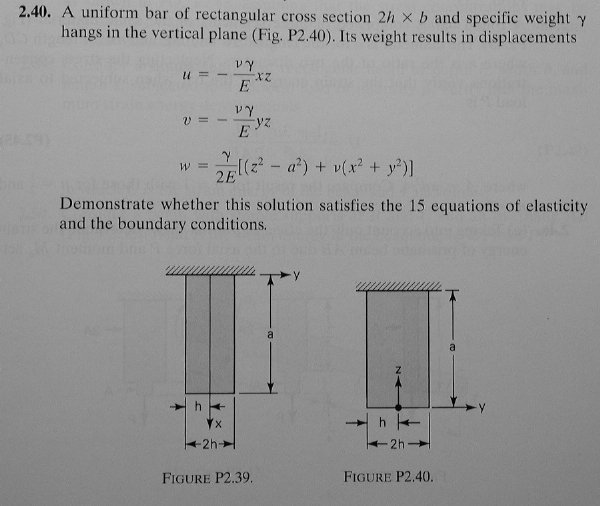
Problem 2.40
2.40. In answering the question concerning the boundary conditions, please do the following:
a) Check that the boundary conditions on the bottom and side edges are satisfied.
b) Show that the conditions of a fixed top edge, as implied by the figure, are not satisfied.
c) Check that the relaxed boundary conditions at the top edge are satisfied.
Field Equations
The 15 equations of elasticity consist of:
a) 6 strain - displacements relations
let c = g/E
ex = u,x = -ncz
ey = v,y = -ncz
ez = w,z = cz
gxy = u,y + v,x = 0
gyz = v,z + w,y = -ncy + ncy = 0
gzx = w,x + u,z = ncx - ncx = 0
b) 6 stress - strain relations
sij = 2Geij + l(ekk)dij
ekk = e11 + e22 + e33 = (1 - 2n)cz
dij = 1 if i = j, 0 otherwise
l = nE/(1+n)(1-2n)
G = E/2(1+n)
lekk = nEcz/(1+n) = ngz/(1+n)
sx = 2Gex + l(ekk) = -nczE/(1+n) + ngz/(1+n) = - ngz/(1+n) + ngz/(1+n) = 0
sy = 2Gey + l(ekk) = 0 since ey = ex
sz = 2Gez + l(ekk) = Ecz/(1+n) + ngz/(1+n) = gz/(1+n) + ngz/(1+n) = gz
All shear stresses are zero since all shear strains are zero
c) 3 equilibrium equations
sij,i + Fj = 0
We have F1 = F2 = 0, and
F3 = -g
For j = 1,2, obtain 0 = 0, and for j = 3, obtain
s33,3 + F3 = g - g = 0
All 15 equations are satisfied.
Boundary Conditions
a) Check that the boundary conditions on the bottom and side edges are satisfied.
The bottom edge is free. The conditions are [(sz , tzx , tzy ) at z = 0] = 0. Satisfied.
The side edges are free. The conditions are [(sy , tyx , tyz ) at y = h and y = -h] = 0. Satisfied.
b) Show that the conditions of a fixed top edge, as implied by the figure, are not satisfied.
At the top edge, z = a. Thus
u = -ncax
v = -ncay
w = cn(x2 + y2)/2
The top edge is not fixed
c) Check that the relaxed boundary conditions at the top edge are satisfied.
The relaxed boundary conditions at the top edge are
x-resultant force = 0. Satisfied since tzx
= 0.
y-resultant force = 0. Satisfied since tzy = 0.
z-rezultant force upward = weight
weight = g(volume) = g(2h)(b)(a)
z-rezultant force upward = sz(area) = g(a)(2h)(b) = weight