Assignment 2
Text problems:
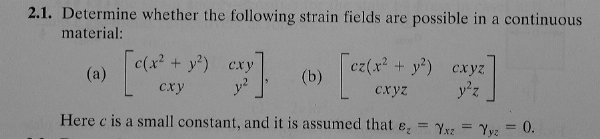
2.1. Note that the state of strain in part (b) depends on x, y, and z, and is thus three-dimensional.
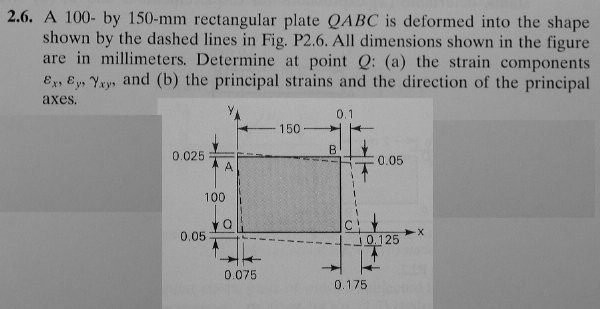
2.6. Please do not answer the questions in the text. Use the data of Fig. P2.6 to do the following:
a) Show that the displacement data is consistent with constant strains in the linear theory, and determine the strains.
b) Compute the strain of diagonal QB using the displacement data in the figure, and the linear theory.
c) Compute the strain of diagonal QB using a strain transformation formula.
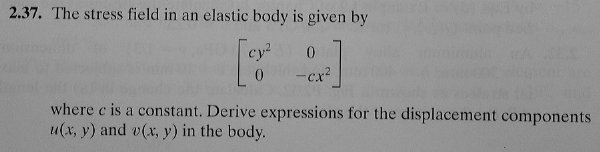
2.37. Before answering the question, please show first that the strains are compatible. Also, note that the integral of a partial derivative such as u,x contains an arbitrary function of y.
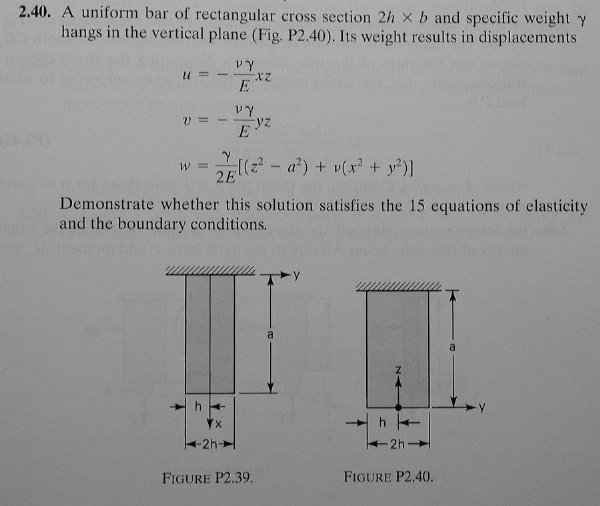
2.40. In answering the question concerning the boundary conditions, please do the following:
a) Check that the boundary conditions on the bottom and side edges are satisfied.
b) Show that the conditions of a fixed top edge, as implied by the figure, are not satisfied.
c) Check that the relaxed boundary conditions at the top edge are satisfied.
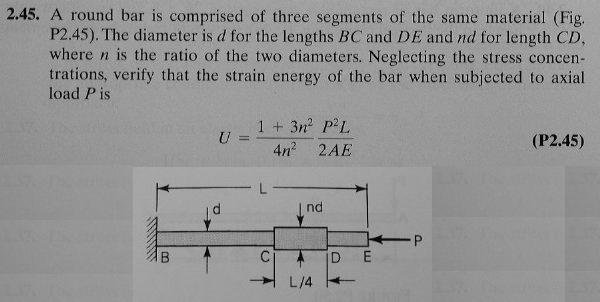
2.45. Please, delete the last part of the question stating "Compare the result etc. ", and add the following to the question:
Determine the displacement u at the load point, and verify that
u = ∂U/∂P
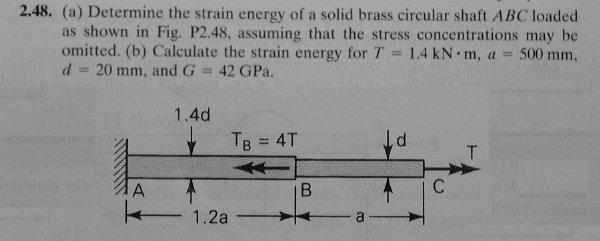
2.48. Please ignore the question in the text, and modify the figure by letting TB be independent of T.
(a) Determine U as a function of T and TB.
(b) Determine the twisting rotations, j at C, and jB at B, in terms of T and TB, and verify that
j = ∂U/∂T
jB = ∂U/∂TB
c) Let TB = 4T in the result of part (a), so U becomes a function of T. Can you determine or guess what would be obtained by the operation ∂U/∂T?