 1. One-Cell Tube
Chapter 7
Torsion of Thin-Walled Closed Tubes
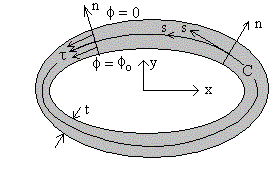
The figure shows a closed tubular cross-section whose geometry is defined by a middle line (C) having arclength s, outward normal n, and a thickness t, which may be variable. As seen in the general study of torsion, Prandl's stress function f must be constant on the boundary. For a tubular section f takes on a different constant value on each boundary curve. We can set f = 0 on the outer boundary, and let f = fo on the inner boundary, where fo is to be determined in terms of the applied Torque. The shear stress at any point is tangent to the contour line, f = constant, and equal to the negative of the directional derivative -f,n . For a thin tube and a gradually varying thickness, f,n may be considered constant along n, and thus equal to Df/t = - fo/t, and the contour lines along n may all be considered parallel to the s direction. We may thus write at any point along the normal,
t = tzs = -f,n = fo/t (1)
The shear flow is
q = tt = fo (2)
and is thus constant around the tube.
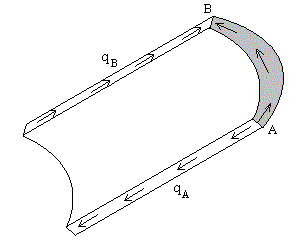
The result, q = constant, may also be obtained by considering the equilibrium of a portion of the tube between longitudinal cuts at two arbitrary points A and B. If L is the length of the tube, the resultant longitudinal force is (qB - qA)L, and must be zero. Thus qB = qA
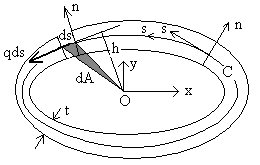
The applied torque T must be equal to the resultant torque of the shear flow. On a differential area element tds act the shear force qds, whose moment about the origin O is dT = hqds, where h is the orthogonal distance from O to the line of action of qds. Noting that hds is twice the area dA of the shaded triangle in the figure, we have dT = 2qdA, and, q being constant, integration around the middle line yields
T = 2Aq (3)
where A is the area enclosed by the middle line of the tube.
Thus, given a torque T, the shear flow is determined as q = T/2A, and the maximum shear stress is
tmax = q/tmin (4)
 To describe
the deformation, consider the shear strain-displacement relation at a point on
the middle line of the tube,
To describe
the deformation, consider the shear strain-displacement relation at a point on
the middle line of the tube,
gzs = w,s + us,z (5)
where w is the warping displacement, and us is the displacement in the s direction. We have, us = hj, where j is the angle of twist, and us,z = hq, where q = j,z is the rate of twist. Thus
gzs = w,s + hq
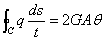
Integration of this relation around the middle line of the tube yields

The integral of w,s between two points A and B is (wB - wA). w being single valued, the integral of w,s around the middle line is zero. The integral of hds is 2A, as seen earlier. We thus have, as a condition of single-valuedness of w,

In terms of the shear stress, t = Ggzs = q/t,
Substituting q = T/2A, and solving for T,
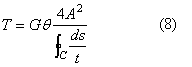
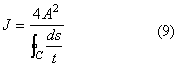
The torsional constant of the tube is thus
T = applied torque
A = area enclosed by the middle line of the cross-section
q = T/2A = shear flow
tmax = q/tmin = maximum shear stress. tmin = minimum thickness.
q = T/GJ = rate of twist. G = shear modulus. J = torsional consant, Eq. (9).
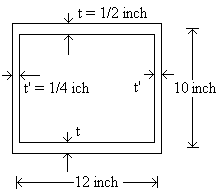
The tubular cross section is subjected to a torque T = 50 k-ft. The internal corners are actually rounded to avoid stress concentration. Determine,
a) the maximum shear stress
b) the rate of twist q, assuming G = 11,500 ksi.
a) The area enclosed by the middle line of the cross-section is
A = 12(10) = 120 in2
The shear flow is
q = T/2A = 50(12)/240 = 2.5 k/in
The maximum shear stress occurs in the thinner elements. Thus
tmax = q/t' = 2.5/0.25 = 10 ksi
b) To calculate J, the integral of ds/t is carried out piece-wise over elements of constant thickness. Thus if Li is a typical length over which t = ti, we obtain
SLi/ti = (12/0.5)(2) + (10/0.25)(2) = 48 + 80 = 128
Then
J = 4A2/SLi/ti = 4(120)2/128 = 450 in4
q = T/GJ = 50(12)/(11500 x 450) = 1.159(10-4) rad/in or 0.0797 deg./ft
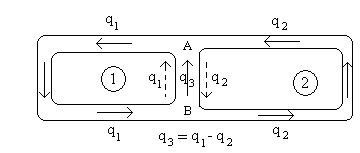
A two-cell tube is shown in the figure for illustration purposes. Each cell has an external branch along the external boundary of the cross-section, and shares with the other cell branch AB, which is along internal boundaries of the cross-section. The shear flow q in any branch is constant for the same reason as in a single cell tube. At a node such as A or B, i.e. a point common to three or more branches, the shear flows must satisfy a longitudinal equilibrium equation, similar to the one used in the preceding section, by which the sum of the shear flows coming into a node, or going out of a node, must add up to zero. In the figure, the shear flows are defined positive as shown. The shear flows coming toward node A are q3, q2, and -q1. The equilibrium equation is thus q3 +q2 - q1 = 0, or
q3 = q1 - q2
There is both a fluid-flow analogy and an electrical analogy to this equation. If q is considered as a fluid-flow, the sum of the flows into a node must equal the sum of the flows away from the node. The electrical analogy is similar.
In general, we can define one independent shear flow, qi, per cell i, and use the node equilibrium equations to define the shear flow in a branch common to two cells in terms of the independent shear flows.
Letting Ci be the middle line of cell i, and Ai be the area enclosed by Ci, the condition of single-valuedness of the warping displacement for cell i is
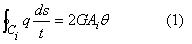
where q is piece-wise constant.
The applied torque T must be equal to the resultant torque of the shear flow. It is convenient to account for a common branch such AB by considering it twice, once as part of cell 1 with the shear flow q1, and once as part of cell 2 with the shear flow q2 running in in the opposite sense to q1. The resultant torque is thus evaluated as the sum over the cells, with a constant shear flow in each cell, or

Given a torque T, the shear stress distribution and the rate of twist may be found by the following procedure:
a) Define a shear flow qi for each cell i, positive counter-clockwise, and express the shear flows in common branches in terms of the qi's.
b) Write Eq.(1) for each cell. The resulting equations form a system of linear simultaneous equations in the qi's, for a given q. Note that in Eq. (1) the coefficients of the qi's are non-dimensional, and the coefficients of Gq on the right-hand side have the dimension of area. Solve the system for the qi's in terms of Gq. The solution has the form
qi = Gqci
where the ci's are numerical values having the physical dimension of an area.
c) Substitute the solution into Eq.(2):
T = Gq(2A1c1 + 2A2c2 + . . .)
The torsional constant J is the coefficient of Gq in the above expression, i.e.
J = 2A1c1 + 2A2c2 + . . .
d) To compute the shear stresses for a given T, compute Gq = T/J, then the shear flows qi = Gqci. The shear stress at any point is the ratio q/t at that point. The maximum q/t yields the maximum shear stress.
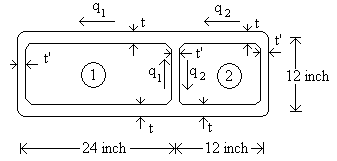
Determine the torsional constant of the two-cell cross section for
t = 1 inch and t' = 1/2 inch.
Step a)
The shear flows for the two cells are defined, respectively, as q1 and q2, positive if counter-clockwise. In the common branch, q3 = q1 - q2, upward.
Step b)
Cell 1: q1(24/t + 12/t' + 24/t) + (q1 - q2)(12/t') = 2G(24)(12)q
Cell 2: (q2 - q1)(12/t') + q2(12/t + 12/t' + 12/t) = 2G(12)(12)q
Substituting t = 1 and t' = 1/2 yields
96q1 - 24q2 = 576Gq
-24q1 + 72q2 = 288Gq
The solution is found as
q1 = (84/11)Gq
q2 = (72/11)Gq
Step c)
T = 2A1q1 + 2A2q2 = [2(288)(84/11) + 2(144)(72/11)]Gq = (69,120/11)Gq
The coefficient of Gq is
J = 6283.64 in4
 Example 1
 2. Multi-Cell Tube
 Example 2