 1. Pressure
Vessels and Circular Rings
1. Pressure
Vessels and Circular Rings
CEE 220 - INTRODUCTION TO MECHANICS OF
MATERIALS
Tutorial Session 8
Topics: Pressure
Vessels. Combined Loadings
1. Pressure
Vessels and Circular Rings
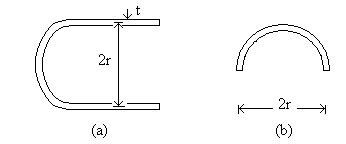
a) Figs. (a) and (b) are portions of a cylindrical pressure vessel subjected to an internal pressure p. In (b), let L be the longitudinal length of the body. Complete Fig. (a) as a free-body diagram for determining the longitudinal stress sx . Similarly, complete Fig. (b) for determining sq. In each case show the resultant of the pressure and the stress resultant.
Assume t << r, so that ri ≈ ro ≈ r.
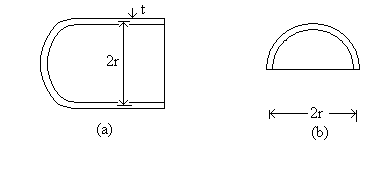 b) Repeat
the preceding question, but consider the free bodies to contain the fluid of the
pressure vessel.
b) Repeat
the preceding question, but consider the free bodies to contain the fluid of the
pressure vessel.
c) Consider a spherical pressure vessel subjected to an internal pressure p. Draw the free-body diagram of a hemispherical portion, and write the equilibrium equation for determining the in-plane stress.
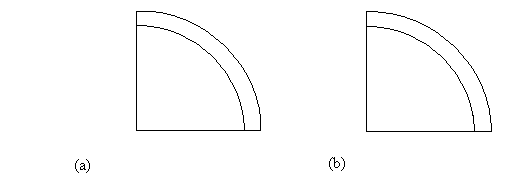
d) The figures show in projection view a quarter of a thin spherical pressure vessel contained between a vertical plane and a horizontal plane passing through the center. Fig.(a) includes the fluid, and Fig.(b) does not.
Complete the free body diagram for Fig.(a), showing on each section the pressure resultant and the stress resultant. The centroid of the area of a half circle is at a distance of 4r/3p from the diameter, and the centroid of a half circumference is at a distance of 2r/p from the diameter.
Complete the free body diagram for Fig.(b).
 e)
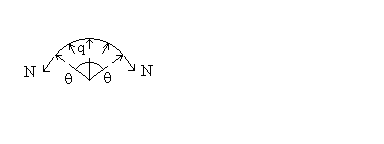
The axial force in a ring subjected to a radial load of intensity q is found by
equilibrium of a half ring as N = qr. Show that equilibrium of any
partial arc of the ring yields the same result.
e)
The axial force in a ring subjected to a radial load of intensity q is found by
equilibrium of a half ring as N = qr. Show that equilibrium of any
partial arc of the ring yields the same result.
2. Combined Loadings
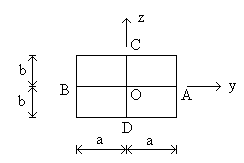
Let Fx, Fy, Fz, Mx, My, and Mz be the internal forces acting on a positive cross section of a bar, shown in the figure. In the table below, each cell refers to a stress at a point of the cross-section, as caused by an individual force.
Write in each cell the formula for the indicated stress. Use symbols A, Iy, Iz, Qy, and Qz for cross-section properties. Leave the cell empty if the stress is zero. Define separately A, Iy, Iz, Qy, and Qz in terms of the cross-section dimensions. Pay attention to the sign of each stress, since superposition is to be applied. For torsional shear stresses, for which we did not obtain a formula for a rectangular cross section, indicate a non zero stress by its symbol with a plus sign if positive, and a minus sign if negative.
| Fx | Fy | Fz | Mx | My | Mz | ||
| A | sx | ||||||
| txy | |||||||
| txz | |||||||
| B | sx | ||||||
| txy | |||||||
| txz | |||||||
| C | sx | ||||||
| txy | |||||||
| txz | |||||||
| D | sx | ||||||
| txy | |||||||
| txz | |||||||
| O | sx | ||||||
| txy | |||||||
| txz |