CEE 220 - INTRODUCTION TO MECHANICS OF MATERIALS
Tutorial Session 6 - Solution
Topic: Bending Deflections
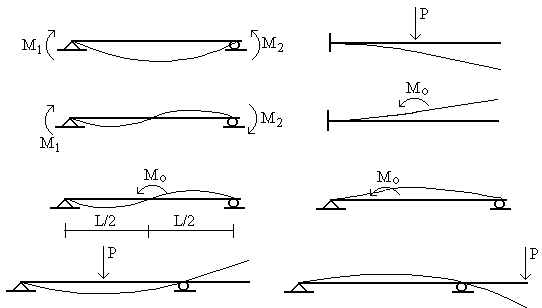
1. Qualitative Deformed Shapes
Draw qualitatively the deformed shapes of the beams. Note that if the bending moment in a portion of a beam is zero, that portion moves as a rigid body, and its displaced centerline must remain straight. Observe the support and continuity conditions.
2. Problem Set-Up for Elastic Line by Integration of d2v/dx2 = M/EI.
To set-up a problem for determining the elastic line do the following:
a) Choose and show on a sketch a coordinate system for x and the deflection v. If applicable, identify beam segments over which M/EI has different expressions. Obtain the function representing M/EI in each beam segment.
b) Write the boundary conditions and continuity conditions by which the integration constants are to be determined.
2.1 Set-up the following problems, outlining in each case steps a) and b) as described above. In all cases, choose the origin of the x axis at the left end of the beam. Assume all loads are positive as shown, EI constant, and the beam span is L. You do not need to re-state the boundary conditions if they are the same as in the preceding case.
Note: A linear function f having the values f1 at x = 0, and f2 at x = L has the expression
f = f1(1-x/L) + f2x/L.
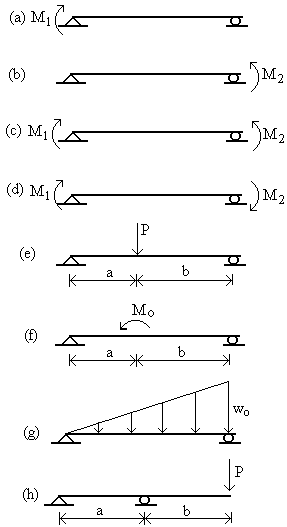 (a) M = M1(1-x/L)
Boundary Conditions: v = 0 at x = 0, v = 0 at x = L.
(b) M = M2x/L
(c) M = M1(1-x/L) + M2x/L
(d) M = M1(1-x/L) - M2x/L
(e) (1): 0<x<a, M = (Pb/L)x
(2): a<x<L, M = (Pb/L)x - P(x - a))
At x = a, v(1) = v(2), v'(1) = v'(2)
(f) (1): 0<x<a, M = (Mo/L)x
(2): a<x<L, M = (Mo/L)x - Mo
At x = a, v(1) = v(2), v'(1) = v'(2)
(g) Reaction at left = R = (woL/2)(1/3) = woL/6.
At x, w = (wo/L)x.
Load resultant in interval (0,x) = Rw = wx/2 = (wo/2L)x2, located at distance x/3 from point x.
M = Rx - Rw(x/3) = woLx/6 - wox3/6L
(h) At roller M = -Pb. At ends M = 0.
(1): 0<x<a, M = -Pbx/a
(2): a<x<L, M = -P(L - x)
Boundary Conditions: v = 0 at x = 0 and x = a.
Continuity Conditions: At x = a, v(1) = v(2), v'(1) = v'(2)
2.2. Set-up the following problems similarly to the problems of part 2.1.
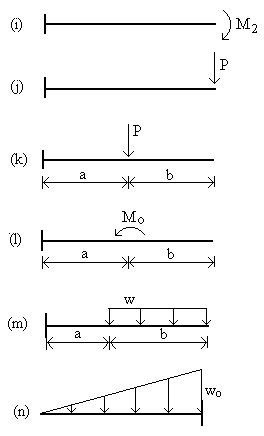 (i) M = - M2
Boundary conditions: v = 0 at x = 0, v' = 0 at x = 0.
(j) M = -P(L - x)
(k) (1): 0<x<a, M = -P(a - x)
(2): a<x<L, M = 0
(l) (1): 0<x<a, M = Mo
(2): a<x<L, M = 0
(m) Reactions at suppport: R = wb, C = wb(a + b/2)
(1): 0<x<a, M = Rx - C = wbx - wb(a + b/2)
(2): a<x<L, M = -w(L-x)2/2 (moment from right)
(n) w = wox/L.
Load resultant in interval (0,x) = Rw = wx/2 = (wo/2L)x2, located at distance x/3 from point x.
M = - Rw(x/3) = - wox3/6L
The boundary conditions are v = 0 and v' = 0 at x = L.
3.1. Superposition
a) The deflection function of segment AB is the same as that of a simply supported member subjected to end moments. Draw a figure showing portion AB, its end moments and its deformed shape. What are the rotations at A and B from the formulas in the book appendix?
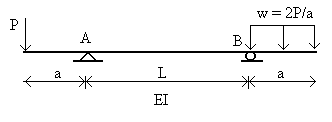
At A, EIq = Pa(L/3) + Pa(L/6) = PaL/2
At B the rotation is equal and opposite to the rotation at A.
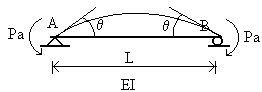
b) The overhang to the left of A is similar to a cantilever whose end A has a known rotation. Obtain the deflection at the load point by superposition of 1) the rigid-body displacement of the overhang induced by the rotation at A, and 2) the deflection due to the deformation of the cantilever considered fixed at A. Obtain needed formulas from the book appendix.
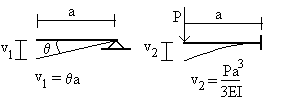
From part a), q = PaL/2EI
v = v1 + v2 = Pa2L/2EI + Pa3/3EI downward
c) Obtain the rotation at the point load by superposition.
The rotation at the tip of a cantilever due to a point load is equal to PL2/2EI. This is superimposed on the rigid body rotation PaL/2EI obtained above to give
q
= PaL/2EI + Pa2/2EI
d) Obtain the deflection and rotation at the tip of the overhang at B by superposition.
The overhang at B, considered as a cantilever fixed at B, has as deflection and rotation at the tip
vcant = wa4/8EI = Pa3/4EI
q
cant = wa3/6EI = Pa2/3EIThe rotation at B was found equal to q = PaL/2EI. It induces an additional deflection equal to qa at the tip. Thus
v = Pa2L/2EI + Pa3/4EI downward
q
= PaL/2EI + Pa2/3EI clockwise
3.2. Superposition
The joint at A is rigid. Are the calculations in this problem any different from those in the preceding problem for obtaining deflections and rotations?
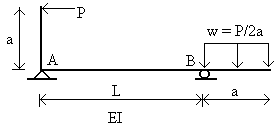
No. The overhang at A is simply rotated 90 degrees.
3.3 Superposition
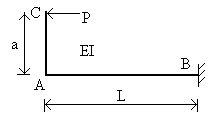 a) The bending
deflection of AB is the same as that of a cantilever fixed at B and subjected at
A to a moment. Draw a figure showing AB, its end moment and its deformed shape.
Neglect the axial deformation of AB. What are the deflection and rotation
at A from the formulas in the book appendix?
a) The bending
deflection of AB is the same as that of a cantilever fixed at B and subjected at
A to a moment. Draw a figure showing AB, its end moment and its deformed shape.
Neglect the axial deformation of AB. What are the deflection and rotation
at A from the formulas in the book appendix?
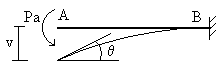 v = PaL2/2EI
q
= PaL/EI
b) The deflection and rotation at A are known from part a). Obtain the displacements and rotation at C by superposition of the rigid body motion of AC induced by the continuity at A, and the deformation of AC as a cantilever fixed at A. Obtain needed formulas for deformations from the book appendix. For the rigid body motion of AC, you may superimpose a translation downward to a small rotation about A.
The rigid body displacements of AC induced by the displacements at A are shown in the upper figure. From part a),
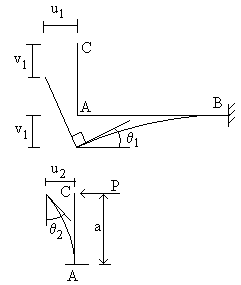 v1 = PaL2/2EI
q1
= PaL/EIWe have
u1 = q1a = Pa2L/EI
The cantilever deformations in the second figure are
u2 = Pa3/3EI
q
2 = Pa2/2EIThe final displacements at C are
v = v1 = PaL2/2EI
u = u1 + u2 = Pa2L/EI + Pa3/3EI
q
= q1 + q2 = PaL/EI + Pa2/2EI