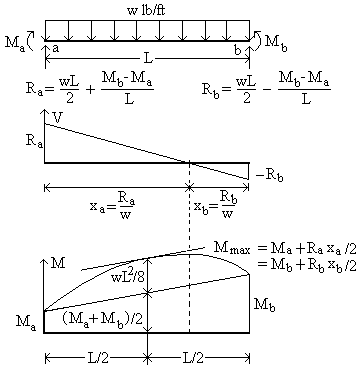
 b) Uniformly loaded beam
segment: Join the end points and the mid-point by a parabola.
A correctly drawn parabola has the following properties:
b) Uniformly loaded beam
segment: Join the end points and the mid-point by a parabola.
A correctly drawn parabola has the following properties:CEE 220 - INTRODUCTION TO MECHANICS OF MATERIALS
Tutorial Session 5
Topics:
Shear Force and Bending Moment Diagrams.
Bending and Flexural Shear Stresses.
Part 1. Key Points Approach to Shear Force and Bending Moment Diagrams.
Method: Compute V or M at key points by the method of sections, then join the key points by appropriate curves.
Key Points
1) The beam ends, and any point at which the load type changes: Points of concentrated force or moment, end points of a distributed loads.
2) Useful points for the M-diagram:
a) Point of zero shear force within a beam segment having a distributed load. The point can be determined without having to draw the shear force diagram.
b) Mid-point of a uniformly loaded beam segment.
Key Points Approach
a) Identify the key points.
b) Compute the internal force of interest at each key point by the method of sections. If discontinuous, compute the values before and after the point of discontinuity, respectively. At the beam ends, the internal forces become the external ones acting on the end cross sections.
c) Plot and join the key points by appropriate curves. The type of curve between two consecutive points depends only on the type of external loading on the beam segment between these two points.
1. Curves joining Key Points of M-Diagrams
a) Unloaded beam segment: Join the end points by a straight line.
b) Uniformly loaded beam
segment: Join the end points and the mid-point by a parabola.
A correctly drawn parabola has the following properties:
The tangent at the midpoint is parallel to the straight line joining the end points.
If the load acts downward, the parabola will be concave downward, and the mid-point will be above the line joining the ends by wL2/8, where w is the load intensity, and L is the length of the segment.
If the beam segment includes a point of zero shear, that point is one of relative maximum or minimum, thus with a horizontal tangent.
c) Segment with a varying load intensity: For a qualitative diagram, draw M concave downward if the load is downward, with a relative extremum at a point of zero shear.
Discontinuities at Key Points of M-Diagrams
a) At a point of concentrated force, without a concentrated moment, the M-diagram has a kink (slope discontinuity) and a continuous value. The kink is concave downward if the load acts downward.
b) At a point of concentrated moment, without a concentrated force, the M-diagram has a jump discontinuity, and a continuous slope.
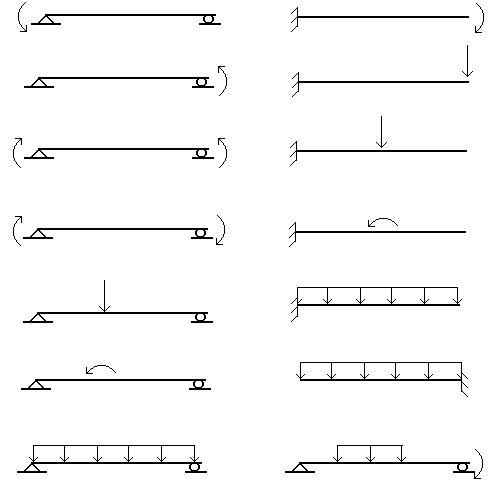
Draw qualitatively the bending moment diagram for the following cases:
2. Curves joining Key Points of V-Diagrams
a) Unloaded beam segment: V is constant. Draw a horizontal line using the value at either end point.
b) Uniformly loaded beam segment: V is linear. Join the end points by a straight line. The line should be decreasing if the load is down. If the line crosses the x axis, the point of intersection is a key point for the M-diagram at which there is a relative extremum.
c) Segment with a varying load intensity: V has a slope equal to the negative of the load intensity . A qualitative V-diagram can be drawn based on that property. For example, if the load is downward and its intensity increases with x, draw a curve decreasing and concave downward.
Discontinuities at Key Points of V-Diagrams
a) At a point of concentrated force, the V-diagram has a jump discontinuity equal in magnitude to that force. If there is also a continuous distributed load at that point, the slope of the diagram is continuous.
b) At a point of concentrated moment, the V-diagram is not affected. ( A more detailed analysis that considers the type of forces that generate the moment, would result in a better understanding of the shear force behavior, and a possible revision of the V-diagram.)
2. Draw qualitatively the shear force diagram for the following cases:
3.
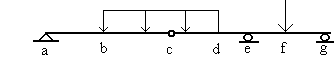 a) The
structure has three vertical force unknown reactions. Why is it statically
determinate?
a) The
structure has three vertical force unknown reactions. Why is it statically
determinate?
Deduce from a condition at pin c that the reaction at a is upward, and is less than the resultant of the applied load to the left of c. Deduce also that the reaction at e is downward.
b) At what points is the shear force discontinuous?
c) At what points is the slope of the shear force diagram discontinuous?
d) At what points is the bending moment discontinuous?
e) At what points is the slope of the bending moment diagram discontinuous?
f) Outline on a sketch of the structure a qualitative V-diagram, assuming the reaction at g is upward.
g) Outline on a sketch of the structure a qualitative M-diagram. Indicate whether the slope is continuous or whether there is a kink at points where the curve changes.
Part 2. Bending and Flexural Shear Stresses
s = -My/I
t = VQ/tI
Geometry Review:
b) The moment of an area about an axis is the product of the area by the distance of its centroid to that axis.
c) The moment of an area about an axis passing through its centroid is zero. Equivalently, a centroidal axis divides an area into two parts having equal moments in magnitude about that axis.
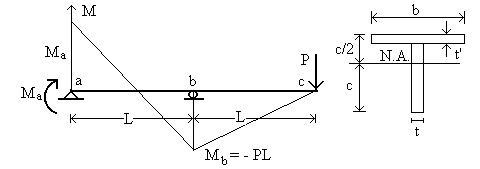 4.
4.
a) In bending, the neutral axis of a cross section is the centroidal axis perpendicular to the plane of bending. Show that in order that the neutral axis of the T section be located as shown, the flange width must be related to the other dimensions by
b = c2t/[t'(c - t') + t(c/2 - t')2]
b) The bending moment diagram of the structure is as shown. At what point in a cross-section within bc does the maximum tensile stress occur? Is that stress larger or smaller than the maximum compressive stress in the same cross-section?
c) Answer the same question as in b) for segment ab.
d) If Ma = 1.75 |Mb|, where do the maximum tensile and compressive stresses in the structure occur? What are their respective values in terms of the given data, and the moment of inertia I of the cross-section?
5.
a) If Ma = 1.75 |Mb|, what is the maximum shear force in the structure in terms of the data shown?
b) Where in a cross section within ab does the maximum vertical shear stress occur, and what is its value?
c) What is the normal force N (resultant of s) acting on the portion of the cross section below the neutral axis, if M is the bending moment at that location?
d) Consider a free-body consisting of the part of segment ab between the supports, and below the neutral plane. Using part c), show on the free-body the axial forces Na and Nb acting on the end cross sections, and, using part b) show the longitudinal shear force acting on the neutral plane. Are the forces in equilibrium?