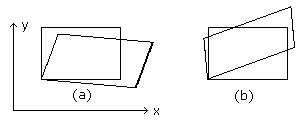
 2. Indicate the sign
of the strains ex, ey,
and gxy for the deformations of the
rectangular figure shown in (a) and (b).
2. Indicate the sign
of the strains ex, ey,
and gxy for the deformations of the
rectangular figure shown in (a) and (b).CEE 220 - Introduction to Mechanics of
Materials
Tutorial Session 2
Topic: Stress, Strain.
Stress
True or False:
a) A Failure stress is a material property. T
b) An allowable stress is a combination of a material property and a factor of safety. T
c) A factor of safety is a material property. F
d) A stress cannot physically exceed the allowable stress. F
e) The factor of safety is the ratio of the failure stress to the allowable stress. T
f) In a properly designed structural element, the maximum stress does not exceed the allowable stress. T
Strain
1. What's wrong with this type of statement: "The strain at point A is 10-3 mm".
A strain is non-dimensional. Also, it may not be clear what specific strain is being considered.
2. Indicate the sign
of the strains ex, ey,
and gxy for the deformations of the
rectangular figure shown in (a) and (b).
ex > 0, ey < 0, gxy > 0
ex > 0, ey < 0, gxy > 0
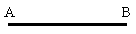 3. Line AB is 100
inch long. Determine its change in length DL and its
average strain e in each of the following cases.
Consider a decrease in length as negative.
3. Line AB is 100
inch long. Determine its change in length DL and its
average strain e in each of the following cases.
Consider a decrease in length as negative.
a) A moves right by 0.1 inch.
DL = -0.1 in, e = -0.001
b) B moves right by 0.1 inch.
DL = 0.1 in, e = 0.001
c) Both A and B move right by 0.1 inch.
DL = 0 , e = 0
d) A moves left by 0.1 inch, and B moves right by 0.1 inch.
DL = 0.2 in, e = 0.002
e) B moves right by 0.1 inch and up by 0.2 inch.
DL = sqrt(100.12 + 0.22) -100 = 0.1002 in, e = 0.001002
What is the answer by the linear theory?
The answer is the same as in b).
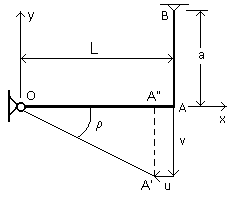 4. Bar OA of length
L rotates about point O by angle r into
position OA'. The two adjoining figures show, respectively, the exact
geometry and the approximate geometry consistent with the linear theory (samll
r). Do each of the following questions by exact
relations, and then by the linear theory.
4. Bar OA of length
L rotates about point O by angle r into
position OA'. The two adjoining figures show, respectively, the exact
geometry and the approximate geometry consistent with the linear theory (samll
r). Do each of the following questions by exact
relations, and then by the linear theory.
a) Determine the displacements u and v in terms of r and L.
Exact:
u = -(OA - OA'') = -(L - Lcosr)
v = -(A'A'') = -Lsinr
Linear Theory:
u = 0
v = -Lr
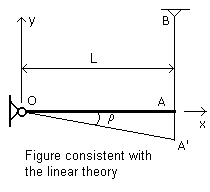 b) What is the elongation
D of cable AB?
b) What is the elongation
D of cable AB?
Exact:
D = BA' - a = sqrt[(a - v)2 + u2] - a
Linear Theory:
D = AA' = Lr
c) What is the rotation r' of cable AB?
Exact:
r' = tan-1[u/(a - v)] = - tan-1[(L - Lcosr)/(a + Lsinr)]
Linear Theory:
r' = 0
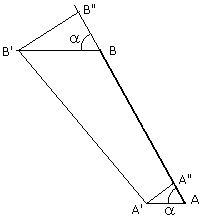 5. Bar AB is
inclined to the horizontal by angle a, and its ends
displace horizontally to A' and B', respectively. Show on the figure the
axial displacements AA" and BB" at A and B, respectively, then obtain by
the linear theory the change in length of AB in terms of AA', BB', and
q.
5. Bar AB is
inclined to the horizontal by angle a, and its ends
displace horizontally to A' and B', respectively. Show on the figure the
axial displacements AA" and BB" at A and B, respectively, then obtain by
the linear theory the change in length of AB in terms of AA', BB', and
q.
DL = BB" - AA" = BB'cosa - AA'cosa
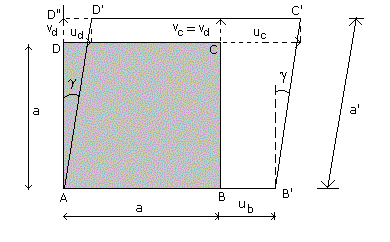 6. A square
element ABCD of side a deforms into parallelogram AB'C'D'. The deformation
may be defined by displacement ub, deformed length a', and angle
g, as shown. All vertical line elements have the same elongation
Dy = a' - a, and all horizontal line
elements have the same elongation Dx = ub.
Using the linear theory,
6. A square
element ABCD of side a deforms into parallelogram AB'C'D'. The deformation
may be defined by displacement ub, deformed length a', and angle
g, as shown. All vertical line elements have the same elongation
Dy = a' - a, and all horizontal line
elements have the same elongation Dx = ub.
Using the linear theory,
a) Write the expression of Dx for line DC in terms of the displacements at D and C.
Dx = uc - ud
b) Write the expression of Dy and g for line AD in terms of the displacements at D.
Dy = vd
g = ud/a
c) Write the relations expressing Dy and g for line BC in terms of the displacements at B and C
Dy = vc
g = (uc - ub)/a
d) Solve the preceding relations for the displacements in terms of Dx, Dy and g. Verify that ub = Dx .
From b): vd = Dy, ud = ga
From a): uc = ud + Dx = ga + Dx
From c): vc = Dy, ub = uc - ga = ga + Dx - ga = Dx
e) Determine the elongation of line AC in terms of (uc, vc).
DAC = axial displacement at C = uccos45o + vccos45o = (uc+ vc)sqrt(2)/2
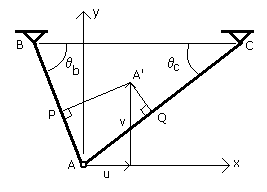 7. Joint A of
bars AB and AC displaces to position A' by small displacements u and v.
The elongation DAB of bar AB is the axial
displacement AP, and is negative in the case of the figure. Similarly, AQ
is the elongation of bar AC.
7. Joint A of
bars AB and AC displaces to position A' by small displacements u and v.
The elongation DAB of bar AB is the axial
displacement AP, and is negative in the case of the figure. Similarly, AQ
is the elongation of bar AC.
a) Express DAB and DAC in terms of u and v and angles qb and qc.
DAB = AP = u
cosqb - v
sinqb
DAC = AQ = -u
cosqc - v
sinqc
b) Let BC = 10 ft, qb = 60o, and qc = 45o. Re-write the expressions found as two simultaneous equations having (u, v) as unknowns, and right-hand sides in terms of DAB and DAC. If a temperature change causes a uniform strain e = 10-3 in the bars, what will be the displacements of the ring?
cosqb = 0.5, sinqb = sqrt(3)/2 = 0.866
cosqc = sinqc = sqrt(2)/2 = 0.707
The simultaneous equations for u and v are
0.5u - 0.866v
= DAB
0.707u + 0.707v =
- DAC
The initial lengths of the bars are found by the law of sines:
AB/sinqc = AC/sinqb =
BC/sin(p - qb
- qc) = 10/sin(75o) = 10.353
ft
AB = 10sqrt(2)/2sin(75o) = 7.3205 ft = 87.85 in.
AC = 10sqrt(3)/2sin(75o) = 8.966 ft = 107.59 in.
The bar elongations caused by the temperature are
DAB = e(AB) = 0.08785 in
DAC = e(AC) = 0.1076 in
Thus
0.5u - 0.866v
= 0.08785 in
0.707u + 0.707v =
- 0.1076 in
The solution is found as
u = -0.0322 in.
v = -0.1200 in.
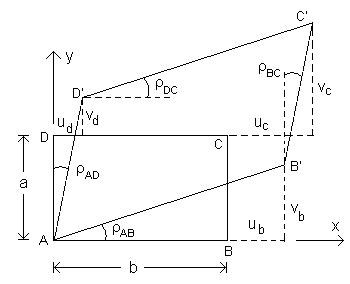 8.
Rectangular element ABCD deforms into AB'C'D'. The corner displacements
and the rotations of lines AB and AD are indicated in the figure. Strains
and rotations are assumed to be small.
8.
Rectangular element ABCD deforms into AB'C'D'. The corner displacements
and the rotations of lines AB and AD are indicated in the figure. Strains
and rotations are assumed to be small.
i) Using the linear theory, obtain the expressions of the following quantities in terms of the displacements:
a) eAB, eDC, eAD, eBC
eAB = ub/a
eDC = (uc - ud)/a
eAD = vd/b
eBC = (vc - vb)/b
b) rAB, rDC, rAD, rBC
rAB = vb/a
rDC = (vc - vd)/a
rAD = ud/b
rBC = (uc - ub)/b
c) (gxy)A, (gxy)B, (gxy)C, (gxy)D
(gxy)A = rAB + rAD = vb/a + ud/b
(gxy)B = rAB + rBC = vb/a + (uc - ub)/b
(gxy)C = rDC + rBC = (vc - vd)/a + (uc - ub)/b
(gxy)D = rDC +rAD = (vc - vd)/a + ud/b
ii) Assume that ex, ey, and gxy are constant, and, consequently, that the deformed shape is a parallelogram. The deformed shape is determined by ex, ey, and gxy, but not its rotational position about point A, which may be determined for example by rAB. Determine the six displacements in terms of ex, ey, gxy, and r = rAB.
From the deformation of AB,
ub = aex
vb= ar
From the definition of (gxy)A,
rAD = gxy - r
From the deformation od AD,
ud = brAD = b(gxy - r)
vd = bey
From eDC = (uc - ud)/a = ex , and rDC = (vc - vd)/a = r, obtain
uc = ud + aex = b(gxy - r) + aex
vc = vd + ar = bey + ar