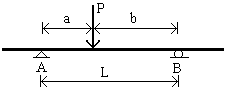
 a) Let the reactions at
supports A and B caused by the load P be Ra and Rb,
respectively. Derive the formulas
a) Let the reactions at
supports A and B caused by the load P be Ra and Rb,
respectively. Derive the formulas CEE 220 - INTRODUCTION TO MECHANICS OF MATERIALS
Tutorial Session 1
Topics: Equilibrium. Equivalent force systems. Internal Forces.
1. Reactions at Simple Supports
a) Let the reactions at
supports A and B caused by the load P be Ra and Rb,
respectively. Derive the formulas
Ra = Pb/L
Rb = Pa/L
using in each case a single moment equilibrium equation.
Can you verbalize the formulas so as to memorize their content without
relying on symbols?
b) The formulas above are applicable whether P is applied within or outside segment AB, provided a sign convention is adopted for Ra, Rb, and a or b. With a and b related by a + b = L, find and state that sign convention.
c) Show that the reactions to an applied moment M are Ra = M/L and Rb = -M/L. What is the sign convention in these formulas? Do the formulas depend on where the moment is applied?
2. Resultants of Distributed Forces
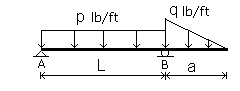 a) On a new sketch of
the beam, replace the uniform load and the triangular load, respectively, by
equivalent resultant forces, and draw a free-body diagram of the beam.
Apply the formulas of Sec. 1 to determine the reactions.
a) On a new sketch of
the beam, replace the uniform load and the triangular load, respectively, by
equivalent resultant forces, and draw a free-body diagram of the beam.
Apply the formulas of Sec. 1 to determine the reactions.
b) On a new sketch of the beam, replace the total applied loading by its
resultants at B, and draw a free-body diagram of the beam. Obtain the reaction
at A from that diagram, and check that it is the same as found in part a).
c) Determine the shear force to the immediate right of B by the force transmission approach. Do the same to the immediate left of B using the reaction at A found earlier. What is the difference between the two answers, and what is its physical significance?
 3. Resultants of a
Spatial Force System
3. Resultants of a
Spatial Force System
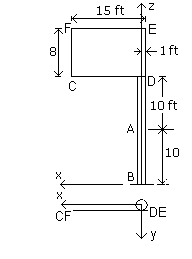
A road sign is formed of a thin plate CDEF, parallel to the (x, z) plane, and attached to a cylindrical post of radius 1 ft centered on the z axis. The plate is subjected to wind pressure p, and its weight is W. The post weighs w lb/ft.
a) Show on the figure the weight of the plate, and the resultant P of
the wind load acting on it. Show a force perpendicular to the plane of the
figure as a dot if it points out of the page (tip of the vector) or a cross if
it points into the page (tail of the vector).
b) Determine the resultants of the forces acting on the plate, at point A
on the z axis. (force resultant components Fx, Fy, Fz,
and moment resultant components MAx, MAy, MAz)
.
c) Determine by the force transmission approach the internal forces of
the post at A, and show them on a sketch as acting on the bottom part.
d) Use the results of part c) to determine the support reactions at B,
and show them on a sketch.
4. Internal Static Conditions
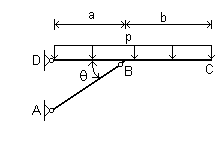 a) A bar such as AB, which
is pinned at both ends, and is not subjected to any external load, is a
two-force body subjected to a force at A and a force at B. If the bar is in
equilibrium, and F is the force at A, the force at B is -F, and
both forces act along line AB. Why is that so? What would happen if
F and -F did not have a common line of action?
a) A bar such as AB, which
is pinned at both ends, and is not subjected to any external load, is a
two-force body subjected to a force at A and a force at B. If the bar is in
equilibrium, and F is the force at A, the force at B is -F, and
both forces act along line AB. Why is that so? What would happen if
F and -F did not have a common line of action?
b) Determine the force in bar AB by a single equilibrium equation.
c) If bar AB is subjected to an external load, it ceases to be a two-force member. Does the problem become statically indeterminate? Explain.
--------------------------------------------------------------------------------------------------
A system being cut into two parts, the internal forces acting on one part
are equal, as vectors, to the resultants of the external forces acting on the
other part.
Equivalently,
A system being cut into two parts, each part exerts on the other part the
resultants of its own external forces.