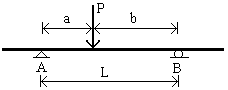
 a) Let the reactions
at supports A and B caused by the load P be Ra and Rb,
respectively. Derive the formulas
a) Let the reactions
at supports A and B caused by the load P be Ra and Rb,
respectively. Derive the formulas CEE 220 - INTRODUCTION TO MECHANICS OF MATERIALS
Tutorial Session 1 - Solution
Topics: Equilibrium. Equivalent force systems. Internal Forces.
1. Reactions at Simple Supports
a) Let the reactions
at supports A and B caused by the load P be Ra and Rb,
respectively. Derive the formulas
Ra = Pb/L
Rb = Pa/L
using in each case a single moment equilibrium equation.
SMB = Pb - RaL = 0,
Ra = Pb/L
SMA = -Pa + RbL = 0,
Rb = Pa/L
Can you verbalize the formulas so as to memorize their content without
relying on symbols?
The reaction at a support is proportional to the distance of the load to the
other support, relative to the distance between supports.
b) The formulas above are applicable whether P is applied within or outside segment AB, provided a sign convention is adopted for Ra, Rb, and a or b. With a and b related by a + b = L, find and state that sign convention.
Ra, Rb, > 0 upward
a > 0 if P is to the right of A, negative otherwise.
Consistently,
b = L-a > 0 if P is to the left of B, negative otherwise.
c) Show that the reactions to an applied moment M are Ra = M/L and Rb = -M/L. What is the sign convention in these formulas? Do the formulas depend on where the moment is applied?
SMB = M - RaL = 0
SMA = M + RbL = 0
M > 0 if counterclockwise.
Ra, Rb > 0 upward.
The formulas do not depend on where the moment is applied because the moment of a moment about any point is equal to that moment.
2. Resultants of Distributed Forces
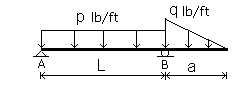 a) On a new sketch
of the beam, replace the uniform load and the triangular load, respectively, by
equivalent resultant forces, and draw a free-body diagram of the beam.
Apply the formulas of Sec. 1 to determine the reactions.
a) On a new sketch
of the beam, replace the uniform load and the triangular load, respectively, by
equivalent resultant forces, and draw a free-body diagram of the beam.
Apply the formulas of Sec. 1 to determine the reactions.
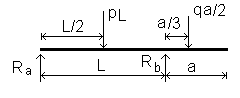
Ra = (pL)(1/2) - (qa/2)(a/3L) = pL/2 - qa2/6L
Rb = (pL)(1/2) + (qa/2)(L + a/3)/L = pL/2 + qa/2 + qa2/6L
b) On a new sketch of the beam, replace the total applied loading by its
resultants at B, and draw a free-body diagram of the beam. Obtain the reaction
at A from that diagram, and check that it is the same as found in part a).
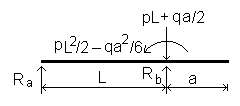
Ra = (pL2/2 - qa2/6)/L = pL/2 - qa2/6L
Rb = pL + qa/2 - (pL2/2 - qa2/6)/L = pL/2 + qa/2 + qa2/6L
c) Determine the shear force to the immediate right of B by the force transmission approach. Do the same to the immediate left of B using the reaction at A found earlier. What is the difference between the two answers, and what is its physical significance?
By the force transmission approach, shear to the right of B is
VB+ = sum of forces to the right of the section, positive if downward = qa/2
Shear to the left of B using the reaction at A is
VB- = sum of forces to the left of the section positive upward = Ra - pL = - pL/2 - qa2/6L
The difference is
VB+ - VB- = qa/2 + pL/2 + qa2/6L
It is equal to Rb. The shear force past a point of concentrated load jumps by the value of that load.
 3. Resultants of a
Spatial Force System
3. Resultants of a
Spatial Force System
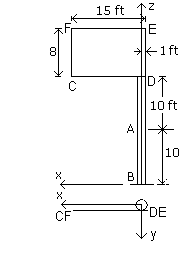
A road sign is formed of thin plate CDEF, parallel to the (x, z) plane, and attached to a cylindrical post of radius 1 ft centered on the z axis. The plate is subjected to wind pressure p, and its weight is W. The post weighs w lb/ft.
a) Show on the figure the weight of the plate, and the resultant P of
the wind load acting on it. Show a force perpendicular to the plane of the
figure as a dot if it points out of the page (tip of the vector) or a cross if
it points into the page (tail of the vector).
b) Determine the resultants of the forces acting on the plate, at point A
on the z axis. (force resultant components Fx, Fy, Fz,
and moment resultant components MAx, MAy, MAz)
.
a) P = 8(15)p = 200p as shown in figure.
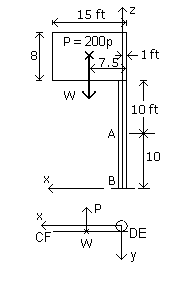
b) Resultants of P and W at A:
Fx = 0
Fy = - P
Fz = -W
MAx = 14P - (1)W
MAy = 6.5W
MAz = -6.5P
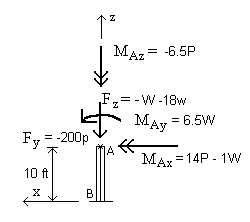
c) Determine by the force transmission approach the internal forces of the post at A, and show them on a sketch as acting on the bottom part.
The internal forces at A acting on the bottom part are equal to the resultants at A of the external forces on the top part. Thus they are equal to the resultants computed in b) to which must be added the weight of the part of the post above A, which is 18w acting downward.
Forces and moments are shown in their actual sense of action. It is assumed MAx = 14P - 1W > 0.
d) Use the results of part c) to determine the support reactions at B, and show them on a sketch.
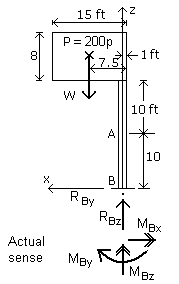 The reactions at B
equilibrate the forces shown in the figure above:
The reactions at B
equilibrate the forces shown in the figure above:
RBx = 0
RBy = -Fy = 200p
RBz = -Fz = W + 18w
MBx = -MAx + 10Fy = -14P + 1W - 2000p
MBy = -MAy = -6.5W
MBz = -MAz = 6.5P
4. Internal Static Conditions
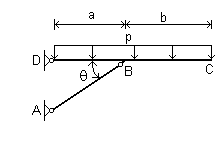 a) A bar such as AB,
which is pinned at both ends, and is not subjected to any external load, is a
two-force body subjected to a force at A and a force at B. If the bar is in
equilibrium, and F is the force at A, the force at B is -F, and
both forces act along line AB. Why is that so? What would happen if
F and -F did not have a common line of action?
a) A bar such as AB,
which is pinned at both ends, and is not subjected to any external load, is a
two-force body subjected to a force at A and a force at B. If the bar is in
equilibrium, and F is the force at A, the force at B is -F, and
both forces act along line AB. Why is that so? What would happen if
F and -F did not have a common line of action?
If the two opposite forces were not collinear, they would form a couple, and the bar would not be in equilibrium. It would be spinning.
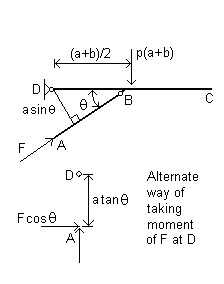 b) Determine the force in
bar AB by a single equilibrium equation.
b) Determine the force in
bar AB by a single equilibrium equation.
SMD = Fasinq - p(a+b)2/2 = 0
F = p(a+b)2/2asinq
c) If bar AB is subjected to an external load, it ceases to be a two-force member. Does the problem become statically indeterminate? Explain.
No. Since the end moments of bar AB are zero, its transverse end forces can be determined by two transverse equilibrium equations. The axial equilibrium equation leaves only one axial force unknown, which can be determined, as in part b), by the moment equilibrium equation of the structure about point D.
--------------------------------------------------------------------------------------------------
A system being cut into two parts, the internal forces acting on one part
are equal, as vectors, to the resultants of the external forces acting on the
other part.
Equivalently,
A system being cut into two parts, each part exerts on the other part the
resultants of its own external forces.