CEE 220 - INTRODUCTION TO MECHANICS OF MATERIALS
Tutorial Session 9
Topic: Stress Transformation. Mohr Circle.
1. Wedge Equilibrium Set Up
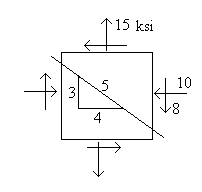
a) Draw the free-body diagram of a wedge for determining the stresses acting on the inclined face. Let the inclined face of the wedge have a unit length. Define axis x' to be perpendicular to the inclined face, and pointing outward. Label the unknown forces. Write the equilibrium equations, and determine the stresses.
b) In the preceding part, the free body you have chosen lies on one side of the inclined plane. Repeat that part by choosing the other side. Check that the same stresses are obtained.
2. Transformation Formulas
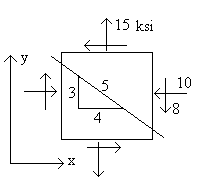
a) Show on the figure a set of (x', y') axes you have chosen earlier, and indicate the angle q of the stress transformation formulas. Fill in below the values of sinq and cosq, then the terms of the transformation formula for tx'y'. Check the value obtained for tx'y'.
sinq =
cosq =
tx'y' =
b) Re-label axis y as axis x, and let the new y-axis be oriented leftward, so counterclockwise rotation remains positive. Redo part a), and check the answer for tx'y'.
3. Mohr Circle
3.1. Draw to approximate scale the Mohr circle for the stresses of part 2a. Indicate points X and Y, the center C, and the origin O of the stress axes.
a) Show on the figure sav, and visually estimate the radius R. Deduce an estimate of s1, s2, and tmax.
b) Show on the Mohr circle the angle qp defining the orientation of the principal axes (xp, yp) relative to the (x, y) axes.
c) Using the geometry of the Mohr circle, compute, without reference to established formulas, R then s1, s2, and tmax.
d) Using the origin-of-axes property of the leftmost point of the Mohr circle, compute tanqp using the geometry of the Mohr circle, and observing the sign convention for qp. Determine qp.
e) Show 2qp on the Mohr circle, and compute tan2qp using the geometry of the Mohr circle, and observing the sign convention for qp. Determine qp so that it looks the same as in the Mohr circle..