 1. Given,
CEE 220 - INTRODUCTION TO MECHANICS OF MATERIALS
Tutorial Session 10
Topic: Strain
Transformation. Strain
Measurements. Generalized Hooke's
Law. Failure Theories.
Mohr Circle for Strain
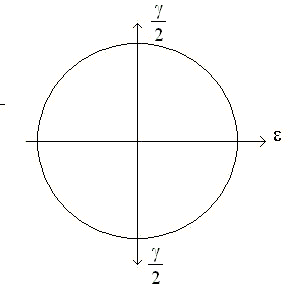
1. Given,
ex = -8(10-4)
ey = 12(10-4)
gxy = -15(10-4)
a) Draw the Mohr circle, and label points X, Y, Xp,Yp, Xs and Ys, Recall that the shear coordinate is exy = gxy/2. Compute the radius R, the principal strains e1 and e2, and the maximum in-plane shear strain gmax.
b) Show the relative orientation of the axes from point Yp as origin. Determine the orientation angle qp of the major principal axis, as it appears on the Mohr circle.
c) Draw qualitatively the undeformed and deformed shapes of an element ABCD cut along the (x, y) axes, assuming that side AB does not rotate. Do the same for elements cut along the principal axes, and along the axes of maximum shear, rspectively.
2. In a 45o strain rosette that measures ea, eb, and ec, let the x and y directions be those of ea and ec, respectively. Using the Mohr circle, show that gxy/2 = eb – (ea + ec)/2 .
Generalized Hooke's Law or Stress-Strain Relations for Linerly Elastic Isotropic Materials.
3. a) Write the general stress-strain relations giving (ex, ey, ez) in terms of (sx, sy, sz).
b) In a state of plane stress in the (x, y) plane, sz = 0. Obtain in that case (sx, sy) in terms of (ex, ey). Obtain also ez in terms of ex and ey.
4. The strains at a point in a state of plane stress are
ex = -8(10-4)
ey = 12(10-4)
gxy = -15(10-4)
a) Obtain the principal strains, then the principal stresses using the stress-strain relations of plane stress. Assume E = 30,000 ksi, and n = 0.3.
b) Outline another procedure for determining the principal stresses.
5. Why are the principal axes of strain coincident with the principal axes of stress in an isotropic material?
6. A thin square plate fits tightly on its bottom face and on its four edges in a square cavity in an infinitely rigid material. A uniform pressure p is applied on the upper face of the plate. Assuming all contacts with the cavity are smooth, determine the reaction stresses on the edges of the plate. Let the (x, y) axes be in the plane of the plate. Assume material properties E and n, and constant stresses.
Hint: What can you say about the stresses on the upper face of the plate? What can you say about the shear stresses on the surfaces of contact with the sides of the cavity? What can you say about the (x, y) strains?
Failure Criteria
7. Let the maximum bending stress in a beam in planar bending be smax.
a) If the shear stress on an area element in the cross-section at the point where smax occurs is zero, is it consistent with the Tresca criterion and with the Mises-Hencky criterion that yield would start when smax = sY? Why or why not?
b) Give one example of a cross section where the flexural shear stress is not zero at a point where smax occurs.
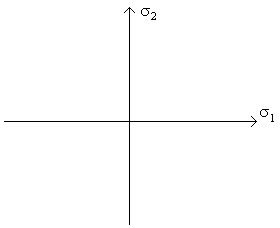 8.
a) Draw the Tresca
hexagon and the Mises-Hencky ellipse in the plane (s1, s2),
and define key points of these curves in terms of the yield stress
sY of the material.
8.
a) Draw the Tresca
hexagon and the Mises-Hencky ellipse in the plane (s1, s2),
and define key points of these curves in terms of the yield stress
sY of the material.
b) In a cylindrical pressure vessel, the hoop stress s1 is twice the axial stress s2. Show graphically the points representing the onset of yield according to the two criteria.
c) Show graphically the points representing the onset of yield for a spherical pressure vessel.
d) Show graphically the points representing the onset of yield for a bar of circular cross section in torsion.