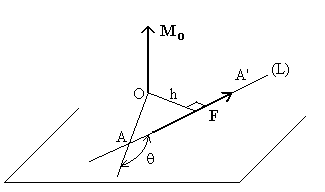
 The moment of a force F
about a point O is defined as
The moment of a force F
about a point O is defined asBasic Properties of Force Systems - Review
1. Moment of a Force. Force as a Sliding Vector.
The moment of a force F
about a point O is defined as
Mo = (OA) x F
where (OA) is the vector from point O to an arbitrary point A on the line of action (L) of F. Mo is orthogonal to the plane containing point O and line (L), is oriented according to the right-hand rule, and has the magnitude,
|Mo| = |OA||F|sinq = h|F|
where h = |OA|sinq is the orthogonal distance from point O to line (L), and is referred to as the moment arm.
The right-hand rule: A faucet or a screw driver at O being turned by F advances in the direction of Mo.
The formula above shows that Mo is independent of the location of A on (L). This can also be seen by considering any other point A' on (L). We have
(OA') = (OA) + (AA')
and, since (AA') is collinear with F,
(AA') x F = 0
Thus
Mo = (OA) x F = (OA') x F
In statics, a force is said to be a sliding vector because its location on its line of action does not matter for the operations of summing forces and taking their moments.
Additional Review Topics:
a) Moment of Cartesian force components by evaluating a cross product
Mo = (OA) x F
= (xi + yj + zk) x (Fxi + Fyj + Fzk) = Mxi + Myj + Mzk
Mx = yFz - zFy
My = zFx - xFz
Mz = xFy - yFx
b) The moment of a force F about an axis (D) oriented by unit vector u is defined as
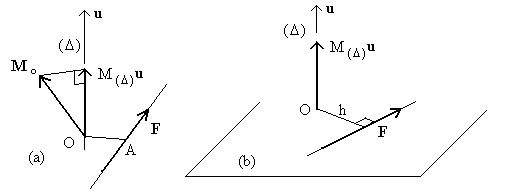
M(D) = Mo.u
where Mo is the moment about an arbitrary point O on (D), Fig. (a). M(D) does not depend on the choice of point O. To show this, consider another point O' on (D). We have
Mo = (OA) x F = (OO') x F + (O'A) x F = (OO') x F + Mo'
(OO') x F is perpendicular to (OO'), thus
M(D) = Mo.u = Mo'.u
Note that, by the definition of the moment about an axis, the Cartesian components of Mo in part a) above are the moments about the (x, y, z) axes, respectively.
Note also that the moment about an axis of a force parallel to that axis is zero.
Figure (b) shows a particular case in which (D) is orthogonal to F. The plane containing F and orthogonal to (D) intersects (D) at point O. Letting h be the orthogonal distance from point O to the line of action of F, we have
M(D) = ± h|F|
and the sign is determined by the right-hand rule.
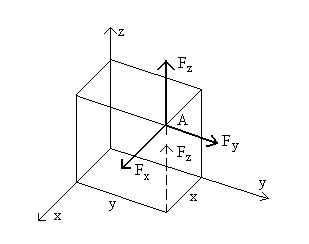 c)
Moment of Cartesian force components about Cartesian Axes
c)
Moment of Cartesian force components about Cartesian Axes
It is not necessary to perform a cross product when evaluating the moments about Cartesian axes of forces parallel to these axes. A force parallel to an axis has moments about the two axes that are orthogonal to it. For example, to take the moments of Fz, slide the force component on its line of action until it intersects the (x, y) plane at point (x, y). The moment arm of Fz about the x axis is y, and its moment, using the right-hand rule, is yFz. The moment arm of Fz about the y axis is x, and its moment, using the right-hand rule, is -xFz. The moments of Fx and Fy are formed similarly.
To take the moment about an axis, consider in turn the two force components perpendicular to that axis. For example, to compute My, consider Fx and Fz. Slide Fx on its line of action until it intersects the (y, z) plane at point (y, z). The moment arm of Fx about the y axis is z, and its moment is zFx. Now, slide Fz on its line of action until it intersects the (x, y) plane at point (x, y). The moment arm of Fz about the y axis is x, and its moment, using the right-hand rule, is -xFz.
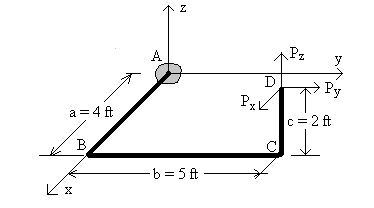 Exercise
1.1
Exercise
1.1
a) Compute by performing a cross product the moment at point A of the forces Px, Py, and Pz applied at point D.
b) Compute separately, without performing a cross product, the moments about the coordinate axes, of each of the three forces applied at point D.
 2.
Resultants of a Force System. The Law of Moments.
2.
Resultants of a Force System. The Law of Moments.
The resultants of a force system consist of :
R = resultant force = sum of the forces
of the system.
Mo = resultant moment = sum of the moments of the force system
at a reference point O.
Law of Moments: Given R and Mo at some point O,
then, at any other point O',
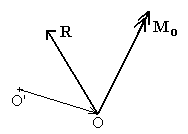
Mo' = Mo + (O'O) x R
where (O'O) = vector from O' to O. In words: The moment at O' is equal to the sum of the moment at O and the moment at O' of the resultant force applied at O.
Exercise 2.1
In the figure of Exercise 1.1, obtain the moment of the forces at point C, then apply the law of moments to obtain the moment at point A. Check your result.
Additional Review Topics:
How to form the resultants of a distributed force over a line, over a surface, or over a volume.
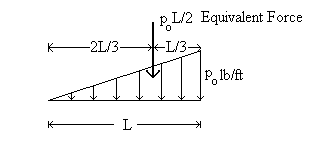
From the law of moments, it follows that if two force systems have the same R and the same Mo at some point O, they have the same Mo' at any other point O'. Such force systems are said to be statically equivalent. Two frequently occurring cases are shown below. In each case, the resultant force is equal to the area under the load diagram, and the line of action of the equivalent force is such that the moment of the distributed force about any point on that line is zero. This guarantees that the moments of the distributed load and the equivalent force about any point are equal.
Uniform Line Load
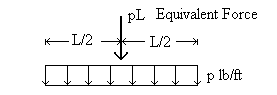
Linear Line Load
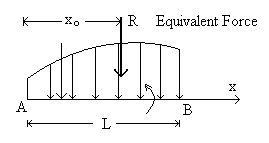
Arbitrary Coplanar Parallel Force System
The equivalent force R is equal to the resultant of the force system. Its line of action is located by equating the moment of R to the moment of the force system about an arbitrarily chosen point. Choosing point A in the figure, and letting MA be the moment of the force system about point A,
Rxo = MA
The force system acting on a body in equilibrium has zero resultants. The equilibrium equations for the body are thus
R = 0
Mo = 0
where point O is arbitrary. A force system in equilibrium is also said to be statically equivalent to zero.
Since equilibrium equations of a force system involve only its resultants, any portion of a force system may be replaced by a statically equivalent system in writing equilibrium equations.
Two force systems that equilibrate a third force system are statically equivalent.
By the law of moments, if the equilibrium equations are satisfied with moments taken at any one point, they are satisfied with moments taken at any other point .
The two vector equilibrium equations are equivalent to three force-component equations and three moment-component equations in an arbitrary set of reference axes.
Exercise 4.1
Determine the reactions at A in the figure of Exercise 1.1. Show the reactions as vectors with their actual sense of action for (Px, Py, Pz) = (50, -100, 30) lb.
Equilibrium of a Concurrent Force System
If all forces of a system pass through a point, the moment equilibrium equation about that point is satisfied. There remains only the force equilibrium equations.
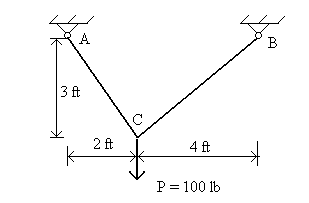 Exercise
4.2
Exercise
4.2
Determine the forces in cables CA and CB.
Exercise 4.3
Three cables are tied together at point O(0,0,0) and are tied, respectively, to support points A(3,0,3), B(-2,3,3), and C(-2,-3,3). Determine the forces in the three cables if a load P = 100 lb hangs from point O in the negative z direction.
Coplanar Force Systems
for a coplanar force system in the (x, y) plane, the z-force equilibrium equation, and the x and y moment equations about a point in the (x, y) plane are identically satisfied. There remains the x and y force equilibrium equations, and the z-moment equation, or
SFx = 0
SFy = 0
SMz = 0
where Mz can be taken about an arbitrary point.
An equivalent set of equations consists of
SFx = 0
SMa = 0
SMb = 0
where the moment equations are about two arbitrary points, a and b, with line ab being parallel to the x axis. To justify this, note that the moment equations, SMa = 0 and SMb = 0, constrain the equivalent resultant of the force system to pass through points a and b, and the force equation, SFx = 0, sets that resultant to zero.
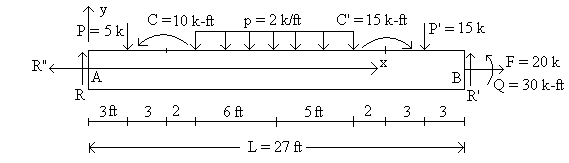 Exercise
4.4
Exercise
4.4
The figure shows a coplanar force system acting on beam AB, including the reactions R, R', and R''.
a) Replace the distributed load by an equivalent force.
b) Determine R' by the moment equilibrium equation about point A.
c) Determine R by the moment equilibrium equation about point B.
d) Determine R'' by the x force equilibrium equation.
e) Check that the y force equilibrium equation is satisfied.
 If R = 0, the law of
moments reduces to Mo' = Mo.
Thus a force system having a zero resultant force is statically
equivalent to its moment resultant, which is a constant vector. This is also
expressed by saying that such a moment is a free vector. By contrast the
moment of a general force system is a bound vector, meaning that it
depends on the point about which the moment is taken. The simplest system
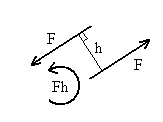
having a zero resultant is a couple formed of two equal and opposite
forces of magnitude F, having distinct lines of action. Letting h be the
orthogonal distance between the lines of action of the two forces, the moment of
the couple has a magnitude equal to Fh, and is oriented along the perpendicular
to the plane of the forces according to the right-hand rule. It is shown as a
curved arrow in the plane of the couple.
If R = 0, the law of
moments reduces to Mo' = Mo.
Thus a force system having a zero resultant force is statically
equivalent to its moment resultant, which is a constant vector. This is also
expressed by saying that such a moment is a free vector. By contrast the
moment of a general force system is a bound vector, meaning that it
depends on the point about which the moment is taken. The simplest system
having a zero resultant is a couple formed of two equal and opposite
forces of magnitude F, having distinct lines of action. Letting h be the
orthogonal distance between the lines of action of the two forces, the moment of
the couple has a magnitude equal to Fh, and is oriented along the perpendicular
to the plane of the forces according to the right-hand rule. It is shown as a
curved arrow in the plane of the couple.
A generalized force system may be considered as formed of force and moment vectors. The moments may be considered as the moments of couples. They contribute nothing to R, and they contribute their sum to Mo.
Any force system is statically equivalent to a system formed of one force and one moment, equal, respectively, to the resultants R and Mo of the system. This is expressed by saying that a force system is statically equivalent to its resultants.
7. Equivalence of a Force System to a Single Force
If there is a point O at which Mo = 0, the force system is equivalent to a single force equal to R, and applied at point O. Further, by the law of moments, the force can slide on its line of action.
A coplanar force system having a non-zero resultant force can always be made equivalent to a single force, which is referred to as the resultant of the system. A couple is a limiting case where the line of action of the equivalent force recedes to infinity, and the equivalent force tends to zero. The cases of a uniform load, and of a linearly varying load were seen earlier.
Some non-coplanar force systems, such as a system of concurrent or parallel forces, are equivalent to a single force, but in general this is not so. For a force system to be reducible to a single force, Mo must be orthogonal to R.
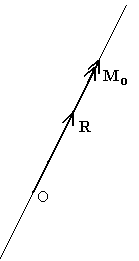
A wrench consists of a force and a moment that are collinear on a line called the axis of the wrench. From the law of moments, it is deduced that the moment of a wrench is constant on the axis of the wrench, and that at any point not on that axis, the moment contains a component orthogonal to the axis in addition to the constant axial component.
For any force system, if at any point O Mo is not orthogonal to R, then the force system cannot be reduced to a single equivalent force, but only to a wrench.
 8. The
Wrench
8. The
Wrench