|
Finding the Range
A very simple, but very useful, description of the spread of the
data is the
range. The range
is simply the difference between the maximum data value and the minimum data value.
If the data are first sorted from smallest to largest, it is easy to identify the
minimum, the maximum, and the range. For example,
| Set A: |
7 |
8 |
9 |
10 |
11 |
11 |
12 |
12 |
12 |
13 |
13 |
13 |
14 |
14 |
14 |
| |
| Set B: |
1 |
2 |
3 |
4 |
5 |
5 |
6 |
12 |
18 |
19 |
19 |
19 |
20 |
20 |
20 |
|
|
| |
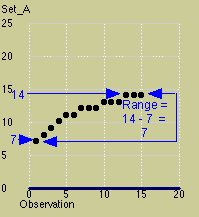
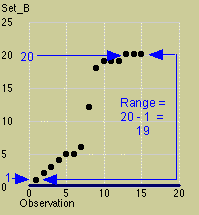
For Set A, the range = 14 - 7 = 7 and for Set B, the range = 20 - 1 = 19.
Clearly, Set B has a much larger range than does Set A. While both Set A and
Set B have the same center (i.e., the same median and mean), Set B spreads out
much further from that center than does Set A.
It is easy to see the two ranges and the greater spread for Set B in these
graphs:
|
|
|
File:
© 1999, Duxbury Press.
|
|
|