Katherine Stovel
Associate Professor of Sociology
206R Savery Hall
Box 353340
University of Washington
Seattle, WA 98105
206|616|3820
stovel at dot u dot washington dot edu
Papers
- Stovel, Katherine and Mike Savage. 2006. Mergers and Mobility: Organizational Growth and The Origins of Career Migration at Lloyds Bank. American Journal of Sociology, 110(4).
- Savage, Michael, Katherine Stovel, and Peter Bearman. 2001. "Class Formation and Localism in an Emerging Bureaucracy: British Bank Workers 1880-1960." International Journal of Urban and Regional Research, 25: 284-300.
- Stovel, Katherine, Mike Savage, and Peter Bearman. 1996. "Ascription into Achievement: Models of Career Systems at Lloyds Bank, 1860-1970." American Journal of Sociology, 102: 358-399.
Funding
Original Funding for this research came from the ESRC for a project entitled, "Pathways and Prospects: The development of the modern bureaucratic career, 1875-1090."I have always been interested in the thorny problem of how organizational and institutional dynamics affect different types of workers over the course of their careers. While it has long been recognized that organizational constraints limit career outcomes for workers, modeling the precise nature of these relationships has proven difficult in part because of the intersetion of multiple temporal processes across a variety of relevant structures. And yet understanding the relationship between organizational change and the prospective prospects of workers is of great importance, especially as economic restructuring rewrites career ladders. My work on this topic emphasizes the multi-level nature of these dynamic interactions, and has yielded insight into how competing incentives at the micro-level may yield surprising macro-level patterns. To accomplish this I have exploited a rare data set containing organizational and occupational data over a hundred year period at Lloyds Bank, one of Englands' five major banking houses. The research that has resulted sheds light on how organizational dynamics that characterized the late nineteenth century in England lead to the emergence of modern firm-based career system. Specifically, in a series of papers with Mike Savage I have documented the path by which legal changes in the status of English banks, a massive wave of mergers, and broad cultural shifts resulted in fundamentally new employment relationships and career structures.
In the most recent paper (AJS 2006), we directly address how the tension between local and central control of an expanding firm produced a new employment norm organized around geographic transfer. Both theoretically and empirically, this paper goes well beyond our earlier work on Lloyds and demonstrates the precise mechanisms by which organizational and institutional dynamics changed the nature of careers. We follow in the footsteps of Chandler, whose great contribution was to outline how conditions specific to particular industries shape and constrain the possibilities for increasing organizational efficiency. In banking, the process of institutional modernization unfolded in an environment bounded by competing logics of local and central control. Becuase of our fine-grained data, we are able to untangle the relationship between a series of contingent events (rapid industrial consolidation through merger) and the introduction of geographic mobility in careers of employees at Lloyds. We focus on how the acquisition of small and patrimonially governed firms shifted the balance between local and central control, and argue that transferring staff from one location to another was initiated not simply in response to general growth, but rather in response to the acute agency problems the merger wave exposed. An important--if unintended--consequence of internal processes of this sort was the ermegence of mobile white-collar careers, a hallmark of the management structure of the modern industrial economy. We show that the argument fits the empirical data by estimating discrete time proportional hazard models of the rate of geographic mobility.
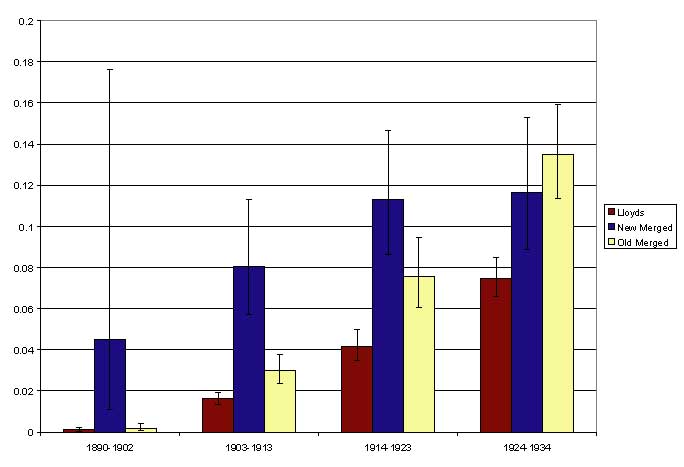
This figure reveals differences in the probability of a geographic move for men working in different types of branches, at different times. In the late nineteenth century, when career migration was extremely rare, men working in recently acquired branches were much more likely to be transferred away from their home branch than were any other Lloyds' employees. This pattern continues and amplifies through the first two decades of the twentieth century, a period of active agglomeration in British banking. Eventually, however, career migration become a common feature of all bankers' careers.
Stovel and Savage 2006
Last modified: 1/25/2006 12:11 PM