Katherine Stovel
Associate Professor of Sociology
206R Savery Hall
Box 353340
University of Washington
Seattle, WA 98105
206|616|3820
stovel at dot u dot washington dot edu
- Christine Fountain, Ph.D.
- Now an Assistant Professor at the University of South Carolina!
- Yen-Sheng Chiang, Graduate Student (Sociology) UW
- Stephanie Lee, Graduate Student (Sociology) UW
- Anshuman Shukla
- Now a graduate student in Applied Math at the UW!
Papers and Other Products
- Hearing About a Job: Employer Preferences, Networks, and Labor Market Segregation (draft manuscript)
- NSF Grant Proposal
- Hearing About a Job (CSSS Working Paper # 30)
- Worth Their Weight in Diamonds (Paper Presented at the 2005 Sunbelts)
- Turbulent Networks: Social Capital, Employer Hiring Preferences, and Labor Market Outcomes.
- Fountain, Christine. 2005. "Finding a Job in the Information Age" Social Forces, 83:1235-1262.
Funding
This research is funded by NSF grant SES-0351834, Stovel, PI.
We also received seed grant funding from the Center for Statistics and the Social Sciences (University of Washington).

From left to right: Stovel, Lee, Chiang, Fountain, and Shukla
This project develops a dynamic model of the structure of job-finding and its consequences for segregation in labor markets. We begin with the obvious insight that which people end up in which jobs is not merely a matter of the individual and human capital characteristics of workers and the requirements and rewards of jobs, but is also a function of the process by which persons and jobs are matched with one another. In spite of fascinating developments in the economics of information, how workers and employers find out about each other (and the consequences of information structures) remains a poorly modeled aspect of the matching process.
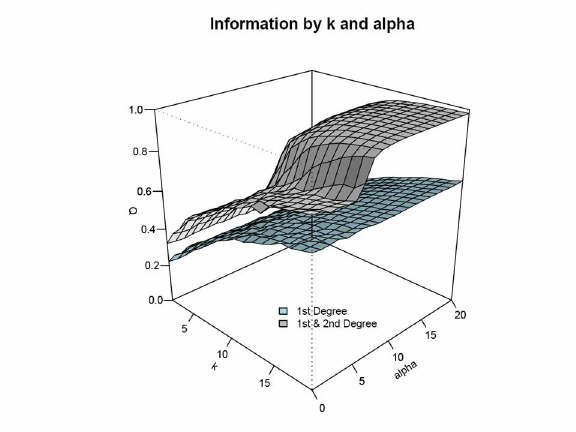
This figure shows the shape of the information advantage available when actors use both first and second order network ties to search for jobs. Here k is the mean degree of actors, and alpha is a parameter that determines the levelof local clustering in the network (0 = an extremely clustered graph; 20 = a largely random graph). Q is the proportion of all possible information to which actors have access (1.0 equals perfect information). Clustering affects information access very little if only direct ties are used; if direct and indirect ties are used, there is a phase shift in the information quantity at moderate levels of clustering. This is the mechanism by which small worlds can facilitate diffusion of information.
Stovel and Fountain 2004
Last modified: 1/17/2007 5:42 PM