sdoty.jpg (24430 bytes)

Sharon Lafferty Doty, Ph.D.
Assistant Professor
College of Forest Resources
UW Box 352100
University of Washington
Seattle, WA 98195

sldoty@u.washington.edu


BIORESOURCE SCIENCE

Phytoremediation
My colleague, Stuart Strand  and I study the processes by which plants take up and metabolize a variety of organic pollutants. Halogenated hydrocarbons such as trichloroethylene (TCE), carbon tetrachloride (CT), ethylene dibromide (EDB), and the energetic pollutants, TNT and RDX, are the main pollutants we would like to help remove from the environment. We have demonstrated that a variety of plants are capable of removing and degrading TCE and EDB. Some of the plants we have studied are poplar (Populus trichocarpa x P. deltoides hybrids), Leucaena leucocephala (a tropical legume), tobacco, and Arabidopsis thaliana.
My lab has several projects underway to better understand the mechanism by which poplar trees metabolize the common groundwater pollutant, TCE. By using poplar culture cells and hydroponically-grown plants exposed to TCE, we can track the metabolites that are formed. We recently published an article in the Proceedings of the National Academy of Sciences on enhancing uptake of a variety of pollutants by poplar.


Symbiotic Plant-Microbe Interactions
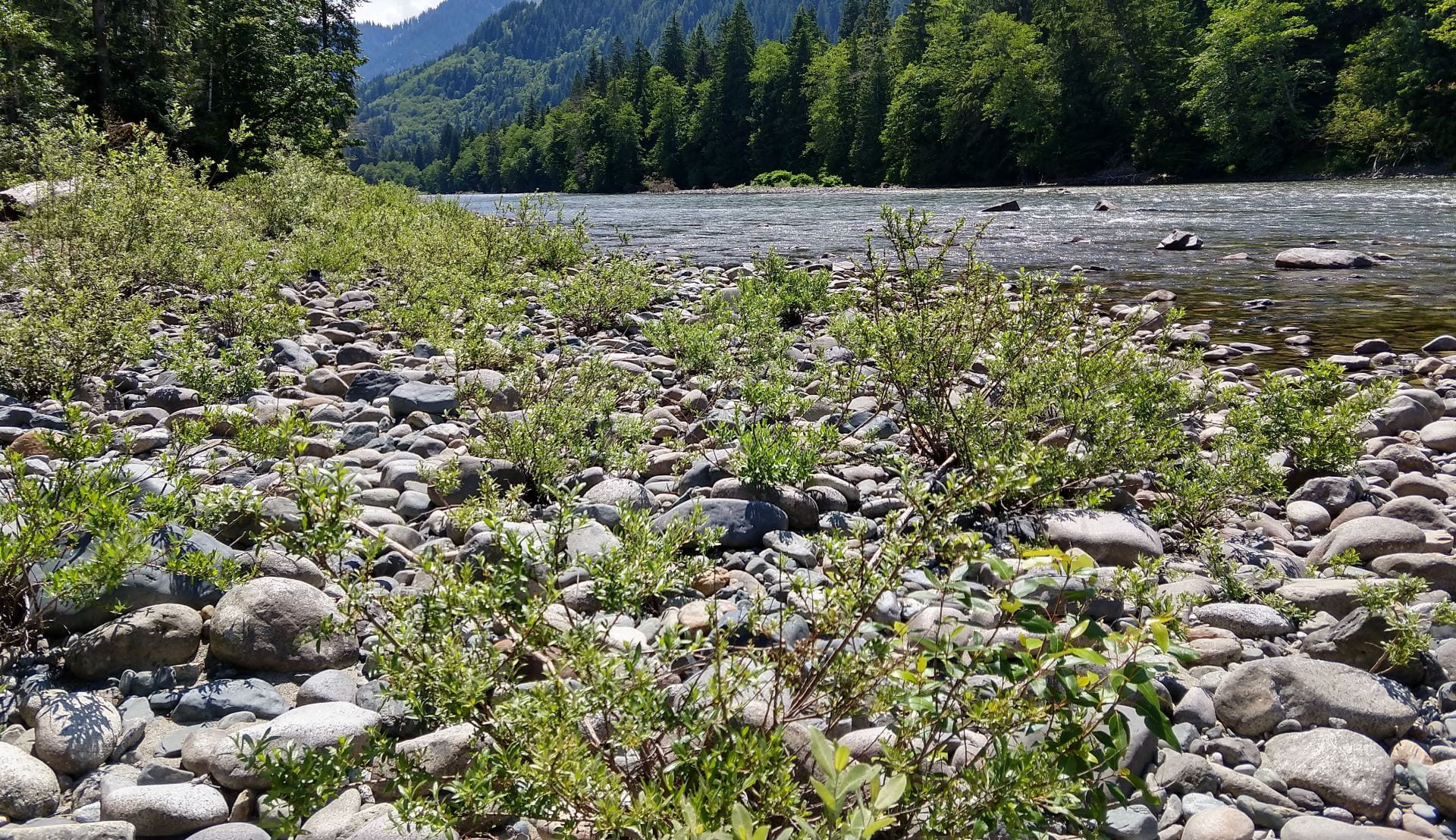
I isolated a variety of microorganisms from the stems of our poplar hybrids. One of the isolates is a close match to Rhizobium tropici. Native poplar and willow grow in low-nitrogen settings including the rocky habitat alongside the Snoqualmie River in Western Washington.  Many of the endophytes of poplar and willow at this site are able to grow under nitrogen-limitation.  I am studying how endophytic microorganisms may help poplar and willow to grow under nitrogen-limitation.


Biofuel Production

I have several research projects aimed at increasing the efficiency of bioethanol production.  By lowering the cost of bioethanol production, this locally-made fuel can be made more attractive as an alternative to foreign oil.  In collaboration with Professors Renata Bura, Rick Gustafson, Bill McKean, and Mark Lewis, we are studying yeasts isolated from plants with several advantages over traditional baker's yeast for the production of bioethanol.  One of these strains is currently being sequenced by the DOE Joint Genome Initiative.  As part of the UW IGERT program on bioenergy, Prof. Dan Schwartz and I have a project to screen additional environmental samples for superior yeast strains.  Our IGERT program is focused on training graduate students for research into environmentally sustainable bioenergy production.  The College of Forest Resources Bioenergy Team is dedicated to research on biofuel production from non-food crops.  Our research was recently (Nov 2007) discussed in the Denman Forestry Issues seminar series that was open to the public.

College of Forest Resources Interest Groups of which I am a member:

Restoration, Forest Systems & Bioenergy, Ecosystem Sciences, and Forest Soils

Publications

Doty, S. L., Oakley, B., Xin, G., Kang, J. W., Singleton, G., Khan, Z., Vajzovic, A., and Staley, J. T.  Diazotrophic endophytes of native black cottonwood and willow.  In press.  Symbiosis (2009) 47:xx-xx.  ISSN 0334-5114.

Doty, S. L. 2008.  Tansley Review:  Enhancing phytoremediation through the use of transgenics and endophytes.  New Phytologist 179: 318-333.

James,C.A.; Xin,G., Doty, S. L., Strand, S. E. 2008. Degradation of low molecular weight volatile organic compounds by plants genetically modified with mammalian cytochrome P450 2E1. Environ. Sci Technol. 42:289-293.

Doty,S.L.; James,C.A.; Moore,A.L.; Vajzovic,A.; Singleton,G.L.; Ma,C.; Khan,Z.; Xin,G.; Kang,J.W.; Park,J.Y.; Meilan,R.; Strauss,S.H; Wilkerson, J., Farin, F., and Strand,S.E. 2007. Enhanced phytoremediation of volatile environmental pollutants with transgenic trees. Proc. Natl. Acad. Sciences 104(43):16816-16821.

Doty, S. L., Dosher, M. R., Singleton, G. L., Moore, A. L., Van Aken, B., Stettler, R. F., Strand, S. E., Gordon, M. P.  2005.  Identification of an endophytic Rhizobium in stems of PopulusSymbiosis 39(1):27-36.

Van Aken, B., Peres, C. M., Doty, S. L., Yoon, J. M., and Schnoor, J. L.  2004.   Methylobacterium oliveri sp. nov.: A novel aerobic, pink-pigmented, facultatively methylotrophic, methane-utilizing bacterium isolated from poplar trees (Populus deltoides x nigra DN34). International Journal of Systematic and Evolutionary Microbiology 54: 1191-1196.

Doty, S. L., Shang, T. Q., Wilson, A. M., Moore, A. L., Strand, S. E., Oda, C. and Gordon, M. P. Metabolism of the halogenated hydrocarbons, TCE and EDB, by the tropical leguminous tree, Leuceana leucocephala. 2003. Water Research 37(2):441-449.

Banerjee, S., Shang, T. Q., Wilson, A. M., Moore, A. L., Strand, S. E., Gordon, M. P., and Doty, S. L. 2002. Expression of functional mammalian P450 2E1 in hairy root cultures. Biotechnology and Bioengineering, 77(4):463-466.

Shang, T. Q., Doty, S. L., Wilson, A. M., Howald, W. N., and Gordon, M. P. 2001. Trichloroethylene oxidative metabolism in plants: the trichloroethanol pathway. Phytochemistry 58:1055-1065.

Doty, S. L., Q. T. Shang, Wilson, A. M., Westergreen, A. D., Newman, L. A., Strand, S. E. and Gordon, M. P. 2000. Enhanced metabolism of halogenated hydrocarbons in transgenic plants containing mammalian cytochrome P450 2E1. Proc. Natl. Acad. Sciences 97(12):6287-6291.

Newman, L. A., S. L. Doty, K. L. Gery, P. E. Heilman, I. Muiznieks, Q. T. Shang, S. T. Siemieniec, S. E. Strand, X. Wang, A. M. Wilson, and M. P. Gordon. 1998. Phytoremediation of organic contaminants: A review of phytoremediation research at the University of Washington. Journal of Soil Contamination 7(4):531-542.

Heath, J. D., M. I. Boulton, D. M. Raineri, S. L. Doty, A. R. Mushegian, T. C. Charles, J. W. Davies, and E. W. Nester. 1997. Discrete regions of the sensor protein VirA determine the strain-specific ability of Agrobacterium to agroinfect maize. Mol. Plant Microbe Interactions 10:221-227.

Doty, S. L., Heath, J. D., Nester, E. W. 1996. Signal detection by VirA. In Crown Gall. S. Gelvin and W. Ream, eds. APS Press.

Doty, S. L., Yu, C., Lundin, I., Heath, J. D., and Nester, E. W. 1996. Mutational analysis of the input domain of the VirA protein of Agrobacterium tumefaciens. J. Bacteriol. 178(4):961-970.

Charles, T., Doty, S. L., and Nester, E. W. 1994. Strain construction in Agrobacterium by electroporation of genomic DNA: Utility in the analysis of chromosomal virulence mutants. Appl. Environ. Microbiol. 60:4192-4194.

Doty, S. L., Chang, M., and Nester, E. W. 1993. The chromosomal virulence gene, chvE, of Agrobacterium tumefaciens is regulated by a LysR family member. J. Bacteriol. 175(24):7880-7886.

Biographical Information

Education:
B.S., Department of Genetics, University of California, Davis, 1985-1989

Ph.D., Department of Microbiology, University of Washington, Seattle, 1989-1995
Advisor: Dr. Eugene W. Nester
Thesis title: Regulation and Function of the Chromosomal Virulence Gene, chvE, of Agrobacterium tumefaciens.

Post-Doctoral Training:
Department of Biochemistry, University of Washington, Seattle, 1995-2003
Advisor: Dr. Milton P. Gordon

Research Assistant Professor in the College of Forest Resources (2003-2006)

Assistant Professor in the College of Forest Resources (2006-present)

Courses Taught

ESRM 325/CFR 521 Forest Bioresources (Autumn Quarters)

CFR521B Current Topics in Phytoremediation (Winter quarters in even years)

CFR522 Plant-Microbe Interactions (Winter quarters in even years)

Biology 162- Introductory Biology (Spring quarters)