Answers to practice problems for Exam 1
I. Phonology
A. See lecture notes or Study of Language text
B. How to solve this problem (or almost any other similar problem):
1. Identify the words that are used with a particular past-tense form (e.g., for /t/, crushed, heaped, kicked, hissed; for /d/, bagged, killed, nabbed, turned, hanged; for /Id/, pitted, deeded, hated)
2. Deduce what aspect of the root word (e.g., crush, heap, etc) is important in determining which sound is used for the past tense. In the case of a suffix, as in this example, the final consonant of the root word is often the important thing.
3. List the final consonants of each root word that takes a particular past-tense form, and then, for each root word, look up on the chart the 3 articulatory features associated with that consonant. This is shown below:
/t/
š (as in crushed) voiceless, palatal, fricative
p (as in heaped) voiceless, bilabial, stop
k (as in kicked) voiceless, velar, stop
s (as in hissed) voiceless, alveolar, fricative
/d/
b (as in bagged) voiced, bilabial, stop
l (as in killed) voiced, alveolar, liquid
n (as in nabbed) voiced, alveolar, nasal
ŋ (as in hanged) voiced, velar, nasal
NOTE: Liquids and nasals are all voiced sounds, even though it doesn't say so on your chart
/Id/
t (as in pitted) voiceless, alveolar, stop
d (as in deeded) voiced, alveolar, stop
4. Figure out what articulatory features are shared for the words using /t/, which different features are shared by the words taking /d/, and so on.
The Rules for this aspect of English phonology:
Use /t/ if the final consonant in the root word is voiceless
Use /d/ if the final consonant in the root word is voiced
UNLESS the final consonant is [alveolar stop], in which case use /Id/
C. The example doesn't allow a really elegant solution using just 3 articulatory features. (Guess this counts as a tricky question! Sorry.) But here's a stab at one solution:
Use eng when the first sound in the root word is [velar]
Use en when the first sound in the root word is [ alveolar, but not a liquid]
Use em in all other cases
In these rules, # indicates word onset (left side) and word offset (right side); + indicates "must have this feature", - indicates "cannot have this feature"
II. Morphology
A. ye
B. none
C.
D. ika ye xa ufo ye
E. oge vo abo ye
III. Syntax
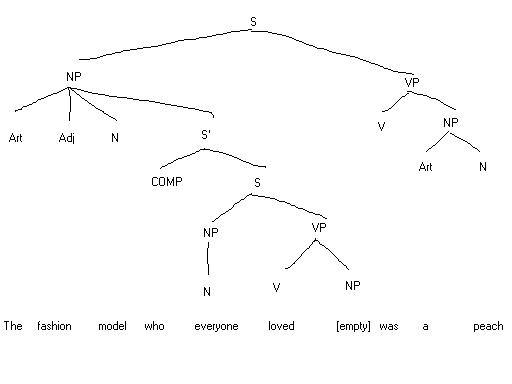
1. Sentence 1:
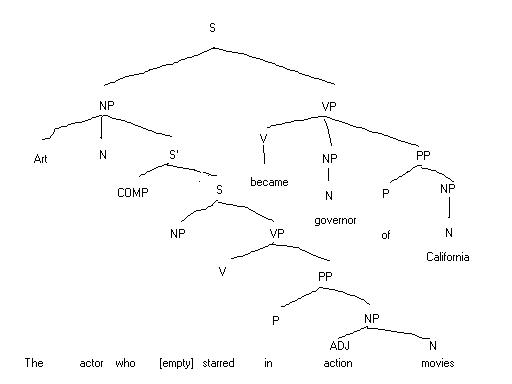
2. Sentence 2
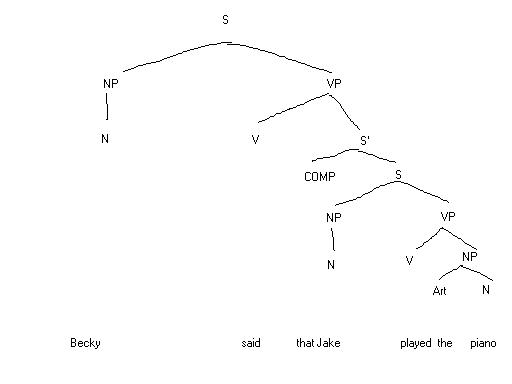
3. Sentence 4